








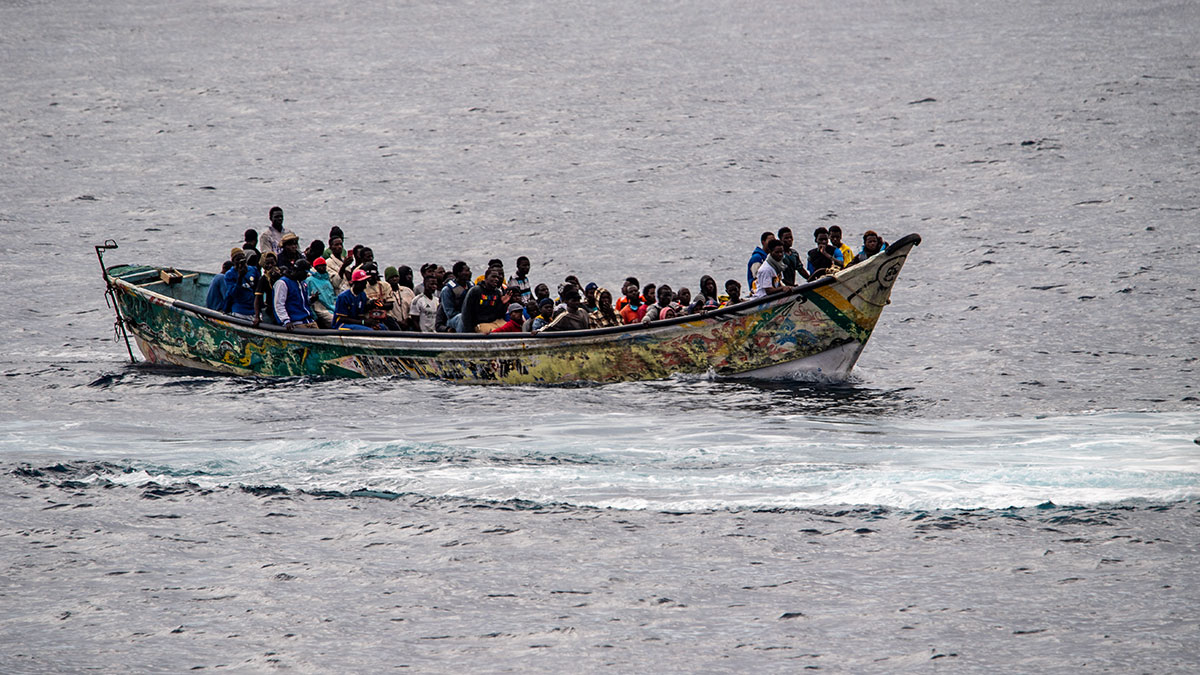
The Government of the Canary Islands has requested the cooperation of the Spanish government and the European Union to address the continuous arrival of boats carrying migrants to El Hierro. Canary Islands President Fernando Clavijo has described the situation on the island as “absolutely unsustainable,” according to a statement he made to Reuters.
A small island facing a constant influx of people
On Friday, November 7, alone, 1,003 people arrived in El Hierro on nine small boats, and one of them was carrying a deceased person. According to Canal Sur, more than 4,500 people have reached the archipelago so far this November. Most are men, though there are also women and minors. They come mainly from Senegal and Gambia and travel the Atlantic route, one of the most dangerous in the world.
The island has just over 30 hospital beds, and according to the president of the island council, Alpidio Armas, the capacity to refer new arrivals to Tenerife has been exhausted. “There is no space, and this is what has caused El Hierro to be in a critical situation right now. “We’re overwhelmed,” Armas told BBC Mundo. The Cabildo has declared a social emergency and estimates that “a little over two thousand” people remain on the island.
This activity is also noticeable in the port of La Restinga, a town of 673 residents whose economy revolves around fishing, scuba diving, and tourism. “We have never been against migration. We ask that people keep in mind that, with so many small boats in the water, it’s hard for fishing boats to get in and out of the dock to go out to sea,” explained Loly Hernández, president of the Neighborhood Association, to Europa Press.
What the Canary Islands Have Requested
Clavijo announced a phone conversation with Prime Minister Pedro Sánchez and requested an urgent meeting with the European Commission. Speaking to Commission Vice President Raffaele Fitto, he called on the EU to recognize the Canary Islands’ unique status as an Atlantic external border and to establish mechanisms for funding, solidarity, and rapid response.
The regional government also drafted a nine-point document, agreed upon with the parties in the Canary Islands Parliament except for Vox. Among other measures, it calls for direct aid to businesses and self-employed individuals on the island, as well as Social Security rebates; weekly meetings with the central government and a contingency plan; additional resources from the European Border and Coast Guard Agency (Frontex); and the activation of the solidarity mechanisms under the European Pact on Migration and Asylum.
The El Hierro Island Council, for its part, is calling for more human and material resources, as well as a rotation system that allows staff from the Maritime Rescue Service, the Canary Islands Health Service, law enforcement agencies, the Red Cross, and NGOs to rest. Clavijo noted that Maritime Rescue workers are working “24-hour shifts followed by another 24-hour shift.”
The Central Government’s Response
The Interministerial Commission on Immigration, which met on Tuesday with the participation of the El Hierro Island Council, has agreed to declare a migration emergency in the Canary Islands. This declaration will mobilize 15.18 million euros to create new spaces in state-run centers and fund transfers between islands and to the mainland. In addition, one million euros will be allocated for health and first-response services provided by the Red Cross in El Hierro.
The government will also add the Guardamar Calíope to the rescue fleet, meaning that three of the five operational Guardamar vessels in Spain will be assigned to the island. It will also increase the staff of the Government Delegation in the Canary Islands to expedite the relocation of unaccompanied migrant minors.
The economic and fiscal measures demanded by the Canary Islands have yet to be finalized. The government has committed to studying how to address the extraordinary expenses and to monitoring the island’s economic developments. On the diplomatic front, Interior Minister Fernando Grande-Marlaska traveled to Dakar, where he called for “strengthening migration management” and announced a contribution of 500,000 euros to the Senegalese Navy.
A challenging route and an island steeped in history
The fall months bring calmer seas, which explains the increase in departures, although the risk remains: Last weekend, a boat sank off the northwest coast of Senegal, leaving at least 35 dead and a single survivor.
Armas recalled that the island is no stranger to migration. “In the 1950s and 1960s, we had to leave for Venezuela. And we did so from the very same port of La Restinga where small boats and dinghies arrive today,” he said. The president of the island council advocates for those who arrive to receive training and integrate into society: “We want them to stay. They are workers we need.”


