








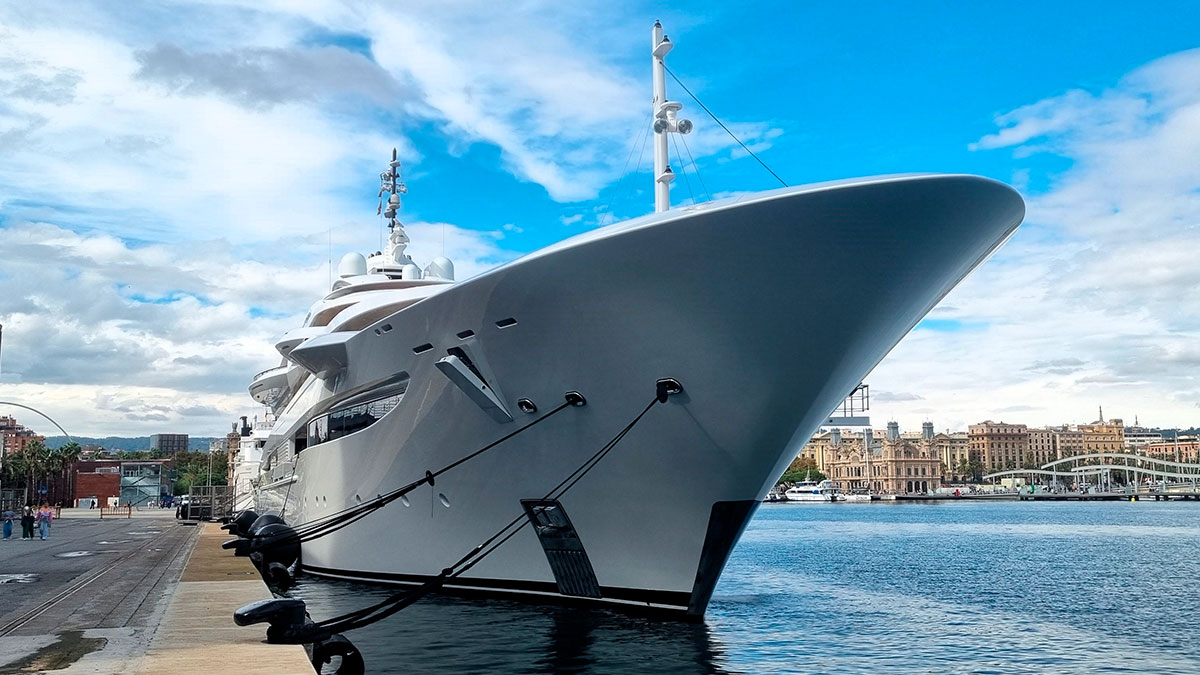
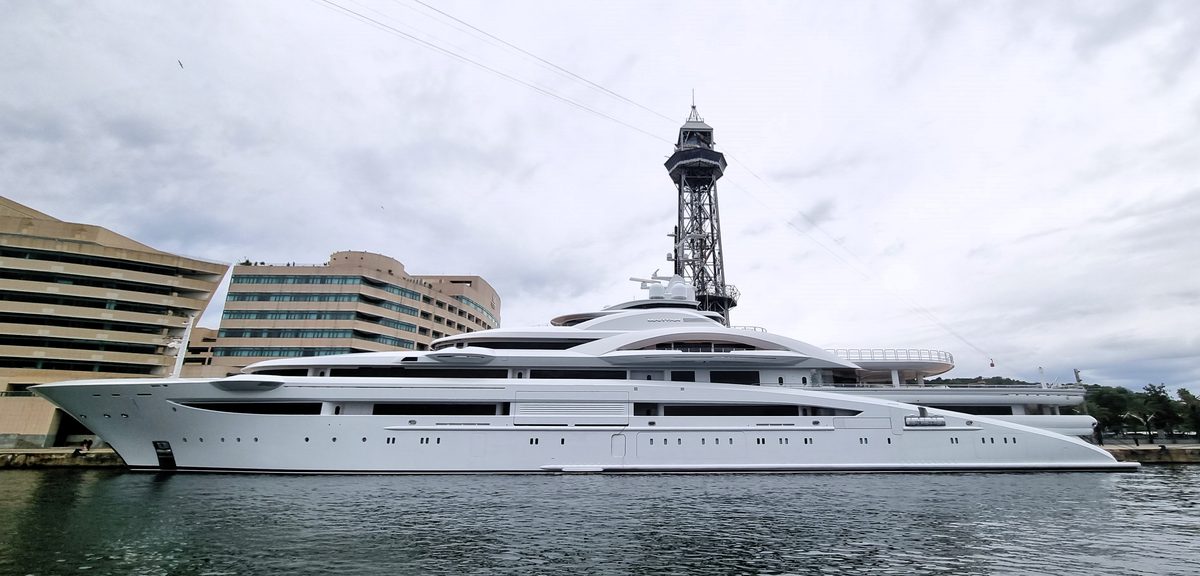
There are ships that hide in the vastness of the ocean. And then there’s the Maryah, which has decided to “hide” at the Barcelona pier—one of the most visible spots in the port—and is now open to the city and passersby. At 125 meters long, with its white steel hull and impeccable lines, it naturally stands out at that mooring.
Anyone passing by the north wall or along the Rambla de Mar can see it: six decks, a bow with bold lines, a crew coming and going, and the classic “No Trespassing—Private Yacht” sign on the gangway. However, all you have to do is pull out your cell phone, open MarineTraffic, VesselFinder, or any other vessel tracking app, and search for it by name for something curious to happen: the Maryah isn’t there. As we’ve verified and confirmed with other maritime sources, it hasn’t transmitted its AIS signal for fifteen days. It’s a giant that takes up a good portion of the berthing line and yet, in the eyes of the technology designed precisely to make ships visible, it doesn’t exist.
This paradox gives us an opportunity to talk about a ship with a unique history. And the story begins long before Barcelona, at a Polish shipyard in a country that ceased to exist 35 years ago.
The Ship That Was Born an Orphan
On July 25, 1991, the Szczecin Shipyard in Poland launched a hull that was to become a research vessel for the Soviet Far East Institute of Marine Geology. It was named Dalmorgeologiya, a name that evokes a scientific expedition through icy seas. It never became that. Five months later, in December of that same year, the Soviet Union ceased to exist, and the ship was left without an owner.
What remained was a massive hull, ownerless and adrift, awaiting either a permanent buyer or scrapping. It remained that way until July 1995, when Lizard Investments acquired it, renamed it Fortune, and registered it in Vanuatu. It was towed to Piraeus, where it arrived a few weeks later, and was left moored in the bay of Elefsina. There began a long wait: for a decade, the hull moved from port to port while plans were made to convert it into a yacht. In 2005, it was renamed Czar and acquired by new owners, and was towed to the Ambelakia shipyard in Salamis, where it moored on June 21, 2006.
The truth is, it’s hard to imagine a stranger history for a luxury yacht: built as an orphan, renamed three times, and towed—almost like a piece of junk—from the Baltic to the Aegean.
The Zar Project
The project was revived with the so-called Project Zar. The British firm H2 Yacht Design was responsible for the exterior and interior design, and the timeline promised to be quick: one year. It wasn’t. In 2011, the project came to a standstill following the death of the director of the company leading it, and it took about another year to get it back on track, this time under the direction of Alphamarine. What was supposed to take twelve months stretched out to two and a half years.
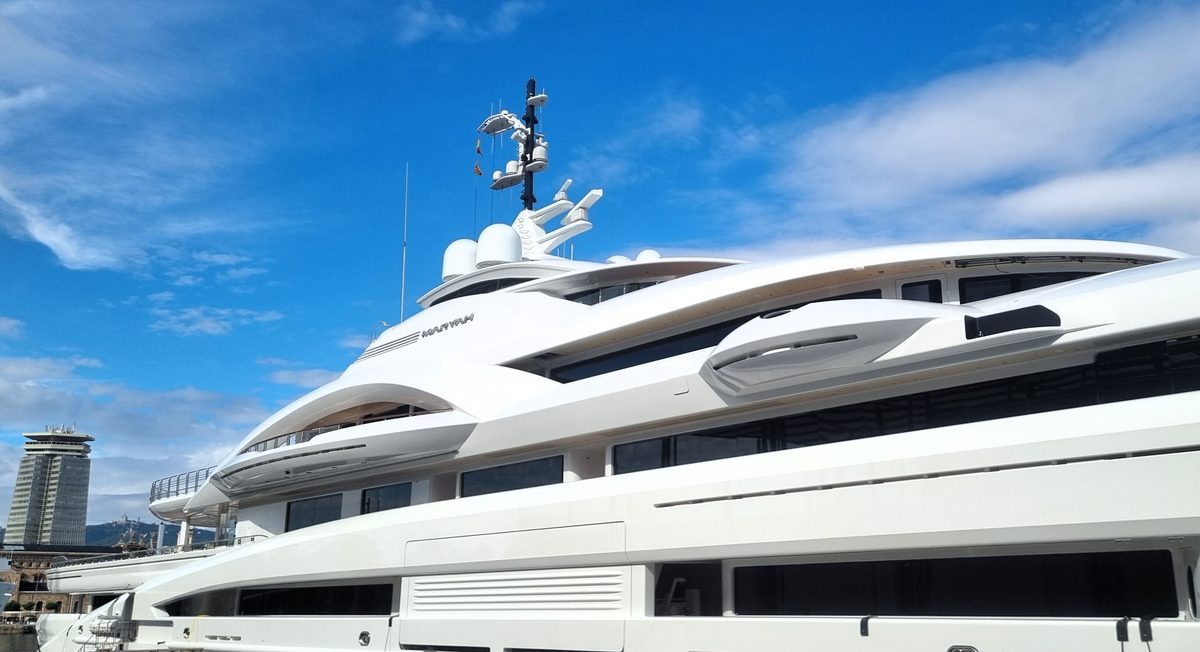
The result of that effort is a rarity: a yacht certified as a passenger vessel under SOLAS regulations, 125 meters long and 17 meters wide, with capacity for 54 guests in 27 suites and up to 60 crew members at their service. To sail around the world without refueling too often, it has fuel tanks holding 533,000 liters of fuel and can reach speeds of 18 knots.
The Owner
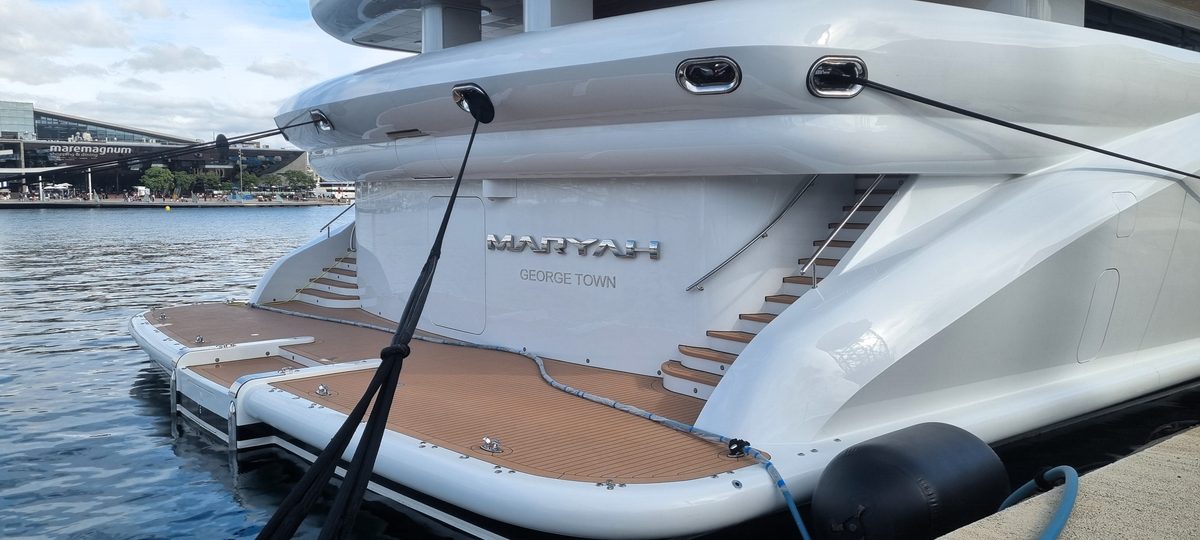
Today, the Maryah sails under the Cayman Islands flag and is owned by Sheikh Tahnoon bin Zayed Al Nahyan, who named it after the island of Al Maryah in Abu Dhabi. He is no ordinary owner. He is the United Arab Emirates’ national security adviser, the brother of the president, and the deputy ruler of Abu Dhabi. He also chairs the sovereign wealth fund ADIA, First Abu Dhabi Bank, and the International Holding Company, as well as the tech giant G42. In other words, he is one of the most economically and politically powerful men in the Gulf, the owner of a massive ship that began as the abandoned hull of a fallen empire.
Why does it matter if the AIS is turned off?
Here we are back at the dock. The AIS (Automatic Identification System) is a small box with a VHF radio that continuously transmits the ship’s identity, its location, its speed, and its course. It was created to prevent collisions and today is also used for rescue operations, port traffic control, and, as a side benefit, allows anyone to track a ship’s position in real time from their computer or phone.
The International Convention for the Safety of Life at Sea (SOLAS) requires that it be carried on all ships of 300 gross registered tons or more engaged in international voyages, and the law makes no distinction between yachts and merchant ships: a yacht of this size is considered a ship. The Maryah, with a gross tonnage of approximately 5,650 metric tons, easily exceeds that threshold.
Turning it off, however, is not automatically a violation. The International Maritime Organization’s guidelines stipulate that it must be turned on when the vessel is underway or at anchor, but they allow the captain to turn it off if he or she believes that keeping it on compromises the vessel’s safety. In that case, the captain must record this in the ship’s log and notify the authorities. In port, the rule is to comply with the requirements of each specific port. In other words: the rule allows for discretion, but only as a justified exception—not as a matter of routine. And when there is no valid reason to do so, the risks are real: penalties from port authorities and, if an accident occurs, an insurer that may argue the vessel was sailing without an essential safety aid.
There are more mundane reasons. Many boat owners aren’t thrilled that anyone can track their movements using an app that’s free in its basic version. And this isn’t a quirk unique to yachts: in various parts of the world, fishing boats turn off their AIS to avoid revealing their fishing grounds, though that’s another matter entirely.
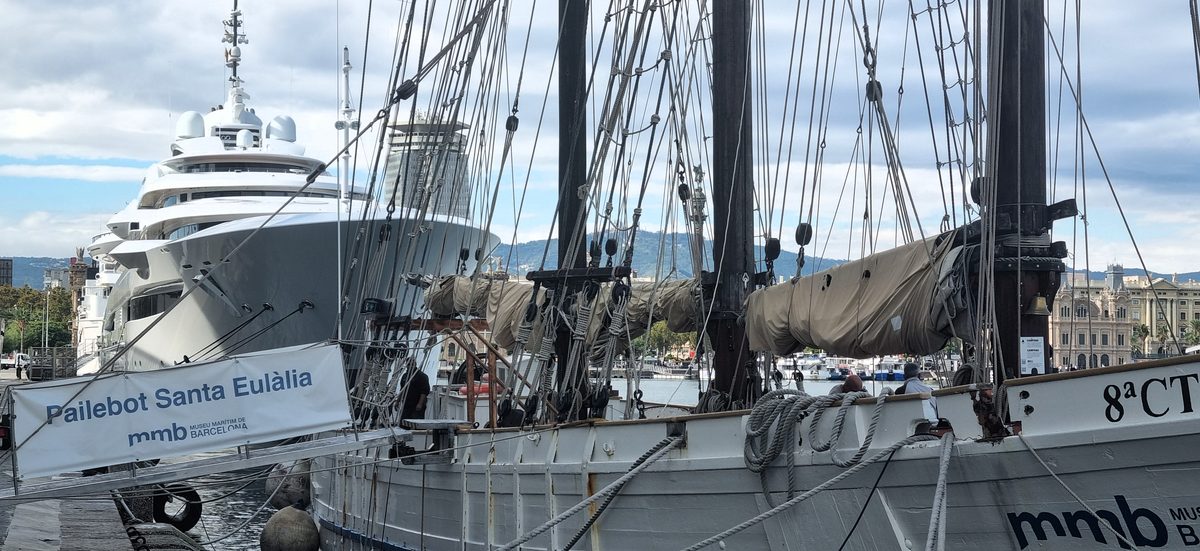
Two weeks ago, while moored at Marina Port Vell, the Maryah transmitted its AIS signal for the last time. Since then, silence. It’s still there, like an elephant trying to hide behind a tree: so obvious that what’s strange isn’t that it’s visible, but that it doesn’t appear on any screen. Perhaps it’s simply the shipowner’s discretion, exercised within the limits of the regulations. Perhaps there’s a security reason known only to the captain and the owner. Whatever the case, a ship that was built without a client, that waited more than twenty years for someone to find a purpose for it, now prefers that no one track its movements—even though everyone can see it.


