








I spent two more weeks anchored off Madagascar, at my refuge in Baly Bay, waiting for a good weather window to set sail for South Africa. The fishermen have gotten used to my presence, and almost every day they bring me something: fish, coconuts, and homemade empanadas they make in the village. In return, I offer them water, Coca-Colas, canned food, fishing hooks, and fishing line. I’ve inevitably grown fond of them, and it will be hard for me to leave this beautiful place behind.
In two days, a good opportunity will arise to continue the journey south. I leave the Sofía to the sound of the sea and am ready to set sail. I sleep poorly on my last night here. I’m feeling the pre-voyage jitters. The weather has been changing so much from one day to the next that it’s making me feel a bit insecure, uncertain, and doubtful. However, in this part of the world, such frequent changes are normal. At 6:00 a.m., as the sun begins to warm the air, I weigh anchor, and the Sofía leaves Madagascar Bay astern after 22 days.
The plan is to set course for Richards Bay, South Africa, about 1,200 miles away. Plan B—and the most likely scenario—is to stop at Linga Linga, a sheltered anchorage in Mozambique. I don’t think the window of good weather will be long enough to make it that far south, so Plan B makes a lot of sense.
For the first two days, I sail under the influence of the thermal winds in the area. During the day, there’s a 15–18-knot breeze from the northeast. In the afternoon, the wind shifts to the southeast and drops significantly in intensity. I decide to head west until the third day to sail down the coast of Mozambique and find favorable currents. Well into the third day, the wind dies down to 2 knots. Inevitably, I start the engine and set a course south. I begin my descent through the dreaded Channel of Mozambique.
These are miles during which I alternate between motoring and sailing due to constantly changing conditions. The constant sail changes and the traffic from merchant ships traveling the South Africa–Southeast Asia maritime route mean I can’t get much rest. Luckily, I don’t have to maneuver to avoid the cargo ships, since they pass more than a mile away from my position. On the fifth day, I realize I need to stop at Linga Linga because in a few days a fairly strong southerly wind will start blowing. Here, in the Mozambique Channel, if there’s a southerly wind blowing against the southward-flowing current, it creates very dangerous sea conditions that must be avoided at all costs.
There are 300 miles left to Mozambique, and today dawns with rain, surrounded by showers. The air is cooling, and the wind is cold. At 9 a.m., a shower brings 30–32-knot winds on the port side. I lower the mainsail and unfurl the genoa fully. The Sofía picks up speed until she reaches 8 knots and begins to ride the wind toward Linga Linga. After two hours, the wind drops to 5 knots, and I have to start the engine again.
Before dark, another squall passes by the stern and brings winds of 26 knots. Following the same pattern as the previous squall, around 10:00 p.m. the wind dies down, leaving the sea very rough and choppy. During the last night before we arrive, I can’t get any rest because the Sofía feels like a blender. She’s rocking back and forth very violently, and I can’t stay on my feet without being thrown to one side or the other. Luckily, everything on board is stowed very securely; otherwise, everything would be flying through the air.
Seeing that I can’t get any rest, I decide to spend my last night on deck, gazing at the star-filled sky. At dawn, I make myself some coffee—only 40 miles to go. The last day of sailing is all under engine power. The wind was supposed to be 17–18 knots, but today the forecast is off. The sea is as flat as a plate, the sky is crystal clear, and it’s completely calm. Little by little, Mozambique comes into view on the horizon.
Access to the anchorage is quite difficult because you have to navigate 6 miles between sandbars that, due to the strong current in this area, are constantly shifting position. Before entering the difficult stretch, a massive downpour washes over the deck of the Sofía, and visibility drops to 50 meters. The waves break on these sandbars, forming crests perfect for surfing.
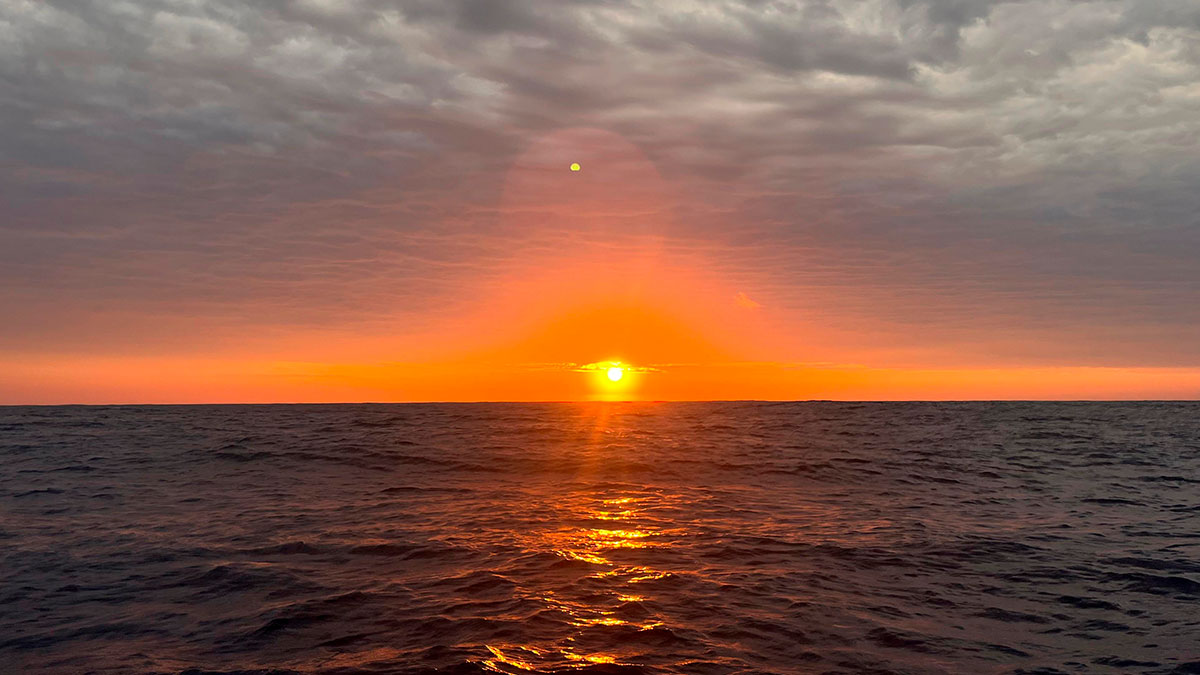
I sail the last few miles under engine power with the genoa unfurled, but even so, I’m only moving at 3 knots. The current is strong. I use satellite imagery to reach the anchorage. A pair of dolphins escort me until I drop anchor in 13 meters of water, off a white-sand beach surrounded by coconut palms. Just as I finish anchoring, the sun disappears below the horizon, leaving an orange sky.
Mozambique Channel objective: achieved.


