








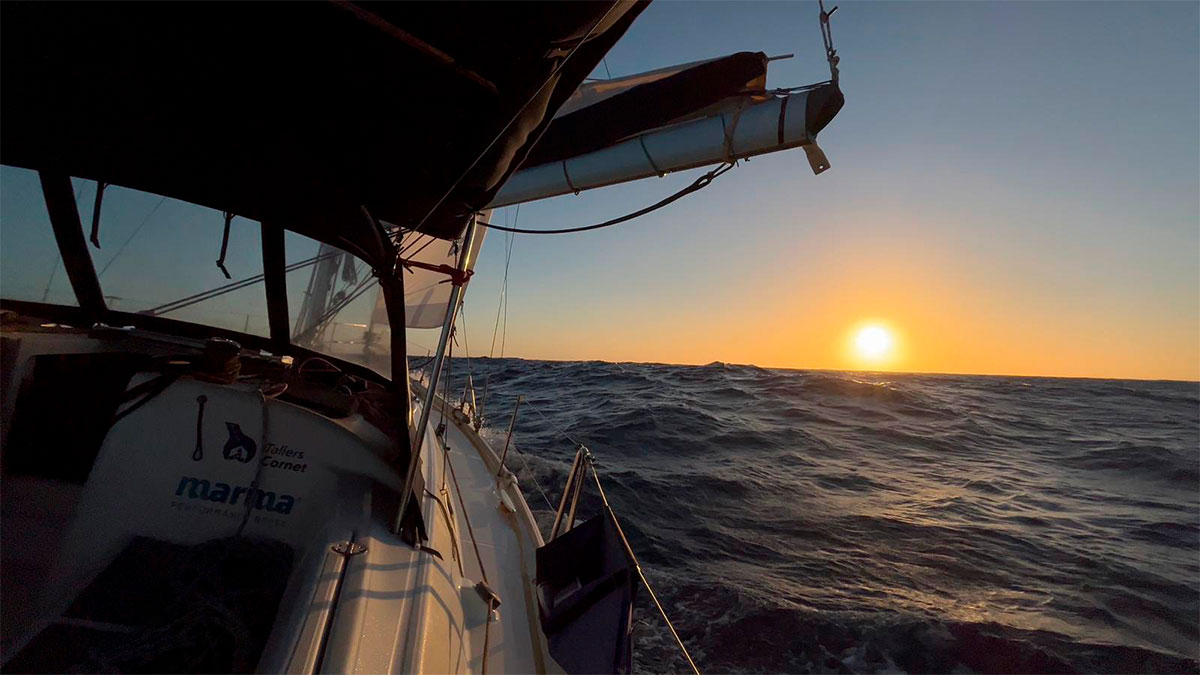
I spent a peaceful night at anchor in the Alphonse Atoll, a third of the way between the Seychelles and Mayotte. The wind roared all night long, but the Sofía held her position steady. Dawn is breaking with a perfectly clear sky—I don’t see a single cloud—and the wind is still blowing. As the sun rises higher in the sky, the water looks increasingly crystal-clear. I’m having coffee and toast on deck while I check the weather forecast. Tomorrow I’ll continue on course toward Mayotte, about 570 miles to the southwest.
I spend the day plotting the course on the chart, preparing food for the first few days, checking the engine, cleaning the solar panels because the birds have been up to their old tricks, and, in the little time I have left, I relax by reading with a cup of tea. At low tide, the waves break on the reef and form some good swells. I don’t see any turtles today, but flocks of birds fly over the Sofia and, seeing nothing of interest, head out to sea. With the sky clear, the sunset is breathtaking. Everything is bathed in orange. As soon as it gets dark, I have dinner and go to sleep. Tomorrow at 7:00 a.m., I’ll weigh anchor.
I wake up as the sun rises; little by little, I clear my head and get ready to set sail. I start the engine to weigh anchor, and within a few minutes, we’re already sailing. There’s a 22-knot wind from 140° (T), and the Sofia is sailing as close-hauled as possible until she reaches a speed of 8 knots. We start riding the waves. Life on board is very challenging; the waves are constantly washing over the deck. Sitting at the chart table, a wave catches us off guard. It crashes against the Sofia’s hull and races across the entire deck until it enters through the cabin hatch. I see a cascade of water pouring inside. Since then, I’ve been sailing with the storage locker closed. I place several towels on the floor to dry everything off. The sea is getting rougher, but it should calm down a bit this afternoon. The waves are short and choppy—extremely uncomfortable for the course we’re on.
I try to make myself a cup of coffee, but the mission fails. Just as I’m about to put the ground coffee into the coffee maker, a wave hits, and the coffee maker—already filled with coffee—flies off toward my bunk… At that moment, I head to the chart table and jot down in the logbook: my spirits are at rock bottom, but at least the sun is shining and the Sofia is sailing. I try to move as little as possible to avoid further incidents. I spend the day reading, eating, and watching the Sofia ride the waves. I’m living on a 30-degree list to starboard.
This voyage from the Seychelles to Mayotte is challenging because it takes you through the convergence zone off the northern coast of Madagascar. The southeasterly wind coming from the Indian Ocean hits Madagascar, with part of it veering north and the other part south. Both to the north and south of the island, the wind accelerates and increases significantly in intensity, generating choppy, short waves. Once you cross this zone, you enter Madagascar’s lee. Since you’re downwind, you’re sheltered from the wind, and your speed drops from 30 knots to 2 knots in just a few miles.
On the third day, I’m sailing right in the middle of a compression zone. The wind goes from 17 knots to gusts of 30. The waves become choppy and the period shortens. Every now and then, we crash into a wave and there’s a huge roar. I’m worried about the rigging. The Sofía, with the smallest possible sail area and a favorable current, picks up speed to 10 knots. I’m amazed by the boat’s stability and balance. It stays on course despite the gusty wind and waves. The night is rough—little rest and very uncomfortable sailing. It’s like being inside a washing machine. At least the sky is starry, and the moon lights up our bow. I finish the meal I prepared at Alphonse before setting sail. I switch to freeze-dried food. I heat up some water and mix it with the packet. In five minutes, my meal is ready. It doesn’t even cross my mind to try cooking anything.
After four days at sea, we crossed the area and entered the calms west of Madagascar. We have 100 miles left to reach Mayotte. The wind drops suddenly. I lower the sails and start the engine… we’re facing a countercurrent and moving at 3 knots. I have to keep myself mentally occupied so I don’t get discouraged. One hundred miles at three knots… I try to do boat chores, cook, rest, and, above all, keep my mind occupied so I don’t lose hope. It feels like the equatorial calms.
On the fifth day, before sunset, Mayotte looms on the horizon. I’ll arrive at night. Mayotte is an island surrounded by a barrier reef. You have to enter through a channel to avoid running aground on the reefs. With the full moon astern, I head into the channel, keeping the green lights to starboard and the red lights to port. I think of the classic sailors who navigated without GPS… my respect to them. The final task of the crossing is to spot the buoy in the dark and moor to it. After dodging the reefs, I set course for the buoy’s coordinates. I reduce engine speed to a minimum and, using the long-range spotlight, begin to illuminate the bow. There’s no room for error because there’s a reef right ahead. When I’m just 20 meters away, I spot it and give a quick reverse to bring the Sofia to a screeching halt. I run to the bow and, using the boat hook, grab the buoy’s line.
I decide to head to a buoy because it’s closer than the main anchorage. Tomorrow morning, I’ll sail the 12 miles that separate us from the anchorage off the coast of Mayotte’s capital to complete the legal entry into the country.
At 9:45 p.m., Sofía and I bring the voyage to an end by turning off the engine, after 36 straight hours. I sit on deck and listen to the silence.


