







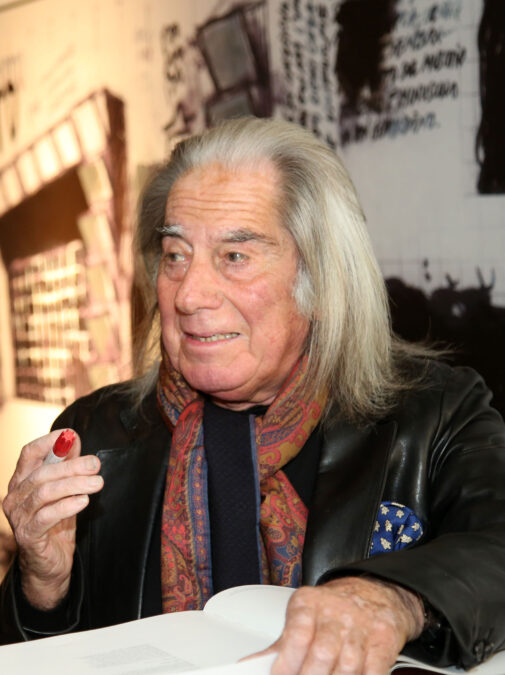
Fabrizio Plessi has died at the age of 86. Born in Reggio Emilia in 1940, he was one of the great pioneers of European video art and an artist who, for more than half a century, used technology, water, fire, stone, and memory as the materials for work that straddled the boundaries of sculpture, architecture, visual art, and performance. But his passing holds special significance in Mallorca, as for nearly 40 years the island ceased to be merely a place of residence for him and became a true artistic home.
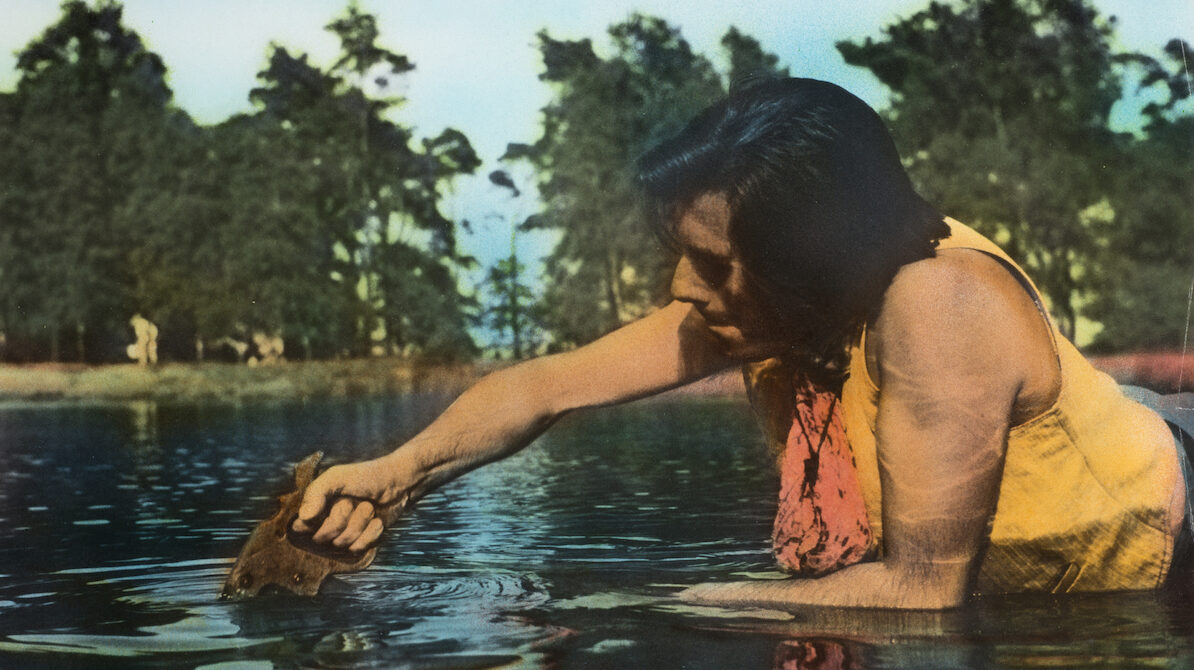
Trained at the Art High School and the Academy of Fine Arts in Venice, Plessi began to focus his research on water in the late 1960s. That choice would ultimately define much of his artistic language. For him, water was not simply a subject but a conceptual medium capable of speaking to time, movement, transformation, and memory. In the 1970s, he created performances, films, and videotapes centered on rivers and lakes, while exploring the possibilities of a medium that was only just beginning to gain recognition within contemporary art.
His great contribution lay in not viewing video as a mere image to be viewed on a screen. Plessi transformed it into sculptural material. Monitors, metal structures, stone, wood, light, and sound began to form installations in which electronic elements could simulate water, fire, lava, or the movement of a current. In his hands, technology did not seek to erase tradition, but rather to engage in a dialogue with it. Hence the characteristic tension in his work between the ancient and the technological, between matter and its representation, and between the real landscape and its digital illusion.
He participated repeatedly in the Venice Biennale and presented his works at leading institutions and events, from the Centre Pompidou in Paris to the Guggenheim in New York. His large-scale installations gradually took on an architectural and spectacular dimension without losing their essentially poetic character.
His first decisive encounter with the island took place in 1989, when he was invited to present a major exhibition at the Palau Solleric in Palma. At that time, Plessi arrived in Mallorca as an artist who was already fully recognized internationally. That visit, however, ended up evolving into a relationship that has lasted nearly forty years. The southeastern part of the island—and Santanyí in particular—would eventually become his refuge, his home, and his workplace. There he established his studio, Sa Pedra, which he conceived almost as a total work of art: a sort of habitable sculpture from which he could plan and prepare his works.
Mallorca offered him something that Plessi considered essential: light, silence, stone, the horizon, and a natural world he perceived as primitive and powerful. The island thus became a counterpoint to Venice, the other great sentimental landscape of his life. If Venice represented for him water, history, and the city suspended over the lagoon, Mallorca offered another way of relating to the Mediterranean: stone, aridity, the open landscape, and a different kind of light. Both places ultimately fueled his imagination.
Exhibitions on the island
In 1991, he presented a major exhibition at Sa Nostra in Palma, focused on the island’s architectural styles and materials. In 1995, he created ‘Fuochi Fatui’ for the Pilar and Joan Miró Foundation, even installing one of the pieces in Miró’s own studio. And in 2004, he returned to Es Baluard to transform the museum’s old cistern. There he presented ‘I lavatoi dell’anima’, a new version of ‘Bombay-Bombay’, creating a dialogue between his monitors, the iron, and the references to water with the stone architecture of the old cistern. The encounter between contemporary technology and that material memory was particularly representative of his way of understanding art.
But perhaps no work expressed his connection to the island as clearly as ‘Llaüt Light’, presented in 2011 at the Llotja in Palma. Plessi took the traditional Mallorcan llaüts as his starting point and made them the focal point of an installation that, significantly, dispensed with much of the technological resources that had characterized his previous work. The boats, the wood, the Gothic architecture of the Llotja, and the light established a dialogue between Mallorca’s maritime tradition and the artist’s contemporary sensibility. By then, the island had ceased to be merely a source of inspiration and had become part of his artistic identity.
That is why the exhibition that Es Baluard dedicated to him in 2019—Fabrizio Plessi: 30 Years in Mallorca—was particularly significant. It was not a conventional retrospective, but rather a review of the works and projects born out of his relationship with the island. The museum emphasized at the time that Mallorca had been his “source of inspiration and creative expression” throughout those three decades. There are artists who live in a place, and artists who bring a place to life within their work. Plessi belongs to the latter group. Mallorca was not merely a Mediterranean backdrop added to an international career: it was a laboratory, a source of images and materials, an atmosphere, and, over time, an inseparable part of his life story.
His work was always permeated by a fertile paradox. He used the most advanced technologies to explore primordial elements. He made screens speak of water; light evoke fire; electronic circuits converse with stone; and digital images recover the memory of ancient objects and landscapes. In that sense, his work did not naively celebrate technology: he sought to tame it, to put it at the service of a much older memory. Perhaps that is why Mallorca seemed so fitting to him. The island is, in itself, a layered territory: landscape and civilization, stone and sea, tradition and modernity, permanence and transformation. There, Plessi found material he did not need to invent.
With his death, we have lost not only one of the great names of the first generation of video art, but also a figure who had become an integral part of Mallorca’s cultural landscape. In Santanyí, the memory of his studio and years of work remains; in Palma, the traces of his exhibitions; and in his works, a Mallorca transformed into water, light, stone, boats, and memory.

