







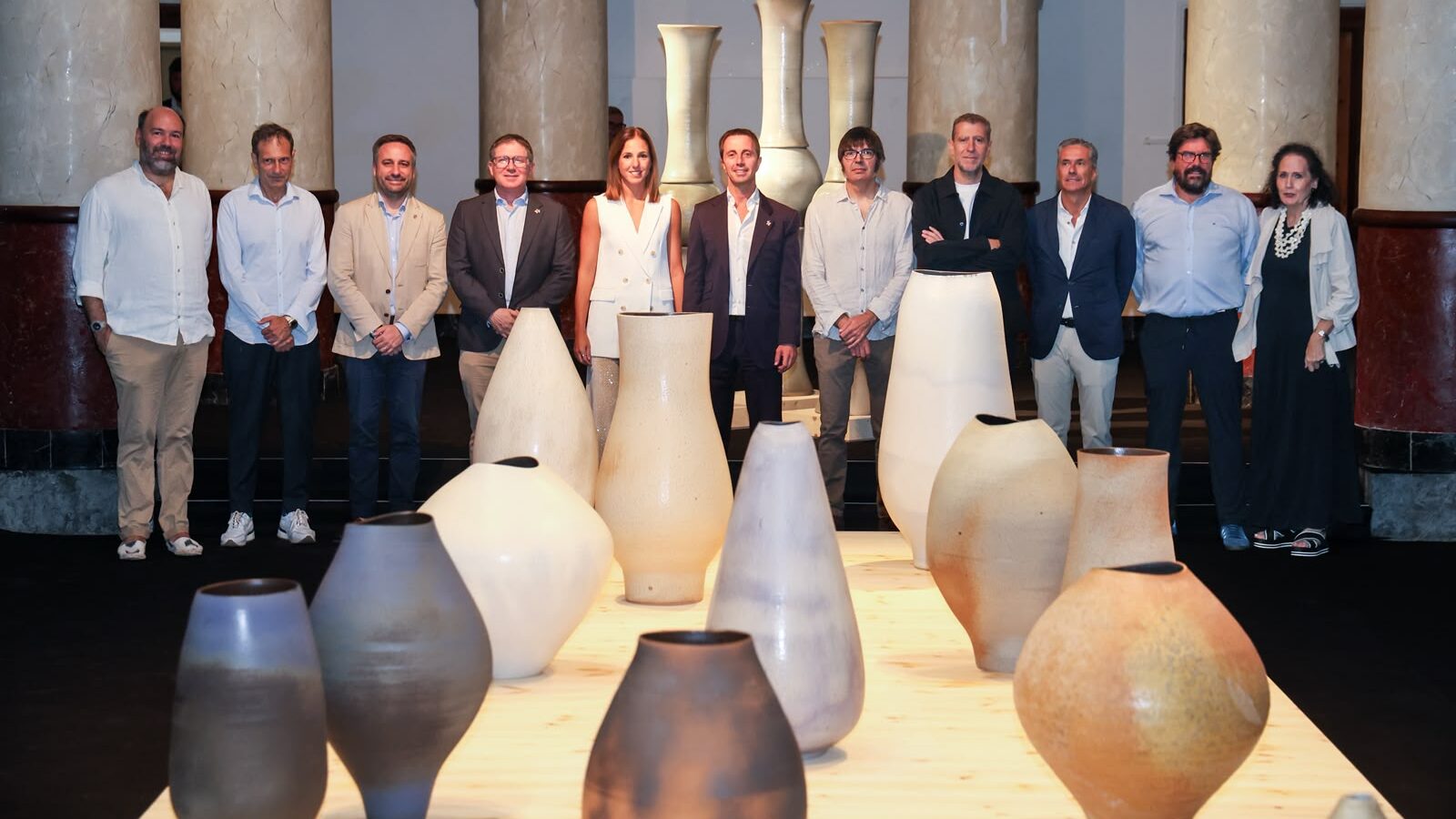
There is something especially contemporary about returning to the earth. While technology accelerates creative processes and artificial intelligence redefines the boundaries of what we understand as creation, Català Roig proposes something seemingly simpler: clay, glaze, fire, and time. In the Chapel of La Misericòrdia, this combination takes on an almost architectural dimension and transforms ceramics into something far removed from craftsmanship understood as a simple decorative object.
‘From Earth to Heaven’, curated by Luis Juan de Sentmenat García Ruiz and part of the Biennial B, opened its doors yesterday in one of Palma’s most unique spaces. The exhibition was part of the cultural program for Mallorca Day and the 30th anniversary celebrations of Art Night, but its importance goes far beyond the institutional calendar: it invites reflection on material, craft, and an artist’s ability to transform a tradition into a completely contemporary language.
Català Roig’s ceramics do not seek to captivate at first glance. Their pieces reject ornamental excess in favor of refined forms, surfaces where the glaze reveals its imperfections, and volumes that seem to retain the memory of the process that created them. The result has an air of a sculptural object, of architecture, and, above all, a very physical relationship with time.
Because in this exhibition, the artist does not have complete control over the outcome. Fire intervenes, alters the colors, changes the surfaces, and transforms the forms. The firing ceases to be a technical step and becomes part of the creative process. There is a particularly appealing idea behind this way of working: accepting that part of the work is produced beyond the artist’s control.
This relationship with the material is also linked to Català Roig’s fascination with various Eastern ceramic traditions and to a spiritual dimension that runs through his career. His pieces seem to seek precisely that realm in which the object ceases to be an object and becomes an experience.
And therein lies much of the appeal of ‘From Earth to Heaven’: in celebrating the craft without turning it into nostalgia. Català Roig comes from a family with a long history in ceramics – his career began at the Es Retall workshop – but his work shows that tradition and modernity are not opposing concepts. On the contrary: the knowledge accumulated over generations can become an extraordinarily sophisticated tool for experimentation.
His career illustrates this combination of craftsmanship and artistic ambition. His projects include the reproduction of 4,000 tiles for the bell tower of the Carthusian Monastery of Valldemossa, the mosaic of the fountain in Plaza de la Reina, and the restoration of the mural by Lluís Castaldo in the Cuarentena Park. A career built around ceramics, but also on the transmission of knowledge, research, and heritage conservation.
A more contemporary version of The Mercy
The Català Roig exhibition was not the only one on display. The courtyard of Les Dones de la Misericòrdia also hosted three exhibitions from Art Palma Contemporani, which further enriched the dialogue between heritage and contemporary art during Art Night.
The contrast proved intriguing: in contrast to the material silence of Català Roig’s ceramics, Alejandro Monge’s ‘The Last Nomad’ introduced a much more technological reflection on the body, mobility, and isolation. The motorcycle, a traditional symbol of freedom, appeared motionless next to a figure suspended in a kind of limbo. The image proved especially relevant at a time when being constantly connected does not necessarily mean feeling closer to others.
Also on display was ‘Nuevo orden’ by Nieves Guri and Marcos Juncal, a work that made the transformation of matter its artistic theme. Guri worked with the concept of rupture: she tore her own canvases and then reconstructed them, revealing the scars left by the process. Juncal, for his part, incorporated his relationship with stone and found objects into his sculpture, transforming existing materials until new forms were revealed.
The exhibition thus served as a dialogue between two ways of understanding the creative process: destroying in order to rebuild and sculpting in order to discover. In both cases, the process ceased to be invisible and became an essential part of the work.
The third proposal, ‘States of Matter, States of Mind,’ by Anna Belén, brought an international perspective to the exhibition as a whole. The German artist, born in 1997 and connected to the art scenes of Hamburg and London, was inspired by the ‘Gedankenexperiment’ – the thought experiment that philosophers and scientists use to test a hypothesis before applying it to the real world.
This choice proved especially significant within the body of the work. While Català Roig used fire to discover what happens to matter, Belén turned to her imagination to explore what happens to ideas before they become reality.
Mallorca as a creative hub
Instead of being merely a series of exhibitions, La Misericòrdia presented a fairly accurate snapshot of Mallorca’s art scene during those days: tradition, private galleries, emerging artists, heritage, and international influences shared the space without having to compete with one another.
And perhaps this was the most interesting takeaway from this edition. Mallorca is no longer just a backdrop for cultural tourism or an aesthetic oasis for international visitors. It is also establishing itself as a creative hub where local artists coexist with galleries and creators from other European scenes.
In this context, Català Roig occupies a particularly interesting position. His work is inspired by a craft deeply rooted on the island, but he uses this knowledge to speak a language that can be understood far beyond its borders. It is, in a way, one of the most fascinating paradoxes of contemporary art: the more deeply an artist is connected to their subject and their territory, the greater their ability to project outward.
Mercy proved it once again. Through stone, clay, paint, sculpture, and contemporary thought, Palma transformed its historic heritage, for one night, into something far more valuable than a mere backdrop: a living space for creativity.
‘From Earth to Heaven’ will be on display until March 6, 2027. And, in an era obsessed with the here and now, perhaps its most sophisticated message is precisely this: to pause, observe the material world, and remember that some things still need time to become art.


