








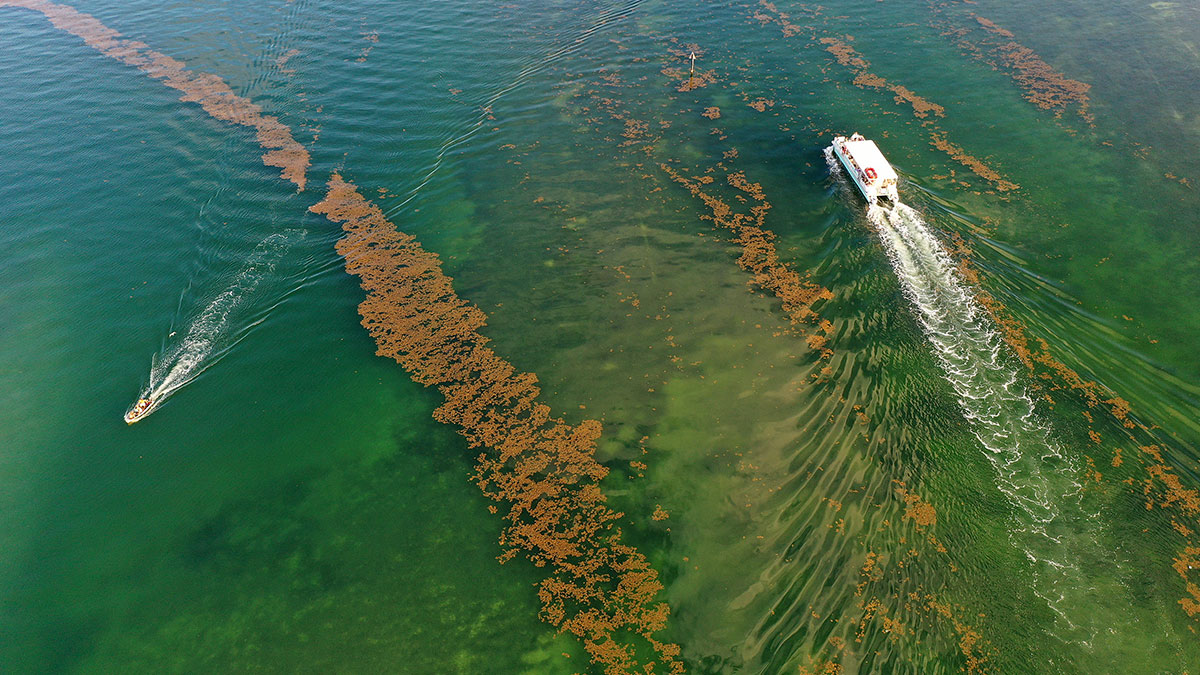
Every year, between spring and early fall, the phenomenon repeats itself: large masses of the macroalgae sargassum invade the Caribbean, a phenomenon that, as the Fundación Caribe Sur explains, affects not only tourism and navigation: its decomposition consumes oxygen from the water and creates brown or golden tides, leading to conditions with low oxygen levels (hypoxic) or no oxygen (anoxic).
The 2026 sargassum season threatens to be the most severe on record. According to the latest report from the Quintana Roo Secretariat of Ecology and the Environment (SEMA), the state has accumulated 92,581.04 metric tons of the macroalgae collected so far this year. The figure confirms what scientists had been anticipating since the beginning of the year. The first signs had already been detected in February. Dr. Christian Appendini Albrechtsen, director of the Sargassum Study Group at the UNAM Institute of Engineering, warned at the time that the size of the bloom detected by satellite at the beginning of the year pointed to a season “much larger” than previous ones. The all-time record (522,000 metric tons) was set in 2018, and all signs indicate that 2026 could approach or exceed that mark.
According to the University of South Florida (USF) and the National Oceanic and Atmospheric Administration (NOAA), the reason lies in a combination of factors: higher sea surface temperatures, an excess of nutrients carried by the Amazon River, and wind and current patterns that favor the accelerated growth of the so-called Great Atlantic Sargassum Belt, a formation of brown algae that stretches from Africa to the Americas.
In May 2026, floating biomass reached 40 million metric tons in the Atlantic and the Caribbean, surpassing all previous records and covering nearly 4% of the monitored ocean surface.
What 2025 Left Behind: The Statistic That’s Setting Off Alarm Bells
This phenomenon is not new: since 2011, with the sole exception of 2013, the Mexican Caribbean has faced a massive influx of sargassum every summer, according to data from the USF’s Optical Oceanography Laboratory. But the 2025 technical report, prepared by researcher Uriel de Jesús Mendoza Castillo, quantifies the magnitude of the problem with unusual precision: that year, 252,659 polygons indicating the presence of sargassum were detected along the Mexican coastline, equivalent to 382.7 square kilometers of affected area over a period of 70 days. The biomass reached an estimated peak of 1.30 million metric tons, although under more conservative scenarios, the figure ranges between 130,000 and 520,000 metric tons.
The study also revealed a key pattern: the phenomenon is highly seasonal, peaking in July and August—its peak months—and nearly 70% of the affected area was located more than 20 kilometers from the coast, that is, offshore, before the algae reached the beach. This data reinforces the argument made by scientists such as Appendini in favor of intercepting the sargassum on the high seas, before it decomposes along the shore.
With that historical data as a benchmark, the 92,581 metric tons already harvested in 2026—and the fact that July and August, the months with the highest landings according to historical trends, are still underway—suggest that the season could end with figures far higher than last year’s.
Playa del Carmen and Cancún, the hardest hit
The distribution of waste is not uniform. Playa del Carmen (Solidaridad) tops the list with 33,411.42 metric tons collected—36.1% of the state total—followed by Cancún (Benito Juárez), with 21,669.58 metric tons (23.4%). Between them, these two destinations account for nearly six out of every ten metric tons that wash up on the shores of Quintana Roo.
The containment strategy calls for installing 16,030 meters of anti-sargassum barriers at strategic locations, but so far only 9,450 meters have been installed. These structures—similar to those used in oil spills—act as walls that stop the seaweed before it reaches the sand, although their effectiveness depends on constant removal: if the accumulated sargassum is not removed in time, its weight can cause the barrier to sink, rendering it useless.
State and municipal authorities, the Secretariat of the Navy (Semar), and the tourism sector are conducting daily cleanup operations at sea and on land, using heavy machinery and sargassum-removal vessels.
When sargassum washes ashore and begins to decompose, it releases hydrogen sulfide—a gas that smells like rotten eggs—and ammonia, which can cause respiratory irritation, especially in people with asthma. Added to this is a less visible risk: the algae bioaccumulate heavy metals such as arsenic and cadmium along their journey across the ocean, and some studies also warn of the presence of concentrated microplastics.
From Waste to Opportunity
In the open ocean, sargassum plays an essential role as a refuge and food source for turtles, fish, and seabirds. The problem arises only when it accumulates along the shore: it blocks the sunlight needed by corals and seagrasses, and as it decomposes, it depletes oxygen in the water, disrupting the balance of coastal ecosystems that are key to biodiversity and the natural protection of beaches.
In the face of the economic impact—which in Mexico already exceeds 150 million pesos annually in harvesting alone, according to SEMAR— the Mexican government is promoting projects for the industrial use of the macroalgae: biofuels, fertilizers, and construction materials are among the alternatives under consideration, although experts insist that its processing must be carried out under strict controls to prevent the release of the contaminants carried by the sargassum itself.