







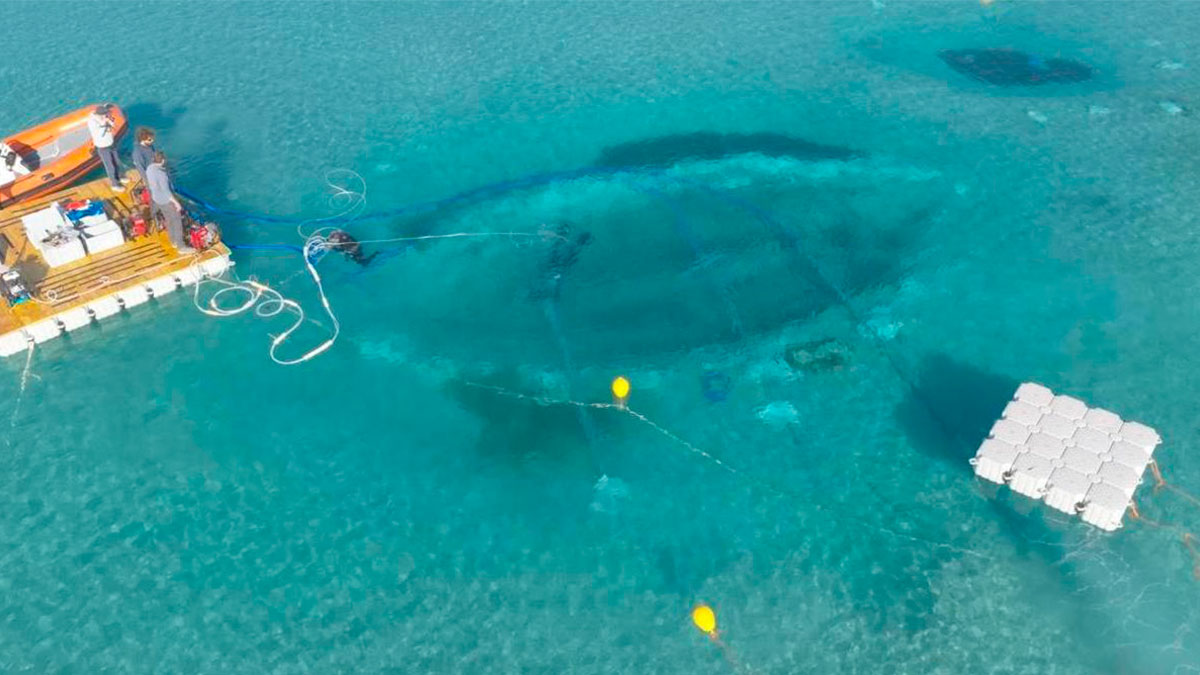
After spending 1,700 years underwater, it took just four months to bring the Roman shipwreck of Ses Fontanelles back to the surface—the 4th-century Roman merchant ship that has just been successfully salvaged in Palma de Mallorca, just 65 meters from Can Pastilla Beach. These four months, however, represented a continuous effort—as titanic as it was meticulous—led by the Arqueomallornauta team, in which the Consell de Mallorca and the universities of Cádiz, Barcelona, and the Balearic Islands joined forces.
The complex recovery operation that has just been completed marks a milestone for underwater archaeology in the Mediterranean and places our country in a position of outstanding prominence in the international archaeological community. The final section of the hull, approximately 12 meters long by 2 meters wide, was raised using buoyancy bags and transported to the San Antonio de la Playa Maritime Club. From there, the remains were taken to the facilities at Castillo de San Carlos, where they will remain submerged for a year and a half in desalination pools. Subsequently, the wooden sections will be transported to the ARQVAtec laboratory in Cartagena for conservation treatment involving PEG impregnation and freeze-drying, thereby ensuring the preservation of this treasure for future generations. To share this discovery with the public, an exhibition will be held starting in November at the La Misericordia Cultural Center in Palma de Mallorca.
The discovery of a “time capsule”
This incredible journey began by chance in the summer of 2019, when a severe storm stirred up sediment on the seafloor and a diver discovered the shipwreck. To the surprise of the researchers at Arqueomallornauta, the ship lay just 65 meters from the popular Can Pastilla beach and at a depth of only two and a half meters. It is a small merchant ship, about 12 meters long and six meters wide, that sank in the 4th century CE.
Our ship set sail from the area around Carthago Spartaria (modern-day Cartagena) and was carrying more than 300 commercial amphorae loaded with oil, wine, and fermented fish sauce (garum). What is truly revolutionary about this discovery is the state of preservation of the cargo. Nearly 100 tituli picti (original painted inscriptions on the amphorae) have been documented, making this the most significant corpus of painted amphora epigraphy ever found in our country. These inscriptions have allowed archaeologists to identify the names of merchants, tax records, and even the various scribes, opening an unprecedented window into the Roman economy and trade in the Western Mediterranean.
The site’s excellent state of preservation has left the scientific community breathless, and they describe it as a “compendium of economic, social, and religious evolution.” In terms of chronology, the discovery of a coin minted in the city of Siscia in the ship’s cabin has made it possible to date the sinking precisely to after the year 320 AD. The ship also reflects the profound ideological transformation of the Roman Empire in the 4th century, revealing the coexistence of pagan and Christian symbols: among the recovered objects was an oil lamp depicting the goddess Diana alongside amphorae marked with the Christian symbol of the Chi-Rho.
At the same time, the perimeter excavation has shed light on daily life on board. North African kitchenware, remnants of linen sails, 90 meters of rope, two shoes (one made of esparto grass and the other of leather), and a bow drill used for repairs—the first of its kind found in Spain—have been recovered.