







The nearly four million viewers who have made *La bola negra* one of the biggest hits in the history of Spanish cinema aren’t satisfied with just its 155 minutes of running time. The phenomenon has taken over conversations on the street and on social media, turning everything related to the triple plot into an obsession. Because, as in *The Hours*, Los Javis’s film features three parallel and closely intertwined storylines: that of Carlos in 1932, that of Sebastián in 1937, and that of Alberto in 2017.
In the 1937 film, actor Miguel Bernabeu plays Rafael Rodríguez Rapún (Madrid, 1912 – Santander, 1937), Federico García Lorca’s second-to-last love and one of the few main characters in *La bola negra* based entirely on a real person.
Rapún, as Albert Plá’s character explains in the film, was a mining engineer, a soccer player for Atlético de Madrid, a lieutenant in the Popular Army of the Republic, and a secretary and occasional actor with La Barraca, Lorca’s theater company. But, unlike in *La bola negra*, he did not die by firing squad; rather, he bled to death from wounds sustained in the Battle of Santander at the age of just 25.
María Teresa León, Rafael Alberti’s wife and a close friend of Lorca and Rapún, wrote in her memoirs: “No one suffered more than that quiet young man over that death. […] And Rapún went off to die on the Northern Front. I’m sure that after firing his rifle furiously, he let himself be killed. It was his way of bringing Federico back.”
A cemetery unlike any other in Spain
It was Alberto Conejero, playwright and co-screenwriter with Los Javis, who first sparked the recent interest in Rodríguez Rapún. In 2013, he premiered the play *La piedra oscura*, in which he imagines the relationship between the fictional Sebastián (played by Guitarricadelafuente) and the real Rapún, whose surviving relatives helped Conejero with his extensive research.
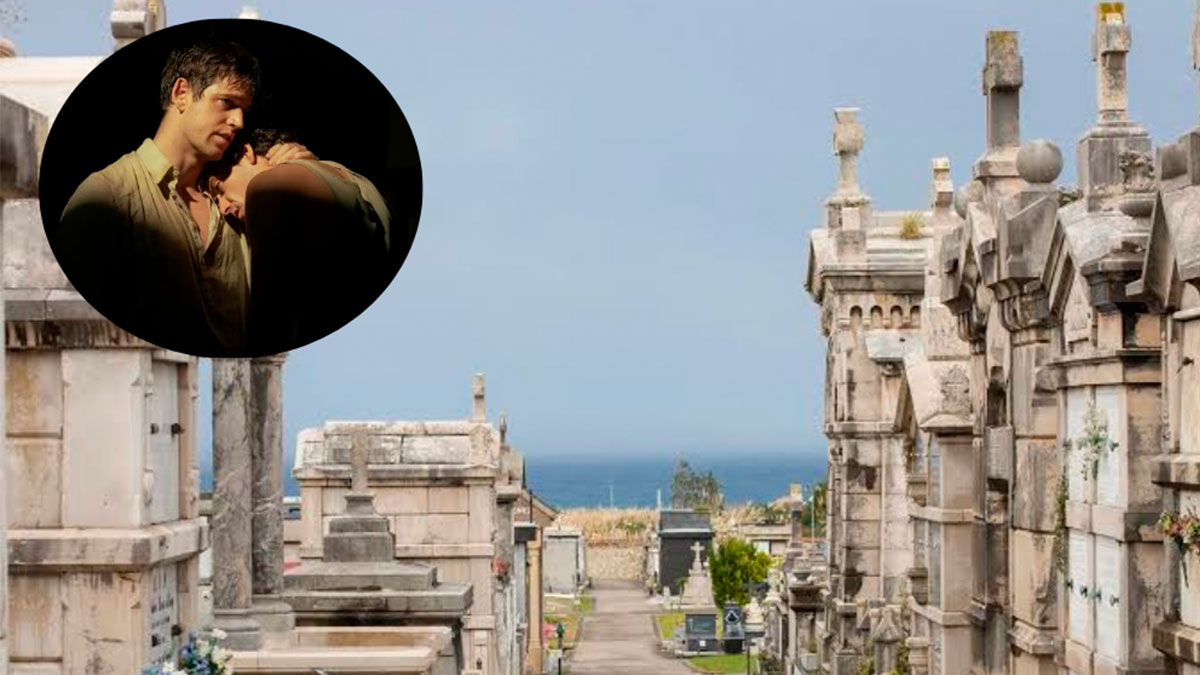
Thanks to the writer’s research and social media posts, we know where the remains of García Lorca’s penultimate love are laid to rest. It is the Ciriego Cemetery in Santander: a burial ground where the memory of those who are no longer with us coexists with the landscape of the Cantabrian coast.
Opened in 1893 and a member of the European Cemeteries Route, it was designed by the municipal architect Casimiro Pérez de la Riva in 1881 and completed by his successor, Joaquín Ruiz Sierra. The cemetery has a cross-shaped layout in its central section, and the burial area is organized into a grid of streets and alleys that form blocks, within which each owner’s plot is demarcated.
The region’s most renowned architects, master builders, and marble carvers worked on the cemetery, which in practice makes it an open-air sculptural and architectural garden. The Ciriego Cemetery was already attracting interest among necrotourism enthusiasts due to its artistic value and its proximity to the sea.
However, several social media users have already shared their visits to Rapún’s grave with their followers—an interest sparked by the film’s release.
According to the cemetery’s own website, “the remains of […] the ‘Man of the Three Rs’—as he was nicknamed by his last love, the Granada-born poet Federico García Lorca (1898–1936)—are interred in this ossuary. […] Lorca’s murder led Rapún to enlist in the Republican Army. He was sent to the front with the rank of lieutenant and was wounded after being bombed by an Italian plane. Although he was transferred to Field Hospital No. 4, he died on August 18, 1937, according to the record at the Ciriego Cemetery, at the age of 25. Fate would have it that death took him on the exact anniversary of his beloved’s murder.”
The article on the cemetery’s website continues: “He was initially buried in one of the cemetery’s standard graves. Ten years later, at his father’s request, his remains were moved to the niche where they rest today.”