







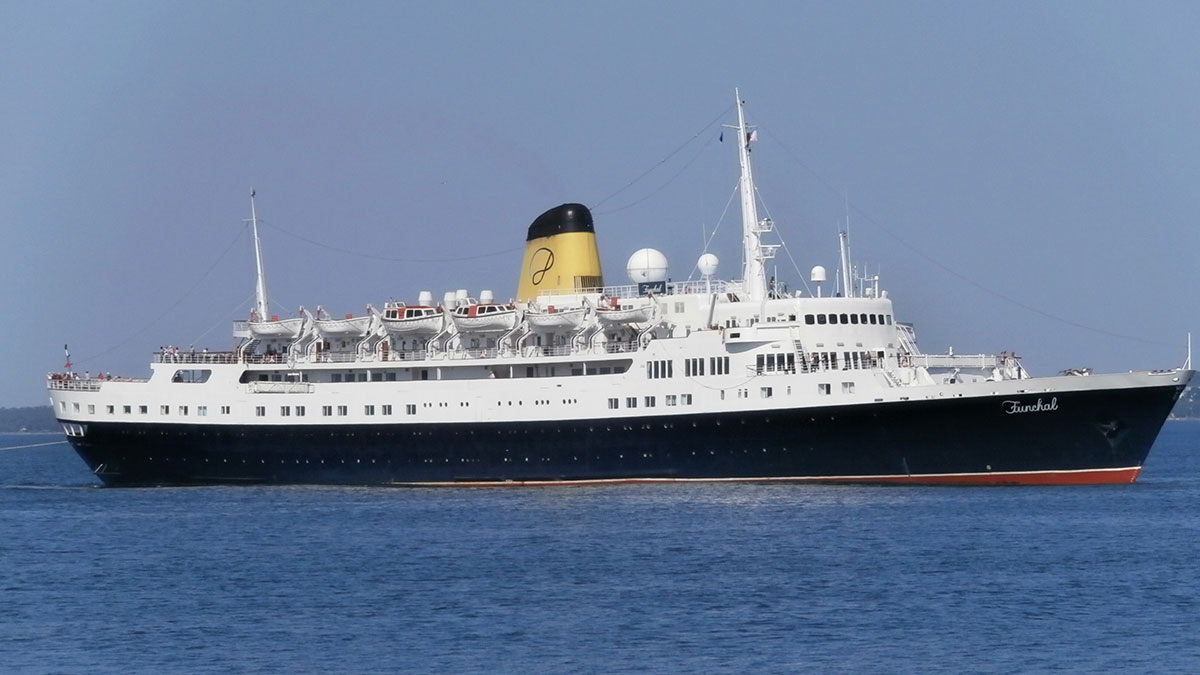
The Funchal, one of the most beloved liners of the 20th-century Portuguese merchant marine, is back on the market. According to reports in the Portuguese press (Correio da Manhã) and as reported by Cruise Industry News on September 8, the ship is being offered through a sealed-bid process that will run until the end of the month.
The sale is part of the insolvency proceedings involving Teamson Lda, the company that acquired Funchal in April 2021, as part of a package that also included the Astoria—which has since been scrapped—and which was once linked to a crypto investor interested in launching an ambitious venture in Portugal. This time, the minimum bid has been set at 802,354 euros. The ship is being sold “as is, where is” (at anchor on the Tagus River) and, interestingly, debt-free.
The deadlines are clear: ship tour on September 18, written bids (accompanied by a 10% security deposit) due by September 30, and a public opening of the bids, on board the ship itself, in one month: October 9, 2026.
There’s an important detail for anyone hoping to acquire this venerable vessel: the insolvency administrators confirm that it’s already asbestos-free and licensed for hotel operations. That’s a result of the construction work that Teamson left unfinished when it tried to turn it into a hotel. In other words, technically speaking, it is closer than ever to a new use as floating lodging… although for years now, no one has stepped forward to see the project through to completion.
To understand why this helmet, which is more than sixty years old, continues to make headlines, we have to go back to its origins. That’s where its story takes an almost literary turn.
A ship born from an airplane lost in the Atlantic.
In the late 1950s, the airline route between Lisbon and Madeira was struck by a tragedy that would shape the fate of Funchal even before it existed: a seaplane operated by Artop Linhas Aéreas crashed into the Atlantic. Neither the aircraft nor the bodies of the 36 people on board were ever found.
That plane crash and the fears of some frequent travelers prompted the Empresa Insulana de Navegação to commission a new ship capable of ensuring a connection between mainland Portugal and Madeira with a level of reliability that aviation at the time could not yet provide. Those who wanted to fly to Funchal had to take a flight to Porto Santo and then continue their journey by sea to the island, which had no airport.
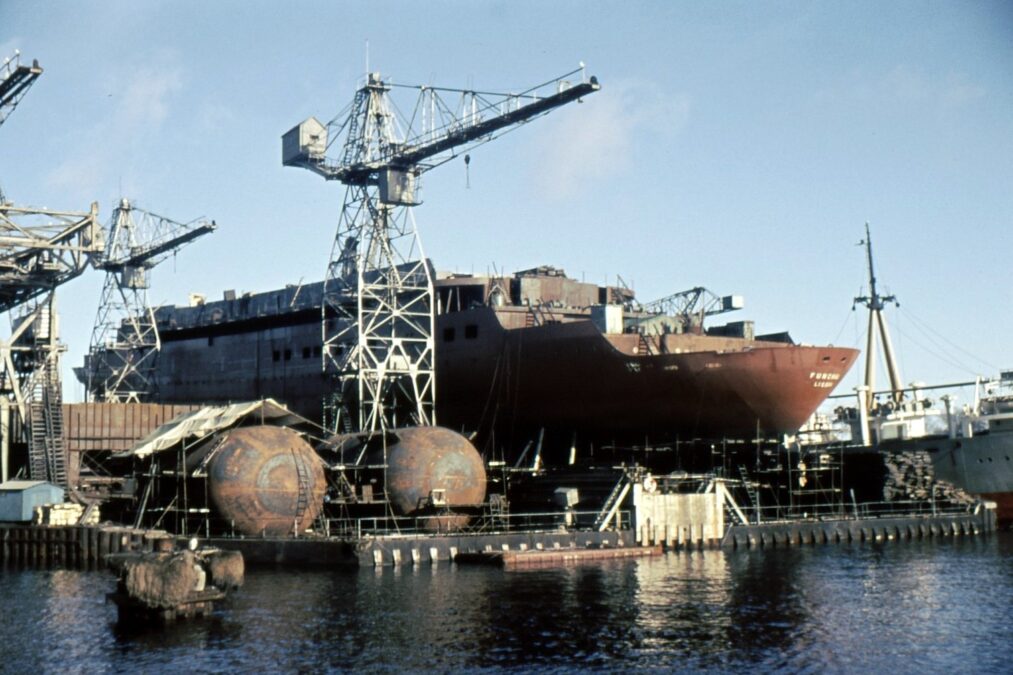
Naval engineer Rogério de Oliveira led the Funchal project, with the support of Azorean shipowner Vasco Bensaúde. The ship was built at the Danish shipyard in Helsingør (very close to the castle that inspired Shakespeare’s Hamlet) and was launched 65 years ago, on February 10, 1961.
It is interesting to look back on its history from today’s perspective, since the ship that ultimately fell victim to the rise of commercial aviation was, paradoxically, born in response to one of its own failures.
The Years of the “Bus” to the Islands
The Funchal set sail on its maiden voyage on November 4, 1961, covering the Lisbon–Madeira–Azores route. Over the next decade, it became something of a “sea bus,” transporting passengers, cargo, and mail between the mainland and the two archipelagos. Sometimes it added a third destination to its regular itinerary: the Canary Islands, leaving no one who came aboard indifferent to its aesthetic appeal.
The elegance of its interior design earned it the nickname “presidential yacht.” In fact, it eventually became the vessel used by the president of the Republic for state visits, although Américo de Deus Rodrigues Tomás used it on only a few occasions. The most memorable was the transport of Emperor Pedro I’s remains to Brazil in 1972. That voyage held enormous geopolitical and symbolic significance, although it took place in a commercially different context: passenger shipping was in sharp decline as jet aircraft were taking over the market from regular shipping lines.
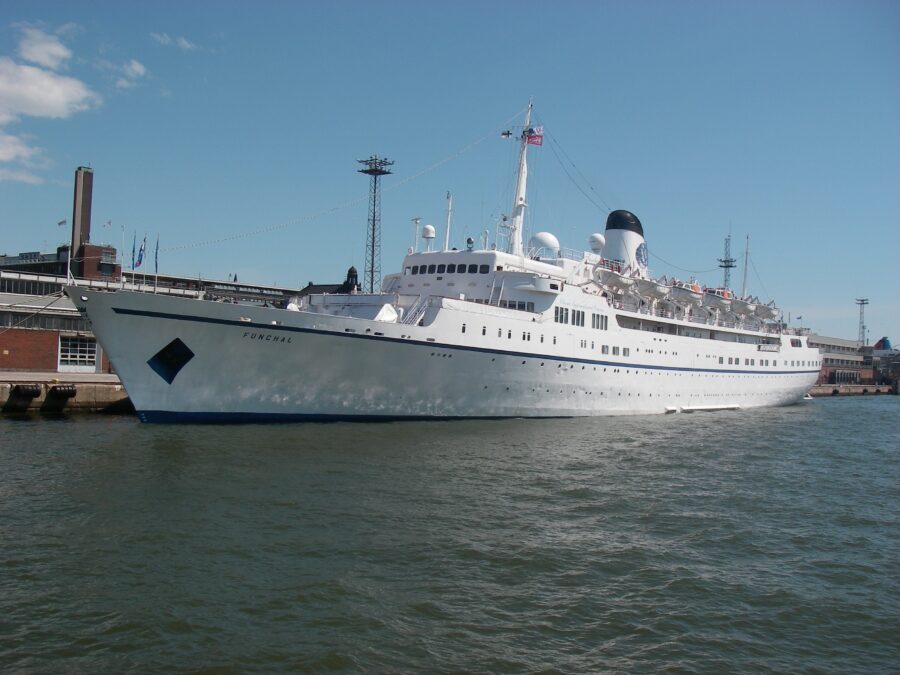
That same year, 1972, serious engine failures during a voyage to Rio de Janeiro—with President Tomás himself on board—forced the ship to undergo emergency repairs in Amsterdam. The shipyard took the opportunity to completely transform it: they replaced its steam turbines with diesel engines, added a swimming pool and economy-class cabins, and turned it into a single-class cruise ship. The island mail ship reinvented itself as a tourist vessel just as air travel had already become the undisputed norm.
Decline, a Greek Shipowner’s Love, and Resurrections
With the 1974 Carnation Revolution and the nationalization of its operator, the Funchal temporarily returned to island routes. On some voyages, according to naval historians, it carried as few as seven or ten passengers and more than 150 crew members on board—a clear sign that its original purpose no longer made any economic sense.
That was when he entered the scene and became its greatest champion: the Greek George Potamianos, who acquired it for his shipping company, Classic International Cruises, and kept it in operation for more than two decades, successfully serving the British cruise market. His death in 2012 and the subsequent liquidation of the company left the ship, once again, adrift.
In 2013, it was the turn of Rui Alegre and the Portuguese cruise line Portuscale Cruises, which returned the ship to the sea after a rapid refurbishment. The relaunch, attended by the Portuguese prime minister himself, was marred days later when the ship was detained in the port of Gothenburg (Sweden) due to safety violations. It returned to service in 2014, although in 2015 it was permanently moored in Lisbon.
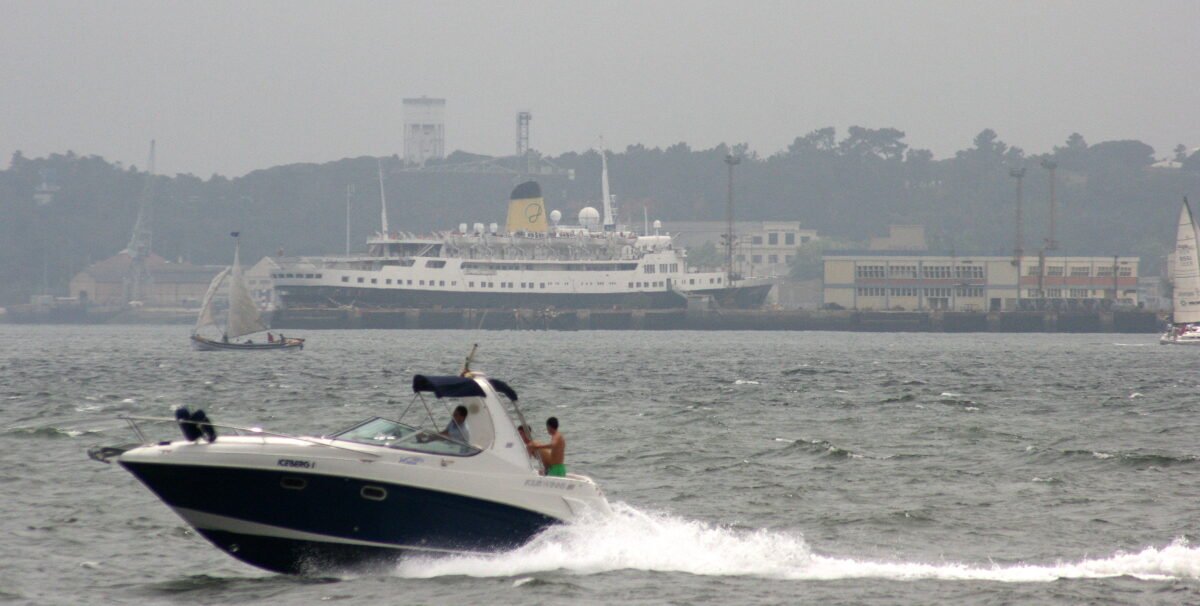
The Party Boat Chapter: From Ibiza to Liverpool
In 2018, a British hotel group called Signature Living purchased it at an auction in Lisbon for 3.9 million euros with a plan quite unlike any of its previous uses: to turn it into a party boat that would sail from Liverpool to the Mediterranean, with Ibiza as one of its top destinations for ravers. The project was even publicly billed as the company’s “party boat.”
However, like so many grand promises aimed at changing the world of entertainment or transportation, it failed. The payment was never fully completed, and the plan shifted to another idea: to tow it to Liverpool to turn it into a permanent floating hotel in the United Kingdom. This, too, never came to fruition. In 2020, Signature Living went into receivership, and the Funchal was once again left stranded in Lisbon, awaiting a buyer.
From the crypto-hotel to the removal of asbestos
In December 2020, the ship was put up for auction again. This time, the buyer was businessman and cryptocurrency investor Brock Pierce, who paid around 1.6 million euros with the intention of converting it into a five-star hotel with 200 rooms—or cabins—at the Naval da Rocha shipyard in Lisbon. The project was even expanded with the purchase of the Astoria, another veteran transatlantic liner, intended to eventually sail to the city of Funchal, Madeira, where a second ship-hotel would open.
Construction progressed slowly, and in 2021, a fire on board required the intervention of twenty fire crews. The project remained, once again, unfinished, although it did, at least, leave the ship finally free of asbestos and with the aforementioned hotel license, which remains in effect today.
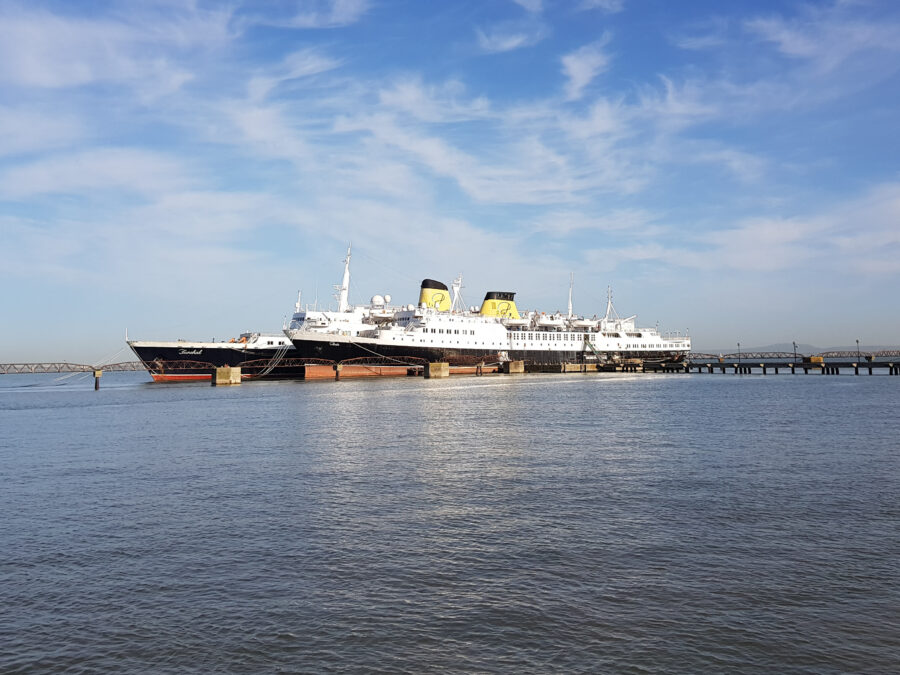
A symbol awaiting its next chapter
From an island mailboat born out of a seaplane tragedy, to a government vessel and a classic cruise ship, to the Ibiza party boat that never set sail and the half-finished hotel of a secret millionaire: few vessels have a history as curious, varied, and even erratic as that of the Funchal. Now, with its hotel license in order and free of debt, it is once again being offered at a bargain price in an auction that will conclude on October 9.
And now, for those of us who keep track of these classic ships, the question is always the same: Will this be the time a project finally comes to fruition, or will the Funchal add yet another chapter to its list of unfulfilled promises?
