








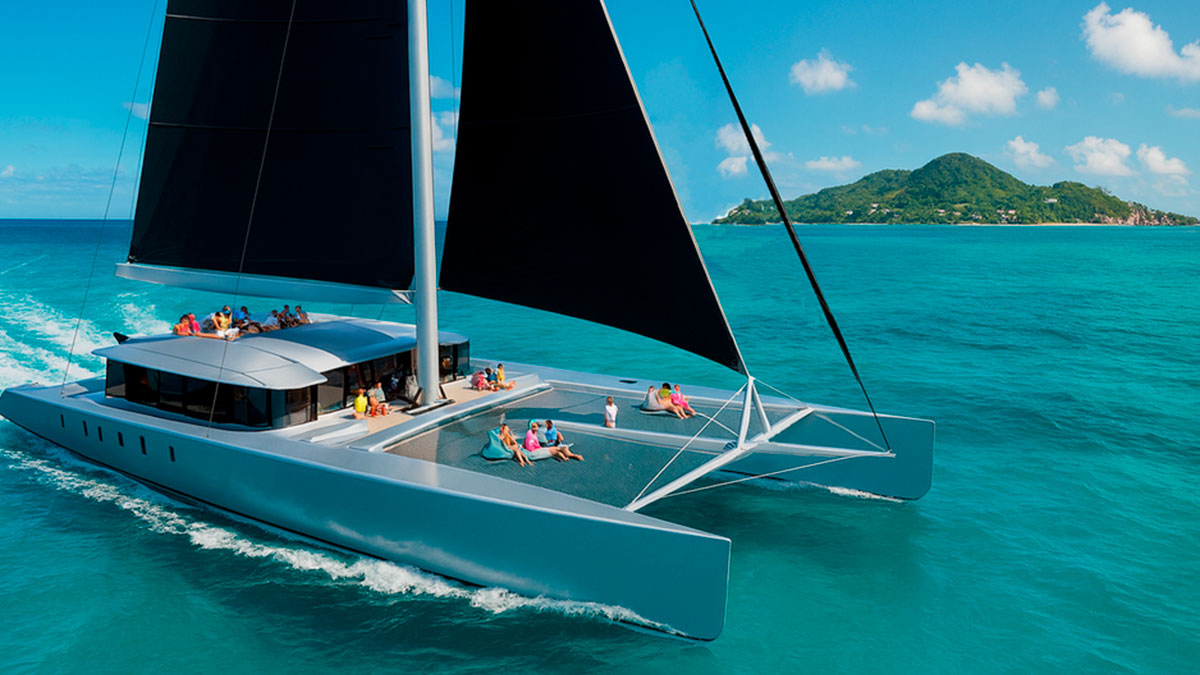
The 115-foot (35-meter) catamaran Team Adventure, which competed in the grueling round-the-world race “The Race” in 2000, is undergoing a remarkable transformation. Originally known for its extreme speed and a third-place finish, the boat is now being reimagined as a luxury charter superyacht. Led by former crew members Larry Rosenfeld and Cam Lewis, along with shipbuilder Tommy Gonzales, the project aims to combine exhilarating sailing performance (over 30 knots) with opulent amenities such as a spacious main salon and six VIP cabins. The rebuild has already begun at Fast Forward Composites, though the team is still seeking additional investment to complete this unique blend of high-speed adventure and superyacht comfort, designed for the Mediterranean and Caribbean charter markets.
I’m old enough to remember when Americans Larry Rosenfeld, Cam Lewis, and a dedicated crew of offshore daredevils competed in what I considered, quite simply, the coolest, fastest, most dangerous, and badass ocean race in the world. It was the dawn of a new millennium, December 31, 2000. They had just set sail from Barcelona to begin The Race (a nonstop, unlimited-distance round-the-world sailing race nonstop and without limits) aboard their 115-foot-long, 60-foot-beam carbon-fiber catamaran, christened Team Adventure and designed and built for one purpose only: to sail nonstop around the world at speeds approaching 50 knots. I was fascinated.
The whole world was watching, too. Especially when Team Adventure was leading the entire fleet as it entered the Southern Ocean, halfway through the race. Unfortunately, they finished in third place due to a detour they had to make midway through the race to tend to two injured crew members. And the catamaran struck a submerged object during a subsequent attempt at a transatlantic record, which brought the entire campaign to an end.
From a trip around the world to a luxury charter
But that’s all in the past.
Today, this legendary offshore racing catamaran is being transformed into a unique type of charter yacht, one that will combine all the high-performance sailing capabilities of a world-class racing boat with the luxury of a superyacht, featuring a spacious main salon, six VIP cabins, and plenty of deck space.

So, as the die-hard fan that I am, I reached out to Rosenfeld, Lewis, and the skipper of Team Adventure—and expert composite builder— Tommy Gonzales, to find out what it was like to sail on the original Team Adventure and when we’ll all be able to hop aboard for a ride at over 30 knots on the reimagined Team Adventure, now a charter superyacht.

“I had just sold my company to Oracle when we started Team Adventure,” Larry tells me from his home in Marblehead, Massachusetts. “That was in 1998. And I’d known Cam since high school—before he became the only American crew member aboard the Commodore Explorer, the first boat to sail around the world in less than 80 days, in 1993, and even before he sailed with Dennis Conner on his large catamaran in the 1988 America’s Cup.

“Cam and I were always talking, and the timing worked out perfectly with the announcement of The Race. Cam wanted to participate because he wanted to help educate and inspire young people to pursue their dreams. And I wanted to help. So we founded the Team Adventure Education Foundation and built the boat to support that mission.”
The rest, as they say, is history—until Rosenfeld, Lewis, and Tommy Gonzales began discussing transforming Team Adventure into a high-performance sailing superyacht unlike any other on the Mediterranean and Caribbean charter market.

“There are many possibilities for the boat,” adds Lewis. “The current design is very comfortable. And we’re going to be very careful not to overload the boat and lose all its fun, high-performance sailing capabilities. Because let’s be honest: there are many large sailboats, including some large catamarans, developed for the charter market. But, in my opinion, none of them are as fast or as much fun to sail. What I love about this boat is that it should be able to reach 30 knots or more, while still being as comfortable and safe as a superyacht.”

“Great,” I say. “You’ve got the boat, and you’ve got a new, innovative design. When can we head out to Narragansett Bay for some speed tests at 30 knots?”
That’s when Larry speaks up again. “Well, we want this project to be self-sustaining, with a small, passionate group of investors,” he says. “Yes, I know that ‘investment’ and ‘boat’ aren’t two words that usually go together. But based on our projections for the cost of the reconstruction and the revenue potential in the charter market, we’re excited about the possibilities.”
“It’s exactly like raising funds for a sailing race campaign,” he continues. “Tommy has already begun rebuilding his company, Fast Forward Composites, in Bristol, Rhode Island. But we won’t be finished—and we won’t be able to take you out for speed tests in Newport—until we secure some more capital from investors.”

“At Fast Forward Composites, we’re always looking ahead,” adds Gonzales. “The latest technologies. The fastest boats. We even work with Formula 1 teams. But what I love about the Team Adventure project is that this time we’re looking back—and in a very interesting way. We’re paying tribute to a legend from the past using all the modern technology and construction expertise available today.”

“Team Adventure and the other great catamarans of its era were incredible,” he continues with genuine enthusiasm. “We sailed more than 480 miles in 16 hours before hitting something at 40 knots during our transatlantic record attempt. It was absolutely crazy.”
I think I’ve fallen in love. Stay tuned to find out when I’ll be able to do those speed tests—and to see just how comfortable sailing at 30 knots can be.
