








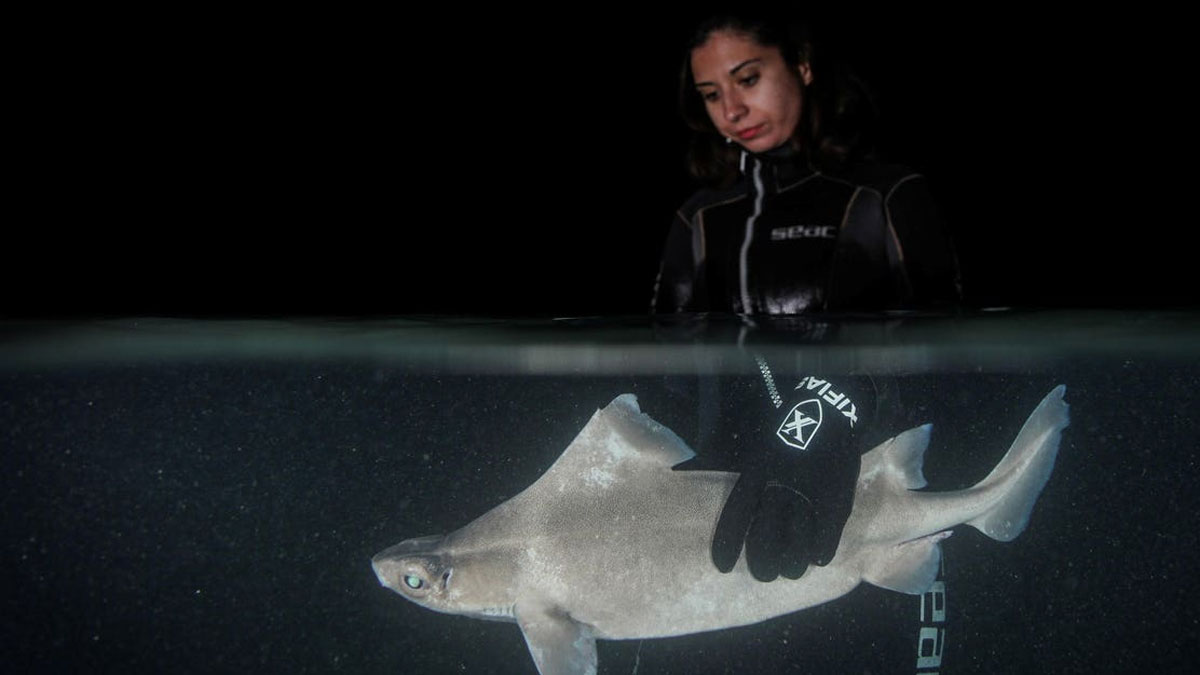
The first time you look at a map of the Mediterranean, it’s easy to overlook the Adriatic Sea. Nestled between the Italian peninsula and the Balkan coast, it looks like a simple arm of water branching off from a much larger sea. However, beneath its surface lies one of Europe’s most important regions for sharks and rays.
Within a relatively compact area, it encompasses shallow coastal waters, estuaries, muddy bottoms, Posidonia seagrass beds, rocky reefs, sandy habitats, deep-water canyons, and trenches that plunge to unfathomable depths. This diversity creates opportunities for an equally diverse community of sharks and rays. Some species rely on shallow coastal areas as feeding and breeding grounds. Others seek refuge in the depths of the basin. The southern Adriatic, particularly the Strait of Otranto, also serves as a critical link between the Adriatic and the wider Mediterranean, allowing animals to move between regions and populations. This makes the Adriatic far more than just a small corner of the Mediterranean: it is a place where ancient predators navigate an extraordinary mosaic of habitats that scientists are still learning to understand.
Researchers such as Emina Karalic, laboratory coordinator at the Sharklab ADRIA Research Center, are working on exactly that.
“What makes the Adriatic Sea particularly interesting is that it still holds many surprises. Although it has been studied for decades, we continue to document important habitats, rare species, evidence of reproduction, and findings that challenge what we thought we knew about the sharks and rays in this region. Our recent publications, for example, have transformed what we’ve known about the elasmobranchs in this region for decades,” he explains in an email.
These findings are particularly important because Mediterranean sharks and rays are among the most threatened marine vertebrates on the planet. More than 75 species have been recorded throughout the Mediterranean, and long-term monitoring in the Adriatic alone has documented more than 300,000 sharks and rays belonging to 35 species. Alarmingly, nearly half of those species are listed as threatened or critically endangered on the IUCN Red List.
Behind these rankings lie dramatic population declines: some species have suffered reductions of more than 96 percent—and even 99.99 percent—in recent decades. For animals that grow slowly, mature late, and produce few offspring, recovery can take decades or may never occur without intervention. These biological traits have allowed sharks and rays to survive for hundreds of millions of years, but they also make them particularly vulnerable to modern human pressures. The greatest threat? Overfishing, particularly bycatch. Sharks and rays are frequently caught unintentionally in trawl nets, longlines, and other fishing gear. Illegal and poorly regulated fishing continues to add pressure in some areas of the Mediterranean, although, according to the General Fisheries Commission for the Mediterranean (GFCM), “fishing pressure in the Mediterranean and the Black Sea has fallen by about 50% since 2013, while overexploited stocks have reached their lowest recorded levels.” However, there is another challenge that receives far less attention: the lack of reliable data.
Conservation decisions are only as good as the information on which they are based. If scientists do not know where animals breed, where juveniles grow up, how populations change, or which habitats are most important, conservation measures may miss the mark. In many regions, management decisions are still based on incomplete or outdated information. “Without high-quality, long-term data, it is very difficult to understand the true status of populations or to direct conservation efforts where they are most urgently needed. That is why continuous, well-designed monitoring is essential,” explains Karalic. Unlike short-term projects, which provide only a snapshot, long-term monitoring allows scientists to observe trends over the years. Changes in abundance, distribution, behavior, and survival typically occur gradually, and a single field season can completely overlook them. “It’s not just about recording which species are present, but about understanding how their populations change, where key habitats are located, which life stages are most vulnerable, and how fishing affects them. Only with this kind of evidence can we make effective, realistic, and science-based conservation decisions.”

Karalic recently presented his work at the 8th GEF Assembly in Samarkand to “give a voice not only to the sharks and rays of the Adriatic Sea, but also to the people who work every day on the front lines of nature conservation.” Although conservation is often framed as a conflict between protecting wildlife and protecting livelihoods, the reality is much more complex. Fishermen are sometimes portrayed as obstacles to conservation goals, when in fact they are the ones who possess decades of firsthand knowledge about marine ecosystems and perceive changes in catches, seasonal patterns, species appearances, and habitat conditions long before those changes appear in scientific data. That is why Karalic and his colleagues in the Adriatic have chosen to build partnerships with fishing communities rather than treat them as adversaries. Instead of starting with restrictions and regulations, they began with conversations. The fishermen were asked how the sea had changed over the course of their careers, and many shared the same observation: there are fewer fish today than there were decades ago.
Today, scientists spend much of their time in fishing ports and at sea, working alongside fishermen. They provide training in species identification, safe handling practices, and techniques for releasing sharks and rays alive whenever possible. And, just as importantly, scientists listen to fishermen, whose observations often help generate research questions and guide scientific investigations. The results of this collaboration have been remarkable: the voluntary participation of fishing communities has contributed to the rediscovery of rare species, the identification of important breeding habitats, and the collection of data that has led to numerous scientific publications. In many cases, fishermen now actively contact researchers when they encounter unusual or significant specimens. And perhaps even more encouraging is the shift in perception, Karalic notes. Sharks and rays have long suffered from reputations marked by fear and misunderstanding. Through education and firsthand experience, many fishermen have changed their view of these animals. Instead of seeing them as threats or nuisances, they increasingly recognize them as important components of healthy marine ecosystems.
This collaboration in the Adriatic serves as a model that can easily be extended beyond the Mediterranean, as conservationists around the world face similar challenges: habitat loss, limited funding, insufficient long-term monitoring, and increasing pressure on natural resources. Even so, the Sharklab ADRIA team demonstrates that effective conservation does not require choosing between people and wildlife. On the contrary, says Karalic: “The truth is that the best results come when scientific methods are combined with the lived experience of people who have known the sea their whole lives. For me, that combination has profoundly shaped my understanding of both research and conservation.”
Looking ahead, the challenge lies not only in understanding how shark and ray populations will adapt to a rapidly changing ocean, but also in identifying habitats that may have gone unnoticed for decades. “Every new study shows that these animals still hold many secrets about their biology, reproduction, behavior, and, above all, their survival strategies in the face of fishing,” says Karalic. “Perhaps this is precisely what motivates me the most: the realization that, despite years of research, there is still so much left to discover.”
If the Adriatic Sea has taught us anything, it is that, even after decades of study, nature still holds surprises.


