








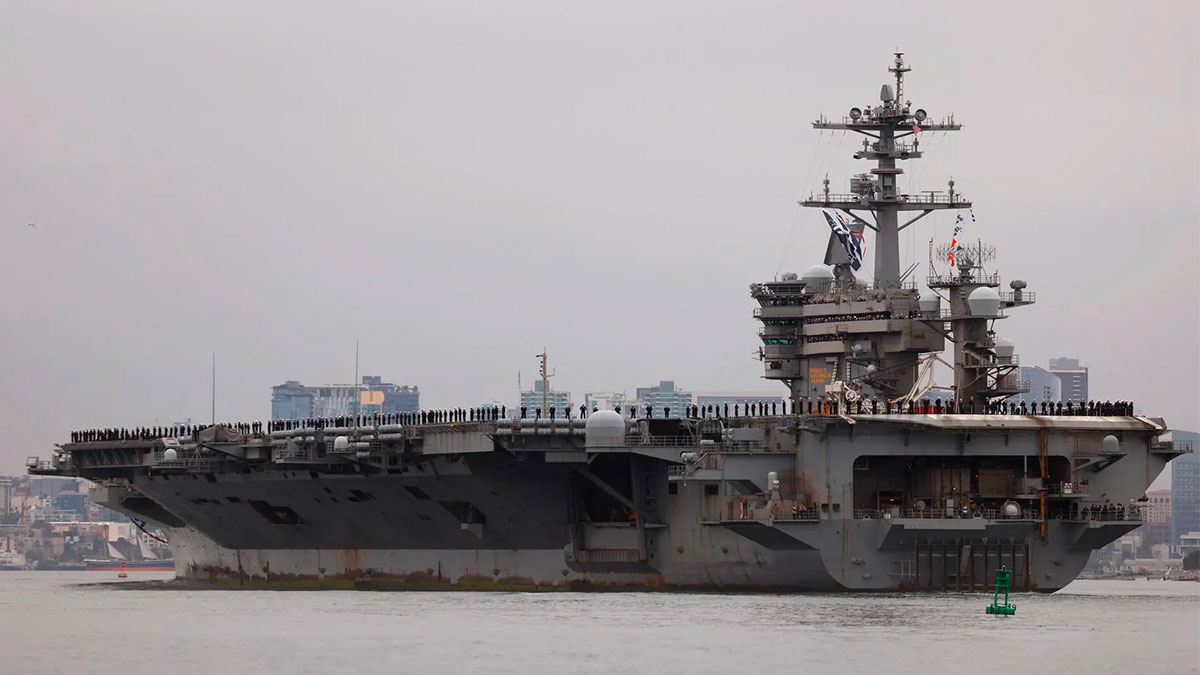
The USS Theodore Roosevelt (CVN-71), the U.S. Navy’s fourth Nimitz-class supercarrier, is currently at the Naval Base in San Diego, California, preparing for its next deployment. Last month, the nuclear-powered warship led the international military exercises Rim of the Pacific 2026 off the coast of Hawaii, and has spent most of August preparing for what is likely to be a long period away from home.
The CVN-71 is now expected to head to the Middle East to relieve the U.S. Navy’s only permanently deployed aircraft carrier, the USS George Washington (CVN-73), based in Yokosuka, Japan, which is currently operating in the Arabian Sea. It’s a sort of game of musical chairs among aircraft carriers, since the CVN-73 had in turn been sent to the U.S. Central Command area of responsibility to relieve the USS Abraham Lincoln (CVN-72), which had been deployed since November 21, 2025, and had spent more than 250 days at sea without calling at a port. Reports have surfaced that morale has suffered aboard the CVN-72, something that Defense Secretary Pete Hegseth has dismissed as “fake news.”
The deployment of the USS George Washington to the Middle East has also left the Pacific Ocean without any aircraft carriers in the region. A similar shortage of U.S. aircraft carriers in the western Pacific already occurred this spring, when the USS Abraham Lincoln was redeployed from the South China Sea to the Arabian Sea in February as part of the buildup of U.S. military forces.
Aircraft from the CVN-72, along with those from the USS Gerald R. Ford (CVN-78), participated in the Operation Epic Fury strikes against Iran. The CVN-78 returned to Naval Station Norfolk, Virginia, in May, completing a lengthy deployment of 326 days—nearly 11 full months. It was the longest period a U.S. aircraft carrier has spent away from its home port since the Vietnam War, and the longest on record for a nuclear-powered aircraft carrier.
Aircraft carrier deployments are being extended
These types of extended deployments are likely to become the new normal, as the U.S. Navy is forced to cover multiple global hotspots with very few available aircraft carriers. As a result, each deployment is likely to be extended.
The ongoing conflict in the Middle East, which shows no clear signs of resolution, comes after the U.S. military spent more than two and a half years countering the threat posed by Iran-backed Houthi militants, who began attacking commercial shipping in the Red Sea in response to the Israeli invasion of Gaza, which was triggered by the Hamas terrorist attack in southern Israel on October 7, 2023.
From late October of that year through September 2025, the United States maintained a nearly constant presence of supercarriers in the Middle East, and it is likely that a similar pace will continue over the coming months.
“We’ve been in conflict practically the entire time I’ve been in this position, and that has certainly put the force to the test,” Admiral Daryl Caudle, chief of Naval Operations, told reporters on Wednesday, according to USNI News.
“I’m trying to work with my chain of command to shape the deployment process so that it provides more certainty for planning… “If we know we’re heading into a danger zone, we should be able to predict with a little more precision how long the aircraft carrier and the strike group will remain in the area,” added Caudle, who appeared alongside Navy Chief Petty Officer John Perryman; both have been in their positions for one year. “We do these extensions in small increments, and families don’t see an end in sight so they can plan their own lives. That puts a lot of stress on the sailors.”
Perryman acknowledged that the families of the sailors and Marines serving on the USS Theodore Roosevelt are already expecting the deployment to last longer than the usual six or seven months.
“[The sailors] will do really tough things for me without batting an eye, because they enjoy that part of the job. But whenever possible, we have to be able to stick to the schedules and be very honest, just as we’re being with the Roosevelt,” Perryman explained. “They know they’ll be there for more than seven months. Their commander is giving them eight months to plan.”
Caudle added that he would prefer to see seven-month deployments, and acknowledged the stress that prolonged missions place on both the crew and their families back home.
“But the enemy also has a vote,” Caudle explained.
Perhaps more port calls
Although deployments may be extended, Caudle also emphasized that efforts will be made to avoid missing port calls, which provide crews with much-needed rest.
It is unclear where the aircraft carriers might make those stops, but options are being explored that include locations in Africa, India, and possibly even Singapore.
The problem is that, just as the enemy can influence the duration of a deployment by continuing to confront the United States, it also imposes conditions on the ports an aircraft carrier can call at. Since the start of the conflict, Tehran has attacked numerous U.S. military bases in the Middle East.
An aircraft carrier in port could simply be too tempting a target, so it would need to remain outside the active combat zone. However, the U.S. Navy has avoided sending its aircraft carriers through the Bab-al-Mandeb Strait into the Red Sea, as the Houthis have resumed attacking ships at that strategic point and in the Red Sea itself. This limits the ability of U.S. supercarriers to transit the Suez Canal—another strategic chokepoint, one might say—toward the Mediterranean, which would otherwise offer multiple port-of-call options.
The “Big Stick” Returns to the Middle East
When the USS Theodore Roosevelt is finally deployed in the coming weeks, it will return to familiar waters. It has operated in the Middle East on several occasions since it was commissioned 40 years ago, this coming October.
Known by the nickname “The Big Stick,” a reference to President Theodore Roosevelt’s famous foreign policy maxim, “Speak softly and carry a big stick,” the CVN-71 was launched in October 1984 and entered service in October 1986. The USS Theodore Roosevelt began its maiden deployment in late December 1988, with Carrier Air Wing Eight on board.
However, that deployment nearly never took place.
In 1976, then-President Gerald Ford had canceled the order for the nuclear-powered aircraft carrier, seeking instead to build two conventionally powered aircraft carriers capable of operating with vertical- or short-takeoff aircraft.
President Jimmy Carter was also initially opposed to the construction of the nuclear-powered aircraft carrier. However, he changed his position following the Iran hostage crisis, which highlighted the need for U.S. aircraft carrier strike groups to be able to operate in remote regions of the world. Construction of CVN-71 was ultimately authorized under the Pentagon’s authorization act for fiscal year 1980.
Although it is named after the man who claimed that it was wise to speak softly and carry a big stick, Roosevelt was also someone who never shied away from his share of the work. It seemed, in a way, fitting that, a little more than two years after entering service, the USS Theodore Roosevelt was deployed to participate in Operation Desert Shield, arriving in the Persian Gulf in mid-January 1991.
During the subsequent Operation Desert Storm, which began just one day before the aircraft carrier arrived in the area, the CVN-71 participated in combat operations in which its pilots flew more than 4,200 missions—more than any other aircraft carrier. In total, the aircraft operating from the USS Theodore Roosevelt dropped more than 4.8 million pounds of ordnance.
Aircraft operating from the aircraft carrier later participated in patrols during Operation Provide Comfort, in support of Kurdish forces in Iraq, and a year later in Operation Deny Flight, in support of the U.S. no-fly zone over Bosnia. The CVN-71 then became one of the few nuclear-powered warships that, up to that point, had transited the Suez Canal, when it was deployed to participate in Operation Southern Watch over Iraq.
The USS Theodore Roosevelt began its seventh deployment shortly after the September 11, 2001, terrorist attacks on New York and the Pentagon, and joined the USS Enterprise (CVN-68) and USS Carl Vinson (CVN-70), which were already in the area, carrying out strikes against Al Qaeda forces in Afghanistan during Operation Enduring Freedom. During its deployment in the region, the USS Theodore Roosevelt spent a total of 160 consecutive days at sea, breaking the record for the longest period at sea by a U.S. aircraft carrier since World War II.
In 2020, the CVN-71 was taken out of service due to a COVID-19 outbreak, forcing the warship to undergo a thorough cleaning in Guam while the crew recovered.
During its 2024 deployment, the supercarrier operated for nearly three months—from mid-July to mid-September of that year—in CENTCOM’s area of responsibility in the Middle East, with the aim of deterring regional aggression. The carrier returned to San Diego in October.
The USS Theodore Roosevelt is one of the most decorated warships of the post-Cold War era. Its awards include one Joint Meritorious Unit Citation, three Navy Unit Commendations, five Battle “E” Awards, two National Defense Service Medals, two Safety Excellence Awards, and a Global War on Terrorism Expeditionary Medal, among others. The ship also received the NATO Medal, as well as the Kuwait Liberation Medals awarded by both Kuwait and Saudi Arabia.
