








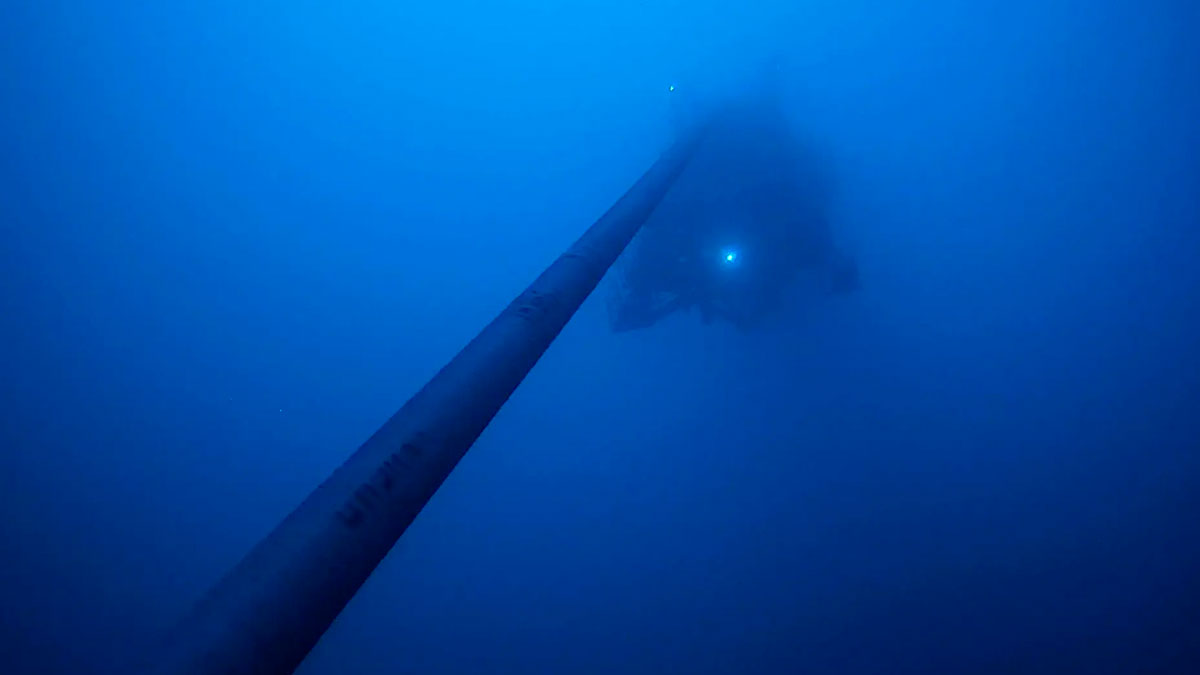
Submarine cables and pipelines are part of the modern world’s critical infrastructure, and that infrastructure is under increasing threat. Companies such as Google, Meta, Microsoft, and Amazon, along with numerous telecommunications operators, invest directly in submarine cables to meet a demand that affects the daily lives of millions of people.
At the same time, undersea pipelines transport enormous volumes of natural gas and oil between countries. Entire nations depend on a handful of undersea gas pipelines to meet their energy needs. This hidden infrastructure is coming under attack with increasing frequency.
The Early Days in the Baltic Sea
The Baltic Sea, bordering Scandinavia, northeastern Europe, and Russia, has become a hotbed of underwater sabotage. The first strike in this silent battle may have been launched by the West. In September 2022, the Nord Stream pipeline—built to carry Russian gas to Germany and other European countries, and which supplied a large portion of the gas networks in Western, Central, and Southern Europe—mysteriously exploded. On several occasions.
Nord Stream had long been a controversial project. Its critics, including the author of this analysis himself, argued that it would increase the dependence of both Germany and the rest of Europe on Russian energy. At the same time, it placed Germany at the center of the controversy for its role, alongside Russia, in undermining Europe’s already fragile energy security, while the Kremlin deliberately deprived Eastern European countries—Ukraine in particular—of both transit revenues and the influence conferred by land transit rights.
Following the explosion that “killed” Nord Stream, several countries pointed to sabotage, and a round of mutual accusations ensued. Although nothing has been definitively proven, in late June 2026 a German court formally charged a Ukrainian citizen in connection with the incident, and on August 19, a second suspect—also a Ukrainian—was arrested.
The sea is the perfect setting for sabotage with plausible deniability, since it is nearly impossible to monitor and patrol. The Baltic Sea is an easy target: shallow waters, averaging about 55 meters deep, and numerous cables and gas pipelines close enough to the surface that any of the nearly 4,000 ships that cross the region daily could reach them. Since 2022, ten undersea cables connecting the region have been cut, seven of them between November 2024 and January 2025 alone.
This is not simply a story of Russian retaliation over Nord Stream. In October 2023, the Balticconnector gas pipeline and two data cables connecting Finland, Estonia, and Sweden were damaged by a Chinese ship that dragged its anchor for more than 160 kilometers. Beijing denied any involvement. Ten months later, it admitted that the ship was responsible and attributed the incident to bad weather. How convenient.
The cable cuts continued. On November 17, 2024, a cable connecting Sweden and Lithuania was severed, depriving Lithuania of one-fifth of its internet capacity. Less than a day later, a second cable linking Finland and Germany was also cut. Investigators attributed both incidents to a Chinese-flagged vessel that had just left a Russian port. On December 25, 2024, a Russian oil tanker dragged its anchor nearly 100 kilometers across the seabed, severing four more cables.
Great Powers, Great Acts of Sabotage
The Baltic Sea is not an isolated case. The same vulnerability exists in other strategic sea lanes, although the perpetrators and their motivations vary. Taiwan may be the clearest example of what a deliberate disruption of undersea cables could entail in the context of a confrontation between major powers. In February 2023, two submarine cables connecting Taiwan to the Matsu Islands were severed within days of each other, leaving some 14,000 residents with severely degraded connectivity for weeks.
With both cables cut, residents had to rely on microwave transmission to maintain basic connectivity. Banking, public services, commerce, and ordinary communications were all affected. Taiwanese authorities identified a Chinese fishing vessel and a Chinese cargo ship as possible culprits, although they were unable to conclusively determine that the damage was intentional. However, the frequency of incidents involving Chinese vessels makes it increasingly difficult to accept the explanation that it was an accident.
The incidents continued. In January 2025, Taiwan investigated the Shunxin 39, a Chinese-crewed vessel, after an international cable was damaged near the island. In February 2025, the Hong Tai 58, a Chinese-crewed vessel flying the Togolese flag, was detained after another cable was damaged off Taiwan’s southwest coast. Taiwan ultimately accused the ship’s Chinese captain of intentionally damaging the cable—the first such accusation on the island. China denied any involvement and accused Taiwan of politicizing the incident before the facts had been established.
If these incidents are deliberate, Beijing has an obvious motive. Cutting a cable does not constitute an act of war in the conventional sense, although it is increasingly an essential part of asymmetric warfare. It does not require the launch of a missile, a blockade, or a military landing. It simply creates uncertainty and imposes costs. Taiwan’s reliance on a limited number of physical connections means that even a temporary disruption can impair military communications, economic activity, and public confidence.
Underwater Terrorism
You don’t have to be a major power to attack undersea infrastructure. The Red Sea presents a different scenario. The perpetrators are much less ambiguous: Yemen’s Houthis have attacked commercial shipping throughout the Red Sea and the Gulf of Aden as part of their campaign, which they have more recently linked to their solidarity with Gaza. What is less clear is whether the Houthis are deliberately targeting undersea cables.
In February 2024, three undersea cables were damaged in the Red Sea following a Houthi missile attack on the cargo ship Rubymar. The vessel was subsequently abandoned and sank, and the dragging of its anchor was the likely cause of the damage to the cables.
The incident disrupted communications between Asia, Europe, and the Middle East. This distinction is important because the Houthis may not have needed to deliberately cut any cables. Their attacks on maritime shipping created the conditions for the cables to be damaged as collateral damage. At maritime chokepoints as heavily trafficked as Bab el-Mandeb, an attack on a commercial vessel can become an attack on the global communications system without the attacker even having to locate a cable. Seventeen percent of global internet traffic passes through the southern exit of the Red Sea.
The Persian Gulf presents an even more significant vulnerability, although the circumstances differ. There is no comparable series of confirmed incidents of deliberate cable cutting attributable to Iran. What does exist, however, is a strategic chokepoint teeming with infrastructure, bordered by a state that has both the capability and the incentive to threaten Western interests.
Iran has already explicitly made this threat. In February 2026, the Islamic Revolutionary Guard Corps threatened to cut the cables. In May 2026, an Iranian military spokesperson warned that Tehran would impose fees on internet cables passing through the Strait of Hormuz. Subsequently, the regime-critical media outlet Iran Times warned that if anything were to happen to the cables in the strait, “it could affect banking networks, military communications, AI cloud systems, online services, and global trade.” Two major cables, FALCON and Gulf Bridge International, run through Iranian waters. Disrupting them would be straightforward.
Washington has failed to respond to the threat
Although between 90% and 95% of U.S. government communications travel through privately owned undersea cables, the country still lacks a coherent national strategy to protect them. Congress must grant the Pentagon, the intelligence community, and the Federal Communications Commission the authority to treat cable security as the national security issue it truly is, rather than just another administrative formality. The White House should establish a single federal point of contact for cable security—something the current, fragmented process still lacks.
The ocean floor has quietly become one of the most contested battlefields on the planet. A towed anchor does not trigger a NATO Article 5 response—and that is precisely why it works. Until the U.S. begins to treat the sabotage of undersea power and communications cables with the urgency it demands, the ocean floor will remain a weak point in the national security landscape, both for the United States and globally.