








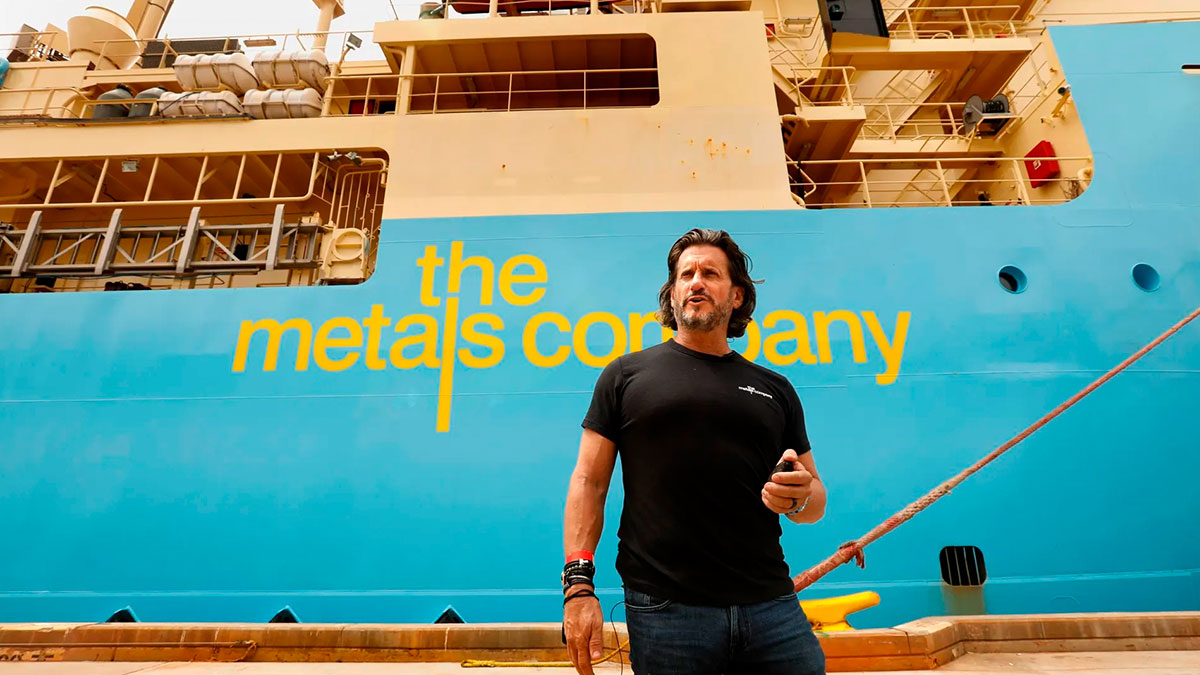
This week, the U.S. National Oceanic and Atmospheric Administration (NOAA) did something no federal agency had done in more than three decades: it published in the Federal Register a formal application from a U.S. company to mine battery minerals from the floor of the Pacific Ocean, and to explore a second area of the seafloor nearly twice the size of West Virginia.
The Metals Company aims to obtain an exploration license and a commercial mining permit covering approximately 65,000 square kilometers of seafloor, with an estimated 619 million metric tons of the potato-shaped mineral nodules that lie in the depths of the Pacific. Two days earlier, NOAA had initiated a formal environmental review for a second, larger block of 122,000 square kilometers, estimated to contain 1,020 million metric tons.
In total, this amounts to nearly 1.6 billion metric tons of rock containing nickel, cobalt, manganese, and copper, processed under a 1980 U.S. law that virtually no other country recognizes as a valid authority over international waters.
It’s worth reading on, because this goes far beyond a small-cap stock. It’s real-time proof of who controls the two-thirds of the planet that belong to no state, and a preview of how the competition for resources with China will play out over the next decade.
“The issuance of an executive order by the U.S. government regarding deep-sea mineral resources raises specific concerns,” stated Leticia Reis de Carvalho, secretary-general of the International Seabed Authority (ISA), the body recognized worldwide as the sole authority on international waters. For more than 30 years, she noted, the United States had been “a reliable observer and a significant contributor” to the ISA’s work, before deciding that it no longer needed the ISA’s permission.
Where does it really happen?
It should be noted that this does not occur near any coastline. The deposit is located in the Clarion-Clipperton Zone, an abyssal plain roughly the size of the continental United States, in the middle of the Pacific Ocean, between Hawaii and Mexico, thousands of kilometers from the mainland. According to the 1982 United Nations Convention on the Law of the Sea, that section of the ocean floor does not belong to any country: it is the common heritage of humanity.
No one disputes that the minerals are down there, or that the seabed lies in international waters. What other nations do not recognize is the legitimacy of a NOAA permit—issued under U.S. domestic law—to authorize mining in an area that, under international law, only the ISA can license.
To justify this action, the United States is relying on the Deep Seabed Hard Mineral Resources Act of 1980. But this law has been dormant for decades because it was not commercially viable. That dormant, 45-year-old law is now the vehicle for the fastest push toward deep-sea mining in history. And it fits almost perfectly with a single company.

The Metals Company spent a decade building up exploration rights in the Clarion-Clipperton Zone, backed by sponsorship agreements with three Pacific nations: Nauru, Tonga, and Kiribati. In 2021, it went public. Since then, it has invested hundreds of millions of dollars in seafloor surveys and a nodule-harvesting vessel, always banking on the ISA eventually finalizing its regulations.
That same year, Nauru demanded that the ISA finalize its regulations within two years. The ISA failed to meet that deadline, and disputes over royalties and the environment have kept the regulations unfinished ever since. Rather than continue to wait, The Metals Company established a U.S. subsidiary in 2025 and redirected a decade’s worth of work toward the path opened up by Trump’s executive order: this is exactly how a single company became the test case for the entire conflict.
There is one question that no one has answered yet: who will actually receive the proceeds if this goes through? The Metals Company’s original demands included a mandatory profit-sharing arrangement for Nauru under the ISA framework—a provision that the U.S. permit is under no obligation to honor. As anti-mining activist Phil McCabe summarized, under the U.S. approach, “there is no mechanism or requirement for any benefits to reach the sponsoring Pacific States.”
The urgency has a name: China. Demand for high-quality nickel for batteries is expected to triple by 2030, and China controls the vast majority of global cobalt refining, regardless of where the ore is mined.
These are metals used in batteries (nickel, cobalt, and manganese power electric vehicle batteries and grid storage systems, not solar panels or wind turbines), which makes this a story about the battery supply chain, not about renewable energy hardware. For the Trump administration, which is trying to build that supply chain outside of China, 1.6 billion metric tons lying at the bottom of the ocean seem less like an environmental gamble and more like a strategic escape route.
Not everyone agrees. Chinese Foreign Ministry spokesperson Guo Jiakun stated that the initiative “violates international law and harms the overall interests of the international community.” France’s special envoy for the ocean, Olivier Poivre d’Arvor, was even more forceful: “The ocean is not there to assert the leadership of a single country at the expense of all others and the multilateral process.”
Nauru, whose sponsorship gave rise to those original claims, did not oppose the U.S. approach: it capitalized on it. In a 2025 agreement with The Metals Company, outside the framework of the ISA, Nauru secured initial payments of $265 million—which could reach as high as $515 million—in exchange for supporting the transfer of the process to NOAA.
Who’s actually going to buy it?
Here’s the problem that even mining advocates acknowledge: a U.S. permit does not guarantee a buyer. Sixty-four companies, including BMW, Volkswagen, Google, and Samsung, have pledged not to purchase battery metals sourced from the seabed until internationally recognized regulations are in place.
“All attempts by deep-sea mining companies and their sponsoring governments to begin operations have been thwarted by financial and logistical difficulties, environmental concerns, and widespread public unease,” wrote Matthew Gianni, co-founder of the Deep Sea Conservation Coalition, in a statement. The group is calling for a moratorium on seabed mining.
The company at the center of all this isn’t agreeing with him—at least not yet: The Metals Company has not yet turned a profit, and two companies that once operated in this same sector—Lockheed Martin and Maersk—have already divested their stakes.
That skepticism may be misplaced. Trump’s executive order not only expedited the permitting process but also directed federal agencies to study strategic stockpiling and off-take agreements for minerals extracted from the seabed itself. Separately, the administration has invoked the authority of the Defense Production Act regarding the export of “recoverable critical minerals,” and has directed the Pentagon to build a $1 billion stockpile of cobalt and other critical minerals, aimed at reducing dependence on China.
To put it another way: the first real buyer of these seabed minerals might not be Detroit or Tokyo. It could be Washington, acquiring strategic supplies in the same way it used to stockpile oil. The Metals Company CEO Gerard Barron himself put it in similar terms this month: “A secure supply chain of critical seabed minerals for the U.S. is moving from political ambition to physical execution.”
This is not a story about whether or not a company obtains its permit. It is a story about whether the United States can assert a unilateral claim to the resources of the ocean floor—commercially, diplomatically, and legally—without global cooperation. China, France, and the ISA have said no. Washington is betting that it can. In any case, the dispute over who owns the ocean floor moved this week from the theoretical to the real—whether people have noticed it or not.