








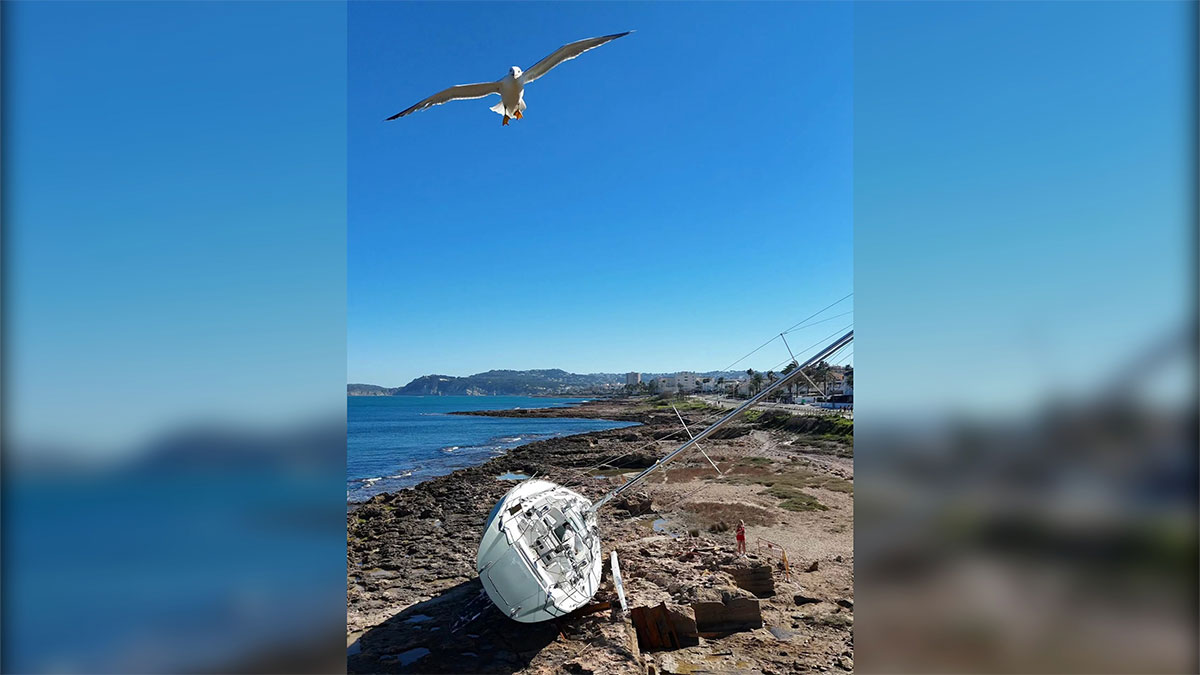
The sailboat Bau Bau ran aground on the rocks at Primer Muntanyar in Xàbia on July 24, 2025, when a severe storm tore it away from its anchorage (according to some sources, in Cala del Tangó; according to others, in the protected area of Cap de Sant Antoni) and the waves pushed it against the rocks. Since then, the boat has remained tilted on its side, at the mercy of the bad weather, becoming an unexpected photo opportunity for locals and tourists. Last November, the first attempts to remove it ran into difficulties when workers managed to install support posts to secure beams and rails that would allow the hull to be slid away, but storms forced them to suspend work for several days.
Green Light from the Coastal Authority
The Alicante Provincial Coastal Service, under the Ministry for Ecological Transition, has now authorized the salvage operations proposed by the sailboat’s owner, who submitted the project on April 30. The resolution requires that the operation comply with the technical, environmental, and safety conditions established by the agencies involved in the approval process, including the Xàbia City Council, the Harbor Master’s Office, the Generalitat’s General Directorate of Coastal Affairs, the Alicante Regional Directorate of the Environment, the Generalitat’s Directorate of Tourism, the General Directorate of the Natural Environment, and the Alicante Regional Directorate of Culture. The authorization is valid for one year, although the salvage operation itself must be completed within five days.
Although the permit has already been granted, work will not begin until October 13, since the Xàbia City Council, through the Local Police, imposed a condition that the work not be carried out in the middle of summer, as it was deemed that closing the road and the Primer Muntanyar promenade would be incompatible with the high volume of visitors during the summer season.
What the bailout will look like
The plan calls for a ground operation using heavy-duty machinery. First, the sailboat’s mast—which is 26 meters tall and weighs approximately one metric ton—will be dismantled. Next, a temporary ramp will be constructed to bridge the approximately six-meter height difference between the road and the area where the boat is stranded, and a 60-metric-ton crane—designed not to damage the land within the maritime-terrestrial public domain—will be positioned on a temporary gravel bed.
The operation will be carried out in two consecutive lifts: in the first, the crane will right the sailboat and set it down at the edge of the slope, about 40 meters away; in the second, it will hoist it again to place it on a transport gondola that will take it to a specialized facility, where it can be repaired. Once the boat has been removed, the authorization from the Coastal Authority requires that all the gravel and sand used for the ramp and the crane platform be cleared away, so that the section of the Primer Muntanyar remains intact, as if the sailboat had never been there.
From Tourist Attraction to Environmental Problem
The Bau Bau is a Polish-flagged Beneteau 62, which was once valued at 74,000 euros. It was intercepted by the Customs Surveillance Service with a shipment of hashish on board and remained impounded for several months in the port of Cartagena, until the Ministry of Justice’s Asset Recovery Office put it up for auction, on a date that sources place between May and June 2. It was ultimately sold for 85,000 euros to its current owner, who was barely able to enjoy it before the storm that left it stranded weeks later.
For months, the sailboat was a magnet for onlookers, who came to take pictures of it and even to have dinner on the shore next to the stranded hull. But its prolonged presence on the rocks has raised concerns among residents and environmental groups, as the hull has visible cracks and there is fear that a severe storm could break it apart, scattering fiberglass throughout the bay. A week after it ran aground, the City Council commissioned the company Kraken Serveis Marítims to remove more than 300 liters of diesel fuel, engine oil, and batteries to prevent a spill. With the schedule now set, the Xàbia coastline is preparing to bid farewell, starting in October, to a sight that has been part of its landscape for over a year.