







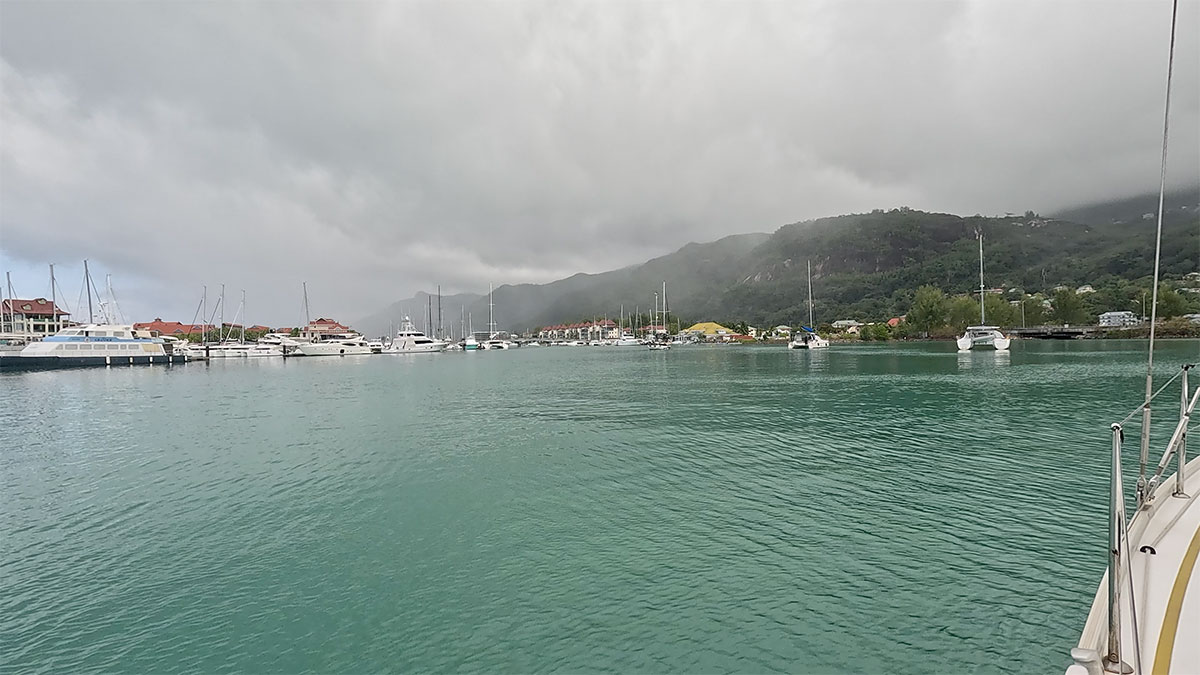
We’re starting a few days of preparation to set sail on the Sofía and begin our journey to South Africa. As for the weather, the leg to the Cape of Good Hope is particularly challenging. Constant low-pressure systems move from west to east, colliding with South Africa and moving up along the African east coast. We need to take advantage of the good weather between these systems to gain miles heading south. A mistake in reading the weather forecast could put us in very dangerous situations. The Agulhas Current flows down from the Mozambique Channel toward South Africa. This current can reach speeds of up to 5 or 6 knots. You can take advantage of it to sail quite fast. If the wind direction is opposite to that of the current, dangerous conditions arise, with very high, chaotic, and breaking waves.
I start going over everything I need to do before setting sail and make a to-do list. I wake up early, without an alarm, have a cup of coffee, and start with the interior: rearranging everything on the boat and stowing the interior of the Sofía to switch from “family vacation” mode to solo sailing. A thorough cleaning is a must. I make a list of the supplies I need. I’ll only need fresh food, diesel, and to do laundry. I don’t know why I say “only”… It takes me from 8:00 a.m. to 2:00 p.m. to get all this done.
Household chores aboard any sailboat are a real challenge. They require a bit of planning to ensure everything gets done on time and successfully. When sailing alone, these tasks take twice as long. This time, I only had to refuel 4 twenty-liter jerry cans of diesel, but often it’s between 10 and 15 jerry cans. Unloading them from the boat, loading them onto the dinghy, going to fill them up at the nearest gas station, loading them back onto the dinghy and returning to the Sofía, unloading the cans onto the Sofía, cleaning them, and stowing them away. Perhaps for these reasons, the “home aboard” chores are the ones I least look forward to doing. Once they’re done, though, it’s a sense of satisfaction and cause for celebration.
In three days, I’ll thoroughly finish up the work on the boat—including inspecting the mast and rigging. I spend a lot of time planning my next moves toward South Africa. Every day I check the weather, plot the course on the paper chart and the digital chart, research emergency anchorage spots, and talk to sailors who have already sailed through this area… The fewer things I leave to chance, the better. What I always find most tedious is all the red tape involved in entering and leaving different countries. Each one has its own procedures, and it’s often a slow process that can take days. You have to tackle these tasks with patience and a positive attitude. The record is in Indonesia. It took me two full days to complete the entry formalities… After a long wait and traveling all over the island, I finally got my paperwork in order.
Dani, the cook on a 107-meter-long Spanish tuna boat, messaged me on social media and told me they were docked at the commercial harbor where I am. He invited me on board and showed me every corner of the tuna boat. Around 1:00 p.m., the lunch bell rang, and they invited me to eat with the crew.
In addition to showing me every part of the boat from bow to stern, he explained how they fish with nets, how they locate the fish, and how they keep them alive until they reach port. Once unloaded here in the Seychelles, the catch begins to be distributed in the market. They were now in port to unload the catch from the previous month. The deck is littered with cranes everywhere, loaded to the brim with tuna, unloading at full speed. They usually fish in the Indian Ocean and use the Seychelles or Madagascar as bases for unloading, maintenance, and crew rotation. What impressed me most was the enormous main engine—a beast two decks high and about 12 meters long. After lunch, they gave me a bag of cookies and a T-shirt from the ship.
When I’m anchored for a long time, my body starts to crave movement. I begin to feel that initial nervousness you get before a voyage, and it’s time to set sail. Sometimes it’s hard to catch a good weather window for sailing. You have to be patient. While I wait, I keep working on improvements to the Sofía: I add a pulley here to make the spinnaker pole easier to handle, reinforce this area where the sheet rubs, replace the stopper loop… Little things that improve sailing performance and safety. I just have to wait a little longer to enjoy it. Soon I’ll set course for Mayotte, an island 800 miles southwest of the Seychelles.


