







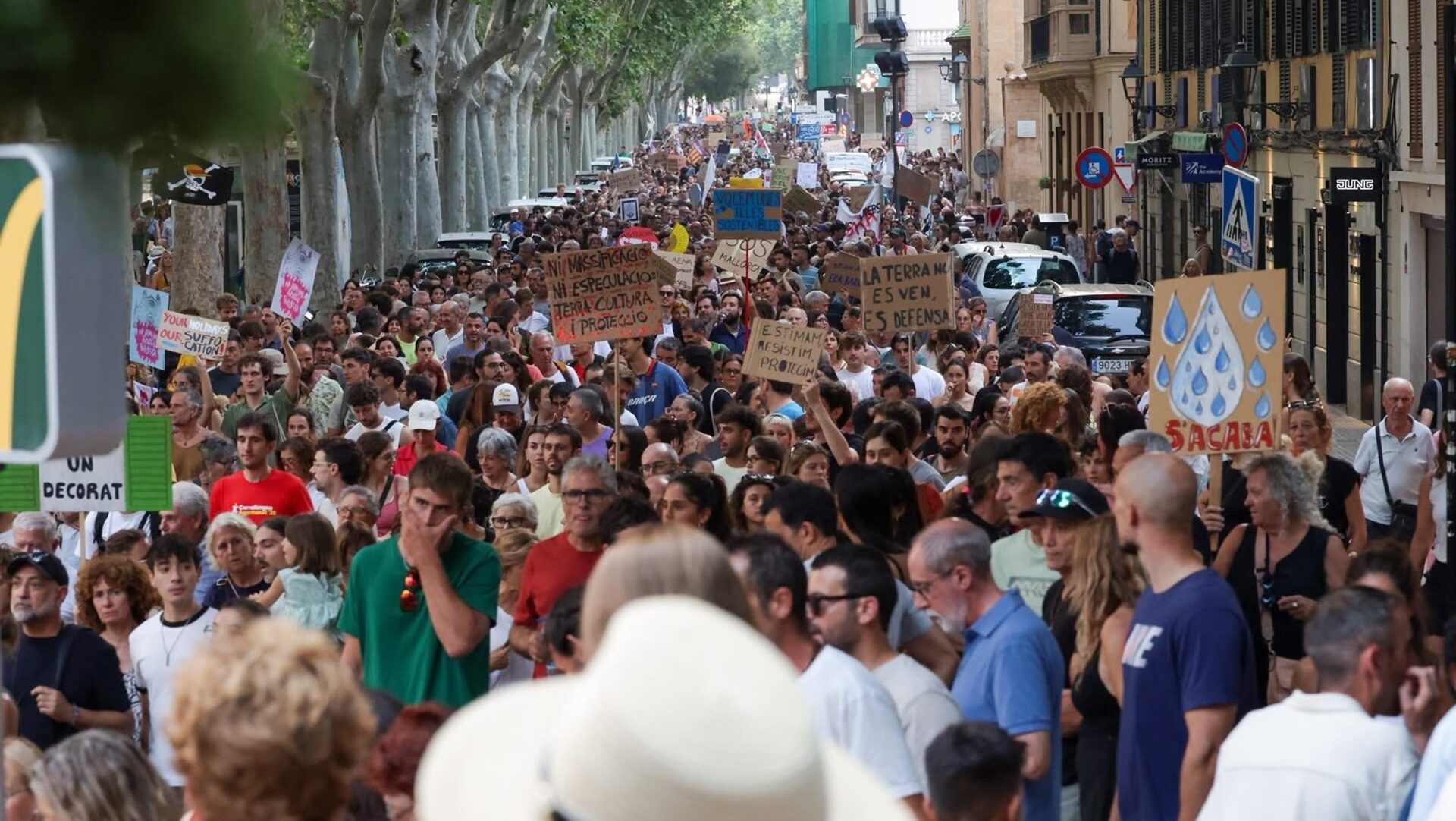
Mallorca has once again put tourism at the center of the public debate. Thousands of people marched through the streets of Palma on Sunday to demand a change in the economic model and to call for measures to curb mass tourism, a demonstration with attendance figures that varied depending on the sources consulted. The march brought together between 25,000 and 70,000 participants, a figure provided by the National Police and the Local Police, while the latter was an estimate by the organizers. In any case, it was the largest demonstration to date against mass tourism; previous demonstrations, which had been held since 2024 – the year the first protests took place – usually drew around 20,000 participants.
The success of the protest, organized by the ‘Less Tourism, More Life‘ platform, once again highlighted the growing tension between the importance of tourism for the economy of the Balearic Islands and the impact that, according to social groups, it is having on housing access, the cost of living, and the conservation of the region. The organization also stated that the march brought together a “cross-section” of Mallorcan society, from families with children to the elderly.
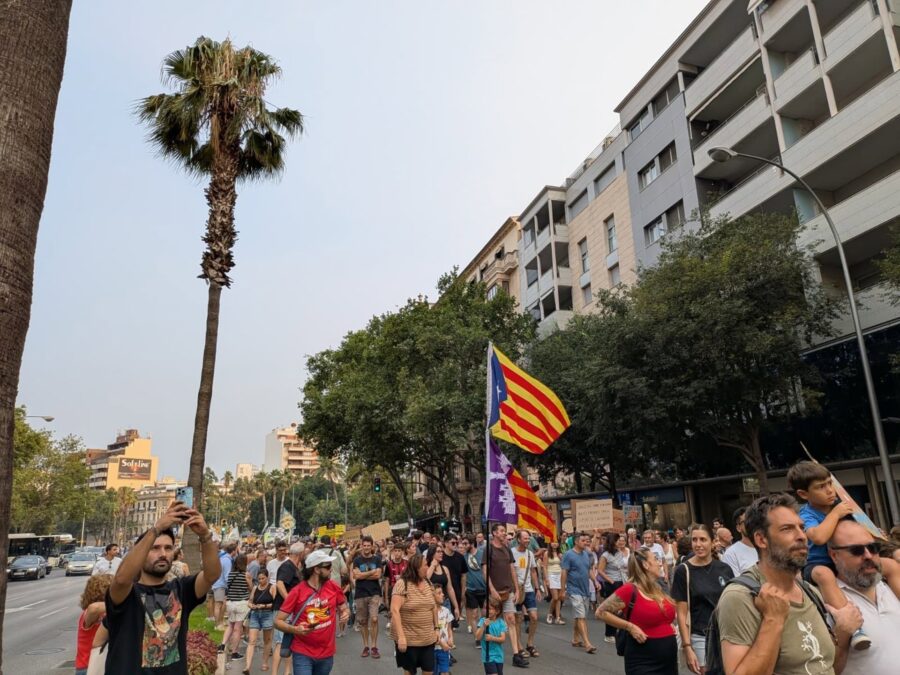
The demonstration began shortly after 7:00 PM in Plaza de España and traveled along some of the main thoroughfares in downtown Palma, such as La Rambla, Calle Unió, and Paseo del Born. At several points along the route, numerous restaurants and cafes cleared their outdoor seating, leaving the streets almost completely occupied by the protesters, while dozens of tourists watched the protest unfold from the sidewalk.
The atmosphere was characterized by traditional music from bagpipe and oboe groups, as well as batucada performances and chants that reflected the discontent felt by a portion of the local population. Among the most chanted slogans were “Tourist, go home,” “We are not servants, we are residents,” and “More Mallorcan, less German.”. The signs also summarized the protest’s central message with slogans such as “I’m not an extra in your Instagram story,” “It’s not touristphobia, it’s the right to live in our home,” “Less planes, more melons,” and “It’s resistance, not violence” were some of the most prominent along the route.
The march ended at Ses Voltes, where the reading of the manifesto and a performance by *La Balanguera* were scheduled. The large number of attendees caused moments of tension when the National Police initially restricted access to the venue. Eventually, some of the protesters managed to break through the security cordon of plastic barriers and enter the area.
Mallorca has long since exceeded its limits.
The manifesto revived the historic slogan “Mallorca at its limit,“ first used 26 years ago to highlight the effects of tourism growth. According to the organizers, this warning is now more relevant than ever. “Touristification first invaded our coasts, then our villages, and now it is taking over our homes,” they stated during the reading of the text, in which they claimed that more than 105,000 homes in the Balearic Islands are currently being used for tourism, both legally and illegally.
The platform argues that this pressure is worsening an ‘unprecedented’ housing crisis, pricing residents out of the real estate market and transforming the island into an increasingly visitor-oriented space. This is compounded by the rising cost of living, pressure on infrastructure, the loss of cultural identity, and the environmental impact of the current tourism model.
In this context, they argued that reducing tourism is no longer an ideological choice, but a necessary condition for guaranteeing access to housing, strengthening public services, protecting the island, and improving working conditions. “Less tourism means more life,” the organizers summarized, insisting that Mallorca “cannot host more cars, more hotels, more vacation rental homes, or more tourists.”
Criticism of the Generalitat Government
During the closing ceremony, the organizers also directed their criticism at the Balearic Government, which they accused of ignoring the public’s demands despite the protest now being in its third year and having the support of 145 social organizations. In their view, the containment policies announced by the regional government are insufficient and do not address the root of the problem. For this reason, they called for “clear and bold” measures that prioritize the needs of the resident population over tourism growth.
The manifesto also criticized the police response following the recent arrests of two activists linked to graffiti on real estate agency premises in Santa Maria and the investigations into other protest actions at Es Trenc. “Graffiti can be erased, but the impact of uncontrolled construction, the depletion of resources, and the suffering of those who work in the tourism sector are much harder to reverse,” the organizers argued, before those present chanted the slogan: “They are activists, not terrorists.”
The platform also took the opportunity to show its support for the demonstrations planned on other islands, such as the protests against the expansion of Ibiza Airport and the demonstration scheduled in Sóller for August 8, where they will once again call for a reduction in tourist pressure as a way to improve the quality of life for residents.
Police officers at the end of the demonstration
After peacefully completing its entire route, the demonstration ended with police charges, the throwing of objects, and at least one person injured. After the reading of the manifesto at Ses Voltes and the musical performances that concluded the main part of the event, some of the attendees attempted to continue the march toward Parc de la Mar. However, a heavy police presence blocked one of the access points from Avenida Antoni Maura, creating a climate of growing tension among those gathered.
Thousands of people remained in front of the police cordon while chanting slogans criticizing the actions of the officers, as they felt they were being prevented from continuing the protest. The police presence included dozens of officers equipped with riot gear, including shields and rubber bullet launchers. In this context, a small group of protesters began throwing objects, mainly plastic bottles, at the police line. Other participants in the demonstration publicly condemned this behavior and tried to distance the protest from the incidents.
After several minutes of tension, the National Police responded by charging the crowd and firing about twenty rubber bullets to disperse those involved in the riots. According to Europa Press, at least one young man was injured in the head and had to be treated by the SAMU 061 emergency medical services before being transported. Emergency crews also treated other people, although none of them suffered serious injuries.
The clashes between this small group of protesters—some of whom had their faces covered—and the police continued for more than an hour and led to several more police charges. Meanwhile, the majority of those present stayed on the sidelines of the riots and ensured that the gathering maintained its peaceful character. In one of the night’s most symbolic moments, hundreds of people sang ‘La Balanguera’ in front of the police cordon, a scene that starkly contrasted with the clashes taking place just a few meters away.
The gathering gradually dispersed just before 11:00 PM, about four hours after the start of a demonstration that, once again, put the debate over Mallorca’s tourism model at the center of the public agenda and which, in its final stages, was marred by incidents involving a small group of participants and the police.