








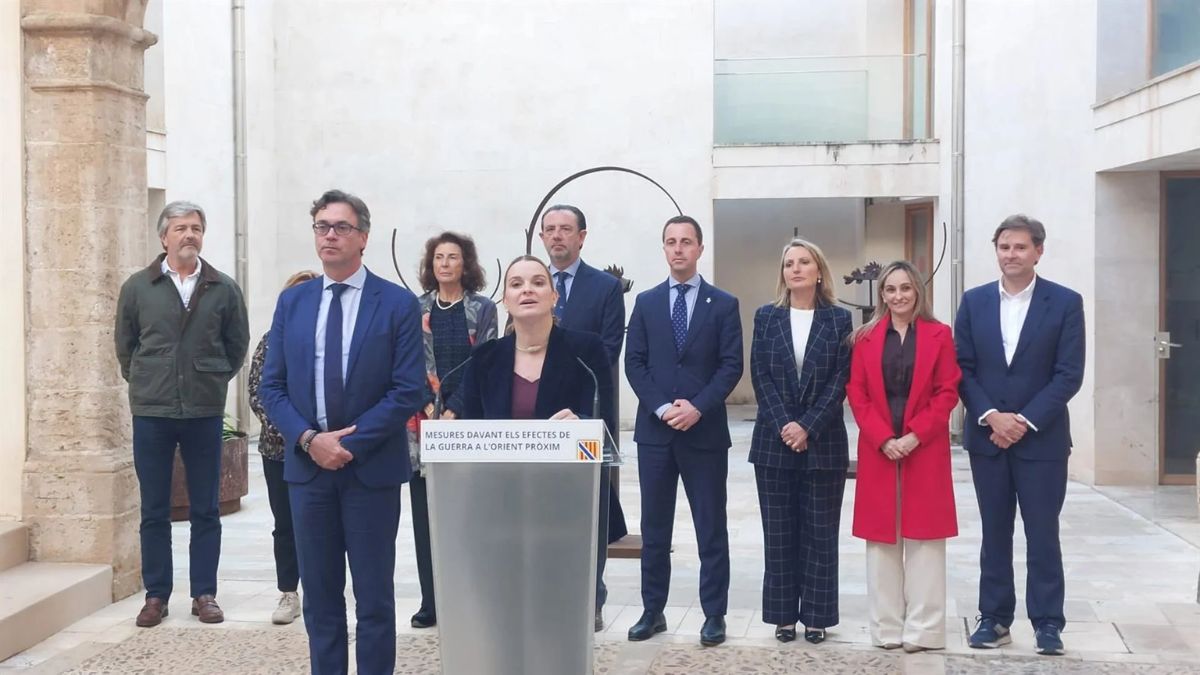
The package will be approved next Wednesday at an extraordinary Government Council meeting to incorporate input from the stakeholders involved and will be organized into five sections covering financial support, direct aid, and structural measures.
Nearly half consists of credit lines for businesses and the self-employed
First, the Government is activating a major mechanism to support the liquidity of businesses and the self-employed by mobilizing 75 million euros in credit lines through the financial institution ISBA.
These lines include a public contribution intended to finance 100% of the cost of guarantees and 90% of the interest, with the aim of "facilitating access to credit as much as possible in a context of uncertainty and rising costs."
Second, the package includes 36.75 million euros in direct aid targeted at the hardest-hit economic sectors. Of this amount, 13.5 million euros are allocated to the primary sector, with measures to offset the additional costs of agricultural and fishing diesel, livestock feed (3.5 million), fertilizers (1.5 million), and other inputs.
It has also specified that there will be €5 million for investments in agricultural operations, product processing, and marketing, along with another €1 million for vouchers to promote the consumption of local products.
In addition, €9.75 million will be allocated to the transportation sector, with specific aid for freight transport—€6 million—non-scheduled passenger transport, and the taxi sector, as well as a fund for vehicle scrapping—€2.5 million—a "demand from the sector."
Another 13.5 million euros is allocated to the industrial, construction, and retail sectors, with aid to offset additional costs for transportation and raw materials—eight million for the self-employed—support for exporting companies—two million—and a new extraordinary round of commercial and food vouchers—3.5 million.
Third, the regional government is implementing a set of measures aimed at streamlining the processing of aid, through regulatory changes to reduce the “administrative burden” and temporary programs to reinforce management teams with additional public sector staff, with the goal of “shortening processing times.”
The fourth set of measures concerns tax policies, with an estimated impact of four million euros. On the one hand, the regional income tax deduction is being reinstated to offset the increased cost of variable-rate mortgages—two million euros—in order to alleviate the financial burden on families affected by rising interest rates.
On the other hand, a 50% reduction in port fees is established for service companies, as well as a 100% reduction for professional fishermen, initially until June 30, with the possibility of extension until September 30—calculated at two million euros.
Finally, the fifth package includes a budget of 45 million euros for price adjustments in public works and service contracts, with the aim of “adapting them to rising prices and ensuring the viability of contract awards.”
On this point, he clarified that the regional administration will go to the “maximum” eligible amount but argued that they will urge the Spanish government to approve a revision of public works contracts to have a “broader” margin and include the island councils and municipal governments.
"Double and triple insularity" in aid
Prohens explained that all these measures will take into account the reality of the “double insularity” of Menorca and Ibiza, and, in the case of Formentera, “triple insularity.”
Prohens emphasized that this is an initial package of measures, with amounts subject to increase depending on how the conflict evolves, as he noted that this is a situation of "uncertainty" because "it is unclear how far the effects will reach."
Even so, she expressed her hope that it “ends as soon as possible” but acknowledged that she remains open to collaboration with various sectors to assess the war’s effects and, if necessary, approve new measures or expand existing ones.
At the same time, she specified that work is already underway on new social initiatives aimed at the most vulnerable groups, which will be announced shortly, following a round of meetings between the Regional Minister for Families, Social Welfare, and Care for the Dependent, Sandra Fernández, and social organizations.
In connection with this issue, the president was asked whether the regional government had considered measures focused on housing or whether, as president of the PP in the Balearic Islands, she could ask Balearic deputies to vote in favor of the decree extending rental agreements.
Regarding the second question, Prohens avoided answering, and on the first, she referred to the measures that may emerge from these meetings, as she emphasized that it was the parliamentary groups who requested that she address these measures separately.
Furthermore, she clarified that the island councils have already conveyed their intention to promote “complementary” measures within their sphere of competence.
The president announced that the regional government will demand “additional financial compensation” from the Spanish government for the Balearic Islands or funding for part of the package of measures, with the aim of “taking the island reality into account.”
"This is a demand that enjoys broad consensus, as all economic sectors in the Balearic Islands agree that the national measures are insufficient for the archipelago, as they fail to account for the island’s reality," she emphasized.
Prohens argued that another 40 million euros should be added to this amount, due to the impact that the reduction in fuel and electricity taxes—approved by the central government—will have on the regional treasury’s revenue.
He also expressed his appreciation for the "tone" of those attending the preliminary meetings held to develop this package of measures, noting that society "demands that we overcome partisan differences" and "live up to citizens’ expectations."