








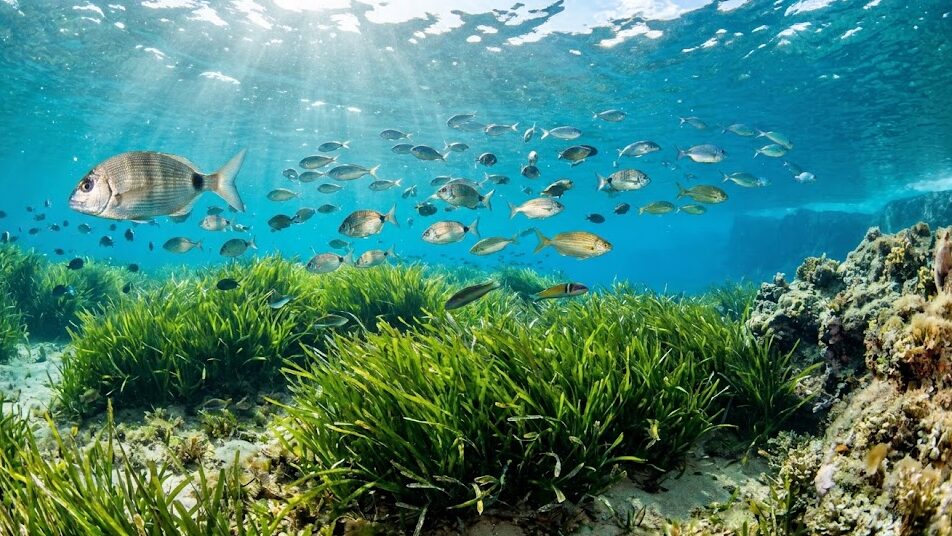
Protecting the Mediterranean requires more than just raising awareness: it requires science, adequate infrastructure, and management capable of anticipating problems. This was one of the key topics of the main day of the 8th Ibiza and Formentera Maritime Forum, during which researchers and professionals from the nautical sector proposed solutions to reduce the impact of recreational boating, restore degraded ecosystems, and prevent new threats to marine biodiversity.
In the sailing sector, Diego de la Viña, owner and founder of Essence Sailing, and Pedro Francisco Gil Martín, president of the Association of Rental Companies of the Balearic Islands (AECIB), have agreed on the need to combine prevention, professionalization, and greater control of the sector.
De la Viña proposes incorporating automatic alerts about seagrass meadows into ships’ navigation systems, through platforms like Navionics or C-MAP, to prevent harmful anchoring without relying on additional applications. He also advocates improving seabed mapping, strategically expanding echo-buoy fields, and clearly delineating authorized anchoring zones.
Preventive measures must be extended to ports. Among its proposals is the installation of connections to discharge gray and black water directly from the docks, with systems that allow these wastes to be managed as easily as the water supply. Additionally, it includes measures to prevent oil spills, limit speed in sensitive areas, and reduce noise and the impact of cleaning products.
“What’s needed is to legislate logically, with people who understand ships at the helm,” argued De la Viña, a proponent of environmental regulations with the resources necessary to ensure compliance.
Gil Martín has highlighted another problem: unauthorized practice and a lack of professionalism in the boat rental sector. According to him, poor management can jeopardize both customer safety and environmental conservation. For self-catering boat rentals, he considers it essential to provide clear instructions on navigation and anchoring, as well as to monitor routes via GPS when necessary.
The president of the AECIB also calls for more inspections and greater collaboration between public authorities, ports, and companies. The need to intensify surveillance is especially relevant in light of the figures published by Ibiza & Formentera Preservation: in 2025, 18 fines were imposed out of a total of 4,813 vessels detected anchoring on seagrass beds in Ibiza and Formentera. The foundation has called for more environmental officers and resources to ensure that information and prevention measures translate into effective enforcement.
Restoration of the seabed: science versus bureaucracy
Human pressure is not the only challenge. The recovery of seagrass meadows also depends on advances in scientific knowledge and the removal of administrative barriers.
Beatriz Marín, a researcher at the Mediterranean Institute for Advanced Studies (IMEDEA, CSIC-UIB), has explored the possibilities of restoring Cymodocea nodosa, a seagrass less well-known than Posidonia but important for coastal ecosystems. This species can colonize certain seabeds and, subsequently, facilitate the establishment of Posidonia.
Together with researcher Fiona Tomás, Marín is reviewing the available studies on planting techniques. Among the options is germinating the seeds in the laboratory and then transplanting the plants into the sea, although the methods still need to be perfected and the young plants must be protected from animals that feed on them.
In addition to the technical difficulties, there is bureaucracy, which can delay restoration work and prevent taking advantage of specific opportunities, such as recovering fragments of seagrass displaced during storms. For Marín, it is essential to streamline procedures and strengthen collaboration between scientists and public authorities. He also points out that restoration alone is not enough if the causes of deterioration are not addressed: preventing pollution and improper anchoring remains essential.
Invasive species: a threat that requires proactive measures
Prevention is also crucial when it comes to invasive species. Marta Florido, a researcher at the University of Seville, has presented her studies on Rugulopteryx okamurae, an alga with a high propagation rate that has come to cover more than 80 percent of the seabed in certain areas of the Bay of Algeciras in less than two years.
Their effects go beyond simply occupying the substrate. A study published in 2026 in *Marine Environmental Research* documents changes in the affected marine communities: some species disappear while others, more adaptable, gain ground. The result is a gradual homogenization of ecosystems, which can reduce their diversity and their ability to cope with new environmental disturbances.
According to the information available to your team, this alga has not yet established itself in the Balearic Islands. This situation presents an opportunity to act before the alga spreads throughout the archipelago. Florido emphasizes the importance of maintaining vigilance and ensuring the cooperation of fishermen, divers, and sailors to detect any potential introduction at an early stage.
Experience from other fields shows that identifying a threat in time can make the difference between preventing it from spreading and having to deal with a problem that has already taken root.
A shared responsibility
The contributions to the Maritime Forum all point to the same conclusion: protecting the Mediterranean requires coordinated action to address the causes of its deterioration. Technology can help prevent harmful anchoring; better-equipped ports can help reduce discharges; professionalization can help improve navigation practices; and research can help restore the seabed and anticipate new threats.
Raising awareness among users and businesses is a starting point, but it does not replace the monitoring, planning, or resources necessary to enforce regulations. In an environment as valuable and vulnerable as that of Ibiza and Formentera, conservation depends on translating scientific knowledge and industry expertise into concrete decisions.
The 8th Ibiza and Formentera Maritime Forum, organized by entities from the environmental, business, and institutional sectors, once again places the need to reconcile economic activity with the protection of the archipelago’s natural heritage at the center of the debate.


