







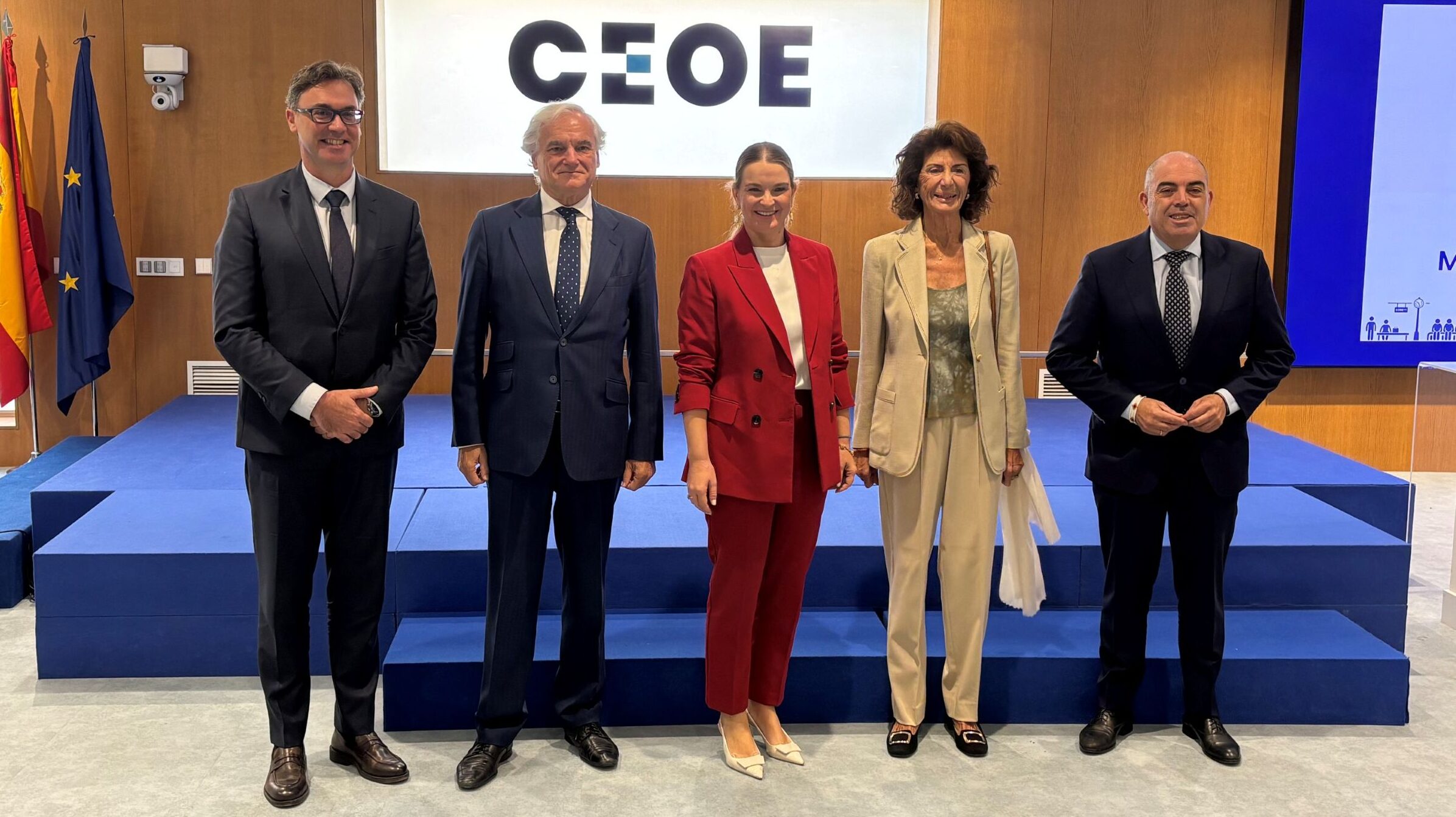
On Monday, the CEOE headquarters in Madrid hosted the conference ‘The Balearic Islands: a region of opportunities for strategic projects,‘ an event organized by the Confederation of Business Associations of the Balearic Islands (CAEB) that brought together representatives from institutions and the business sector to discuss the opportunities and challenges facing the archipelago as it undergoes an economic transformation.
The event was attended by the President of the Government of the Balearic Islands, Marga Prohens; the President of the CAEB, Carmen Planas; and the First Vice President of the CEOE, Miguel Garrido, as well as the First Vice President and Regional Councillor for Economy, Finance, and Innovation, Antoni Costa, and representatives of companies and strategic projects linked to various sectors of the Balearic economy.
During the meeting, Prohens presented the Strategic Project Acceleration Unit (UAPE), a new tool introduced by the Regional Government designed to facilitate, streamline, and support the implementation of business projects considered strategic for the Balearic Islands. The initiative aims to provide a single point of contact for project developers, coordinate the various administrative bodies, reduce processing times, and offer more certainty and predictability to those who wish to invest or develop new projects in the Balearic Islands.
The President of the Balearic Government has emphasized the need to move toward a public administration that facilitates business activity and supports investment projects, with the goal of enabling the Balearic Islands to compete for new business, technological, and innovative initiatives. “We want the next big investment and the next innovative project to look to the Balearic Islands,” said Prohens, who emphasized that simplifying procedures does not mean eliminating safeguards, but rather improving coordination and reducing response times within the regulatory framework.
In this context, the Regional Government positions the UAPE as part of a broader strategy to transform the islands’ economic model, with the goal of moving toward a more productive, diversified, and innovative economy with a greater capacity to generate quality jobs. The areas identified as strategic include innovation and new technologies, the energy transition, the blue economy, industry, research, and knowledge-based activities.
For her part, Carmen Planas has called for greater involvement and coordination between public authorities and the private sector, arguing that the needs and proposals of businesses should be part of the economic transformation of the Balearic Islands. The president of the CAEB emphasized the importance of having tools that facilitate the processing of projects and allow investment opportunities to be converted into economic activity.
Planas also highlighted public-private partnerships as one of the key factors for driving joint initiatives to support businesses, improve their competitiveness, streamline bureaucracy, and facilitate access to European funds and other sources of financing. In this regard, he noted that Decree-Law 8/2025 on strategic projects, presented last March, establishes a framework designed to facilitate and accelerate the processing of initiatives considered of particular interest for the future of the archipelago.
The president of the CAEB has linked this transformation to the opportunities it opens up for entrepreneurs and businesses, especially in areas like innovation, digitalization, and training, elements she considers fundamental to improving productivity and addressing a global economic landscape characterized by volatility and pressure on resources. “The Balearic Islands have a very attractive brand that must be used to attract talent and move toward a future of sustainable progress, ensuring that the fruits of the growth generated by our companies are better distributed and are compatible with the well-being of the citizens who live on the islands,” she emphasized.
The meeting also highlighted the Balearic Islands’ ability to attract talent, investment, and expertise, leveraging the strength of its brand and its position as a region capable of generating new business opportunities. The shared goal is to move toward a more robust and productive economic model, compatible with sustainability and the well-being of its citizens.
Business experiences and future challenges
The event featured two panel discussions in which various companies from the islands shared their experiences, projects, and perspectives on the economic future of the Balearic Islands. Among the participants were Cristina Perea, General Manager of Roiback-HBX Group; Carmen Sampol, CEO of Sampol; José María Bauzá, General Manager of Mac Insular; and Marga Martínez, CEO of Gladtolink, as well as Bárbara Barceló, the regional government’s Director General for Strategic Projects, European Funds, and Administrative Simplification.
The roundtables have allowed for addressing issues such as innovation, financing, digitalization, the growth potential of companies, and the need to create an ecosystem capable of attracting and retaining talent from different perspectives. In this regard, Marga Martínez highlighted the opportunity that the current economic transformation process represents for tech companies and emphasized the need to expand the business ecosystem and facilitate access to financing, grants, and investment.
For his part, Antoni Costa presented the new framework for strategic projects in the Balearic Islands, while Bárbara Barceló participated in the discussions, offering the regional government’s perspective on administrative simplification and the management of these initiatives.
The meeting held in Madrid has therefore served to promote, beyond the islands themselves, an image of the Balearic Islands as a region open to investment, entrepreneurship, and innovation, while also highlighting the tools and conditions necessary for new projects to develop in the archipelago.
The event also highlighted a common point between public authorities and the business community: the need to turn opportunities into concrete projects and to support this transformation with less red tape, greater coordination, access to financing, and public-private partnerships capable of generating economic activity, employment, and knowledge.


