







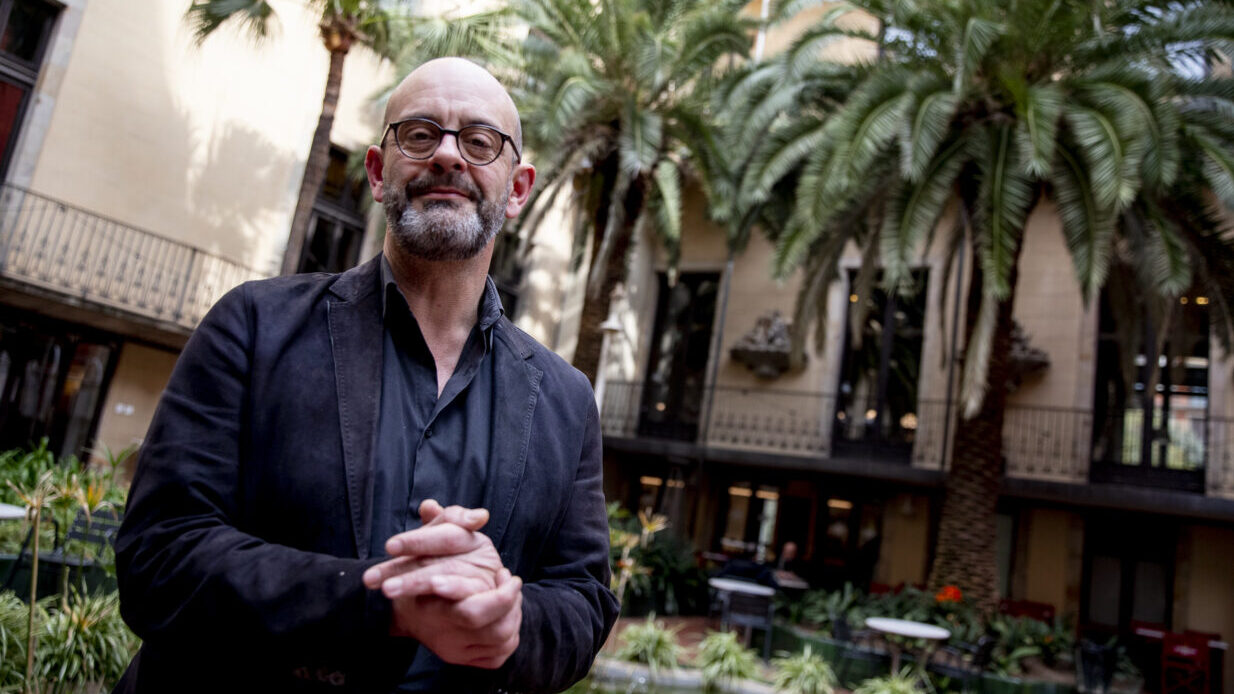
Sebastià Alzamora Martín (Llucmajor, 1972) has added a new award to a literary career characterized by poetry, the novel, and a constant exploration of memory. The Mallorcan writer has received the 2026 National Poetry Prize for his work ‘Sala Augusta seguit de Llengua materna’, published by Proa.
With a prize of 30,000 euros, the award, granted by the Ministry of Culture, recognizes a book that succeeds in bridging two seemingly disparate realms: historical memory and family intimacy. And it is precisely in this that one of the key aspects of Alzamora’s work lies.
The jury has highlighted his ability to move “with equal brilliance” from the language of historical criticism to the subtleties of domestic life. In this collection of poems, this dual perspective functions as a dialogue between collective history and the author’s most personal memories.
From a Prison in Palma to a Mother’s Memoirs
The first part of the book, “Sala Augusta,” recounts the story of the old movie theater in downtown Palma, which was used as a prison during the Spanish Civil War. Alzamora uses this setting as a starting point for a long free-verse poem in an attempt to rescue from oblivion the horrors experienced during those years.
The result is a text in which the brutality of violence coexists with a deeply lyrical perspective. The story unfolds in a context of innocent people’s deaths, the need to remember, and a call for mercy. Memory, in this case, is not presented as an exercise in nostalgia, but as a way of confronting the past.
The second part of the volume takes a radical turn in tone. “Mother Tongue” moves away from the communal setting to delve into the family sphere and pay tribute to the poet’s mother and his modest childhood.
These poems also feature the women who kept the household running while working in the footwear industry, a reality closely tied to the social history of Mallorca. In contrast to the historical violence of “Sala Augusta,” here a more intimate, restrained melancholy prevails.
The jury considers that this combination makes ‘Sala Augusta followed by Mother Tongue’ an especially valuable testament to memory and, ultimately, to the human condition itself.
Eight years later, the prize goes to a man again.
Alzamora’s selection also breaks with a recent trend: it has been eight editions since the National Poetry Prize was awarded to a man. The most recent award went to Miriam Reyes, who joins a list of acclaimed female authors in recent years, including Miren Agur Meabe, Yolanda Castaño, Aurora Luque, Olga Novo, Pilar Pallarés, Antònia Vicens, and Chus Pato.
This recognition now places Alzamora among some of the most prominent voices in contemporary Spanish poetry.
With a degree in Catalan Philology from the University of the Balearic Islands, Sebastià Alzamora began to stand out in 1994 with ‘Rafel’, a work that won the Salvador Espriu Prize. Since then, he has built a literary career that combines poetry and fiction. His novels include ‘Sara y Jeremías’, winner of the Ciutat de Palma Prize in 2002; ‘La piel y la princesa’, winner of the Josep Pla Prize in 2005; ‘Crimen de sangre’, winner of the Sant Jordi Prize in 2011; ‘La Malcontenta’; ‘Reyes del mundo’ and ‘Rabia’, which received the Òmnium Award for Best Novel of 2022. His most recent work of fiction is ‘El Federal’, published in 2024.
In the field of poetry, Alzamora has also published *La parte visible*, winner of the Carles Riba Prize in 2009, and *La pulcritud*, awarded the Serra d’Or Critics’ Prize in 2018. His work has also transcended the borders of Catalan literature and has been translated into French, Italian, Spanish, English, Portuguese, Polish, and Danish.
By winning the 2026 National Poetry Prize, the Mallorcan writer has not only added one of the country’s most prestigious literary awards to his list of honors, but has also consolidated a career in which memory—both personal and collective—has become one of his key literary themes.