








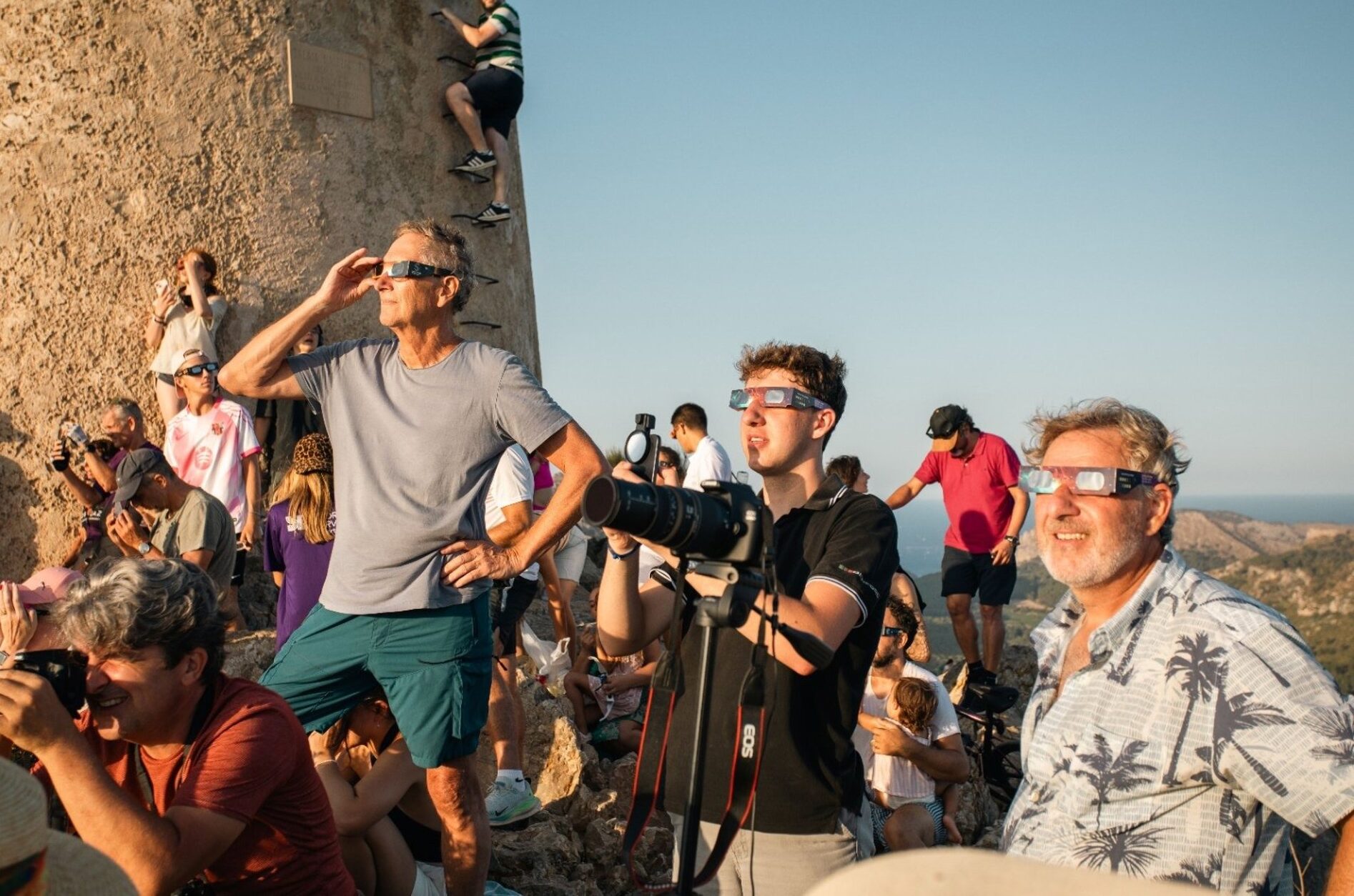
Where were you? It’s very possible that August 12, 2026, will become a historic date in the lives of millions of people. An event that serves as a key collective milestone, just as the declaration of a state of emergency on March 14, 2020, or the Spanish national team’s victory in the World Cup on July 19 could (or could not) have done. The eclipse arrived, amazed us, and disappeared, leaving behind a trail of emotions and what will be a memory whose importance is inversely proportional to the duration of the event itself. In the Balearic Islands, a privileged place to enjoy the astronomical event of the century, there was massive public interest. Emergency services recorded nearly fifty incidents, including mountain rescues, boat collisions, and falls without serious consequences. On the positive side, it was a unique experience that provided the ideal moment to celebrate with company, enjoy time with friends and family in a festive atmosphere, or even to propose marriage.
Passengers on the ferry from Ibiza to Valencia were able to witness it, as the ship had been transformed into a floating observatory by Trasmed and the Department of Astronomy and Astrophysics of the Faculty of Physics at the University of Valencia. The journey featured live scientific commentary and a guided observation session by experts from the University of Valencia. The route was specially coordinated to position the ship at the point offering the best conditions to observe the eclipse from a unique vantage point. In the period leading up to the event, an educational program for all ages was held on board, which included hands-on workshops, contests with prizes and giveaways, talks about eclipses, and Q&A sessions with specialists.
In short, the trip was not without its suspenseful moments. A quarter of an hour earlier, the only cloud visible in the sky had decided to position itself directly in front of the sun. “Everything had been perfect up to that point; no one could believe it,” says Jana Peiró, Director of Passenger Services and Marketing for Trasmed. A lone cloud that, until the very last moment, threatened to ruin the entire event. The suspense—and the anxiety—lasted until 8:20 p.m., about twelve minutes before the total eclipse. The earlier phases were missed, but in return, the audience experienced a triumphant burst of joy when the horizon cleared. It was also at that moment that the couple in question got engaged: on bended knee, with the ring in hand and a trembling voice, he proposed marriage to her in front of an unforgettable landscape. “There were people crying, dancing, screaming… It was spectacular,” explains Jana, who stresses that the Grimaldi Group’s shipping company is firmly committed to public outreach. “The solar eclipse gave us a unique opportunity to offer our passengers an unforgettable experience, and we didn’t want to miss it. The collaboration with the University of Valencia also allowed us to do so with the utmost scientific and educational rigor.”
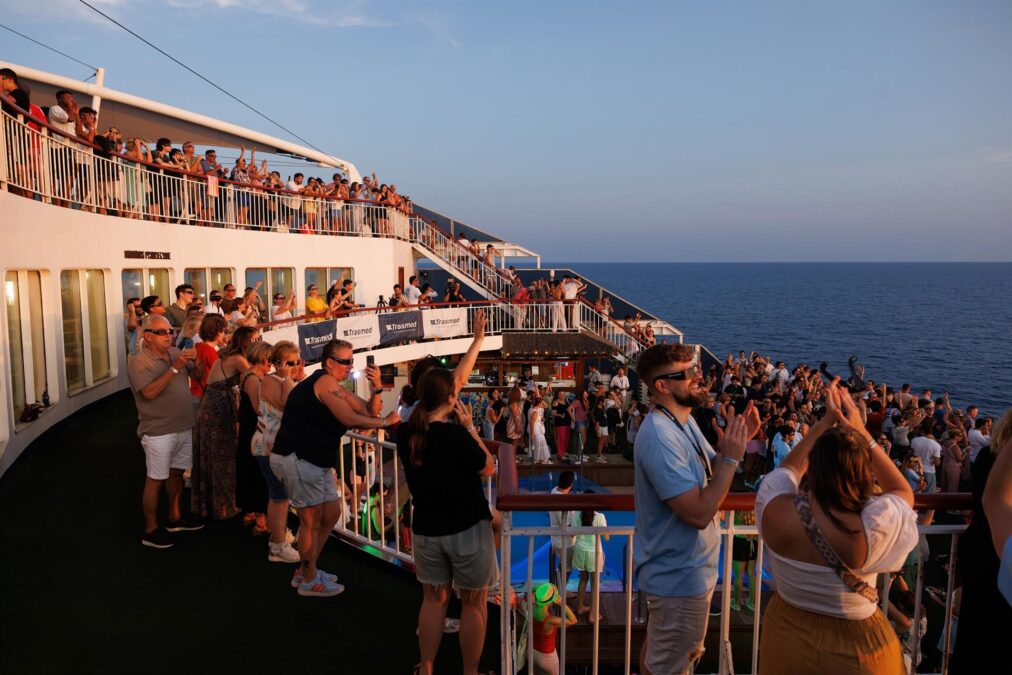
For his part, Pablo Cerdá, head of the Department of Astronomy and Astrophysics at the Faculty of Physics of the University of Valencia, highlighted the value of initiatives like this to “bring the science and research carried out at the University of Valencia closer to the public, as well as to share this unique experience.” More than 700 people, including tourists and local residents, enjoyed the event from the ferry. In fact, many people took the round trip.
Cloud cover spoiled the show in some parts of the Serra de Tramuntana, such as at Es Port d’es Canonge. On the other hand, Platja de Palma was one of the most popular places to observe the phenomenon, whether from land, sea, or air – from people’s balconies. The Palma City Council estimates that around 60,000 people watched the eclipse from this spot, where visibility was perfect. The Mirador des Grau, on the mountain road between Andratx and Estellencs, was packed with hundreds of tourists despite having been designated as a professional observation site for astronomers. Meanwhile, the ‘Moors and Christians’ groups from Calvià took to social media to complain about the complete lack of control in the Sa Pinada dune area in Santa Ponça, which was so overcrowded it was almost unbearable.
Sebastià Barceló, who has a doctorate in astrophysics and is a research associate at the University of the Balearic Islands (UIB), described the observation witnessed in the Balearic Islands as “a unique experience.” Speaking to Europa Press, he highlighted that at the climax of the astronomical phenomenon, “you could feel the wind pick up, the colors fade, the temperature drop, and the crickets start to sing.” Barceló acknowledged that, during the months leading up to the eclipse, he had approached the event as a scientist, although on Wednesday he chose to end the experience by enjoying it like a “layman.” It’s no surprise that he said he had been waiting for an event of this magnitude since he realized he wanted to pursue astrophysics.
The final evaluation of the emergency operation
The eclipse also tested the ability of emergency services to respond to a phenomenon that caused massive movements of people and a lot of activity in natural areas and coastal regions. The General Directorate of Emergency Services recorded 46 incidents related to the emergency response operation deployed for the eclipse between midnight on Wednesday and midnight on Thursday, according to the official report. This figure provides an initial snapshot of the operational impact of a day characterized by extraordinary levels of displacement.
Traffic was the main focus of the response. Emergency services handled 12 traffic-related incidents, in addition to a motorcycle accident and a roadblock. The pressure on the roads was exacerbated by a larger number of people gathering in open spaces and in places from where they were observing the astronomical phenomenon. Activity in natural and coastal environments also played a significant role. In total, four people were reported missing, one on a beach and three in mountainous areas. Additionally, emergency crews responded to two endangered hikers, two rock slides, and a fall from a height.
The report also highlights the maritime aspect of a day when the coast became one of the preferred locations to observe the eclipse. There were three incidents involving boats, as well as an operation related to a drifting vessel and a complaint also related to a boat. In the health sector, services attended to two medical consultations and one medical emergency on the beach. Additionally, five public safety emergencies and one accident at a commercial establishment were recorded. Emergency services also had to handle a variety of other incidents: five safety-related interventions, two reports, one case of illegal lodging, and a search operation, among other incidents.
Upcoming events
The most significant figure in the report is not just the total number of incidents, but the fact that emergency service operations had not yet been concluded at the end of the reference period. After midnight, several traffic incidents remained unresolved in Sóller and Sant Antoni, while the search for missing persons continued in Pollença and Andratx, all without serious consequences.
The second vice president of the regional government and minister of the presidency, Antonia Maria Estarellas, on Thursday praised the preparations for the eclipse, which she described as a “success.” In this regard, she congratulated the public for their “exemplary behavior.“ She also expressed her satisfaction that they could “talk about the eclipse as a celebration” on a day with few incidents. As she emphasized, “the main objective has been achieved,” which was “to ensure that the public was informed.”
These are the final echoes of an unforgettable day. The next major eclipse for the Balearic Islands will be on January 26, 2028. The moon will not completely cover the sun, but will leave a dazzling ring visible around it (unlike the bright halo of Wednesday’s total eclipse) late in the afternoon, which will be clearly visible throughout the archipelago. As an intermediate event, a partial eclipse with 80 percent coverage will be visible from the islands on August 2, 2027. For the next total eclipse, we will have to wait longer than the expected lifespan of anyone present at the last one: another will not occur until November 17, 2180. This fact reaffirms the unique nature of the recent experience.