







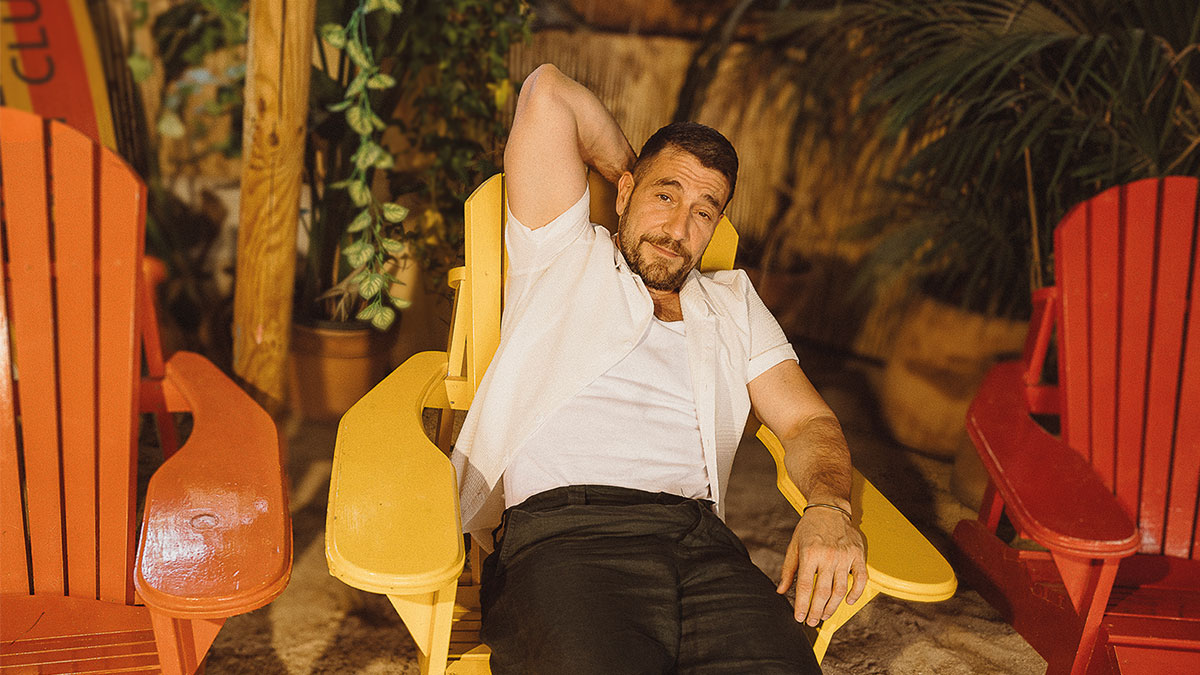
A cultural ambassador for his hometown of Getafe—the city that took in his family following their internal exile after the Civil War—Raúl Tejón (1975) has also been passionate about the sea since childhood and, more recently, has become an Open Water diver: he has dived in El Hierro, the Maldives, the Dominican Republic, and Cuba. He gained worldwide fame for his role in the Netflix series *Machos Alfa*, but he has a career spanning more than three decades as an actor and theater director. Having cut his teeth on series such as *Ana y los 7* and *Al salir de clase*, he is gearing up for a busy few months with two premieres that are sure to leave a mark: he has already wrapped filming on his directorial debut, shot between Getafe and the Canary Islands, which explores sexual assistance and the right to die with dignity. Before that, on September 11, he’ll premiere *Gracias, equipo* on Netflix, a clever comedy directed by Diego Núñez Irigoyen featuring a dream team of actors.
What’s your impression of this shoot?
Well, the title, to me, says it all: Thank you, team. It couldn’t have been better. I hadn’t seen Pedro Casablanc in 25 years, since *Policías*, and it was like a married couple’s reunion: we went out to dinner and to the movies together every weekend. Alexandra Jiménez was a real discovery; Maribel Verdú was wonderful; Blanca Martínez Rodrigo is a powerhouse actress, the queen of improvisation; and Diego, the captain, who directs with a lot of room to play: 17-minute takes, no cuts—he keeps asking for more and more… And we’re all getting into the spirit of it. From day one, we’ve been playful.
You’ve been doing this your whole life, even with Ana Obregón on *Ana y los 7*.
Three great seasons playing Carolina’s boyfriend. I’m one of those actors who, fortunately, hasn’t had to turn to anything else—with my ups and downs, but I’ve always been there, in movies, TV shows, and theater. Now Netflix is coming out with *Machos Alfa*, bringing national and international exposure, but I was already there before.
How do you feel about being stopped at every airport?
People stop me everywhere. It’s part of the job, and as long as it’s not dangerous and they’re polite, I’m fine with it: it’s easier and faster to let them take a picture than to explain to someone why you don’t want to. People are usually friendly. What I find harder to handle is not getting called for work; at least when they see you so often, it saves you from having to go to a casting call.
You say things that are very ordinary but are becoming less and less so: your commitment to the LGBTIQ+ community, your class consciousness…
The middle class doesn’t exist. It’s a fabrication designed to keep us complacent and pitting us against one another. After six months of unemployment, all of us who consider ourselves middle class are in ruins. I don’t want to forget where I came from: I was born in the ’70s in Getafe, during the heroin epidemic of the ’80s. My mother’s family fled Ciudad Real to escape repression for being the children of Republicans: my great-aunt cleaned at a casino, my great-uncle was a shoeshine boy, and my grandfather was a baggage handler. This year I’m Getafe’s cultural ambassador,
and I owe the city a great deal.
In fact, you’ve chosen your city as the setting for your directorial debut—how is it coming along?
It’s already been shot and completed, between Getafe and the Canary Islands, which offered me the mountains and open spaces I couldn’t find in Getafe. It deals with sexual assistance: what might lead someone to become an assistant, whether it’s a commodification of a need, whether someone might take advantage of it… But above all, I was interested in the story of my protagonist, Emilio Walle. It also addresses dying well, not just living well. Death is the only certainty we have, and yet we go through life with our backs turned to it. We’ve lost our rites of passage; funerals are no longer respected or mourned—we have to get back to work. And when illness strikes, they treat us like children, just like they do with the elderly: they can take your children away but you can’t make decisions about your own life. It’s like obstetric violence: before, they told us how to give birth; now, they tell us how to die.
Speaking of filming in the Canary Islands, what does the sea mean to you?
Rest, for starters. If I want to relax, I go to the sea. It’s part of my childhood: I’ve spent every summer by the sea—in Pontevedra, Valencia, Gandía, and Murcia, where my family has a house on the Mar Menor. I need to get wet and feel the sea to unwind. I started scuba diving relatively recently, but with great enthusiasm, and I’m even more eager for the people around me to try it too—I even convinced my teammates from Machos Alfa. I want my nephews to get their certification, and I want my sister—who already has it—to start diving again. When we go back to the Maldives, I want everyone to be able to dive with me, because the sea is like flying—it’s freedom. I’ve dived in El Hierro, the Maldives, the Dominican Republic, and on Cuba’s coral reef. I don’t sail, but I have sailed before and I love it: I don’t get seasick, and seeing the open sea is a unique, priceless feeling.
How are you coping with the end of *Machos Alfa*?
It’s very sad for all of us. We get along as well as it seems: we’ve been like a family that now has to go its separate ways, and that’s just how life is. It breaks our hearts to think that we won’t have those five months a year together, traveling and sharing experiences, because we’ve been such a fun-loving team—not just artistically, but technically as well. There’s a very special energy that comes through. And the best part isn’t just the success, but where it has taken us: thanks to that exposure, someone thought this guy had a story to tell, and that’s why I’ve been able to make my first movie now.
THE FULL INTERVIEW IS IN ISSUE 7 OF NAUTIK, NOW ON SALE.