








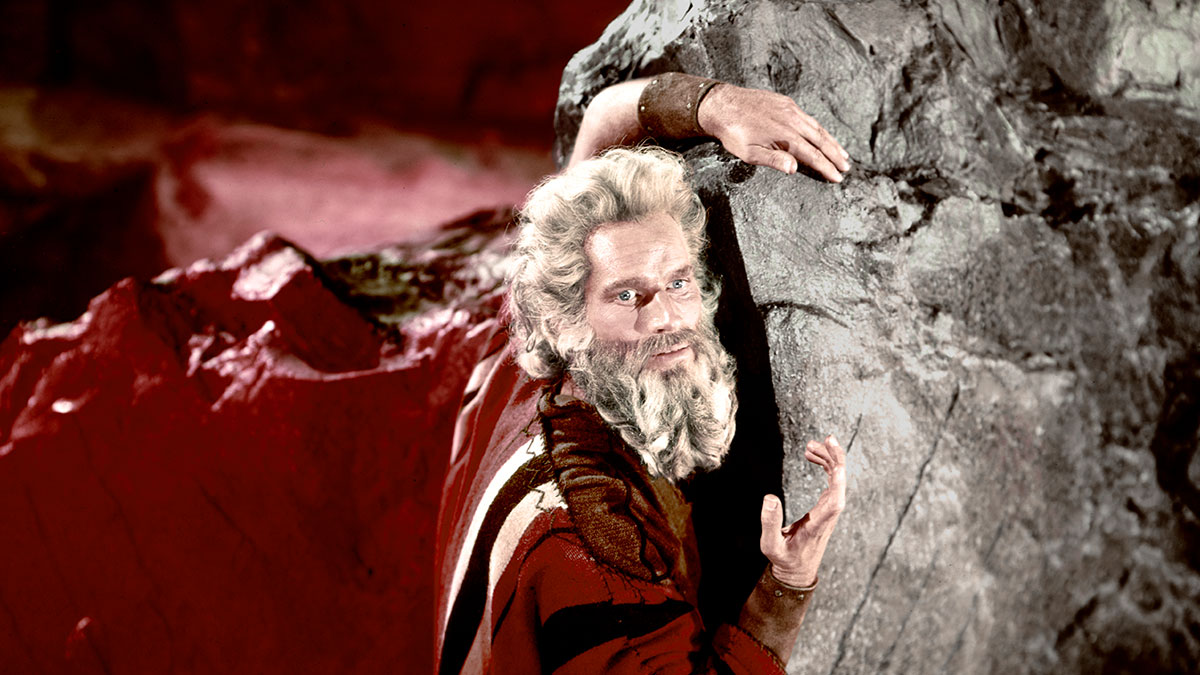
October marks the 70th anniversary of the premiere of *The Ten Commandments*, a film that continues to amaze audiences today with its sense of epic grandeur—especially in what is possibly the greatest seascape ever filmed: the moment when Moses, played by Charlton Heston, parts the Red Sea in two without CGI—using only models, mirrors, and nearly 1.5 million liters of water.
It was the 1950s. Digital technology was the stuff of science fiction, and computers took up entire rooms. However, director Cecil B. DeMille and his special effects team, led by the visionary John P. Fulton, set out to recreate one of the most iconic miracles in history. The result not only won the Oscar for Best Visual Effects but also set the standard for what imagination and craftsmanship could achieve on the big screen.
Far from being a simple camera trick, the sequence was a massive undertaking that combined on-location filming in Egypt with elaborate studio work on Paramount’s backlots. Creating the imposing walls of water was an engineering challenge.
For the study, an inclined ramp was constructed on a 1:5 scale, approximately 10 meters high and 24 meters long. More than 1,360,000 liters of water (about 360,000 gallons) were poured over this structure through 15 manually controlled hydraulic valves, creating a massive waterfall. To add texture and realism, wooden slats were placed along the ramp, causing the water to break into waves and churning currents.
But the magic wasn’t just in the water—it was in the projection. The footage of this waterfall was projected in reverse, creating the optical illusion that the water wasn’t falling but rising to form a wall. This same method was applied in reverse to create the opposite wall, giving the impression that the sea was splitting in two. To complete the illusion, actors and cars were filmed using the chroma key (blue screen) technique and superimposed onto the seabed, which was recreated using plaster rocks and wire mesh. The seams between the different layers of the image were concealed with hand-painted matte paintings of rocks and stormy skies.
The post-production process of combining all these layers was even more complicated. It took more than a dozen original negatives to composite the various elements: the Egyptian landscape, the actors, the two walls of water (each requiring three negatives), the matte paintings, the sky, and the waves breaking at the beginning of the sequence. The entire effort, which included scenes filmed on the shores of the Red Sea and at Paramount Studios, took six months of work and cost one million dollars at the time—an astronomical sum for a single special effect.
The scene was the technical highlight of a film that, despite its nearly four-hour runtime and a budget of $13 million, became a box-office phenomenon, grossing more than $122 million. Although critics such as Bosley Crowther of The New York Times noted that the seabed looked “as smooth and dry as a racetrack,” audiences were amazed. Today, 70 years after its release, DeMille’s “miracle” remains a reminder that the best special effect is one born of necessity and creativity—not just an algorithm.


