








The days in Carita Bay, still in Indonesia, fly by in a blur. During the day, around 8:00 a.m., jet skis and motorboats start cruising around, towing tourists on banana-shaped floats. I keep working on my to-do list to get the Sofía ready for the Indian Ocean. Whenever they pass by and see me on deck, they shout, “Hello, mister.” Later, around 11:00 a.m., the fishermen come to cast their nets. There’s quite a bit of traffic until 5:00 p.m., when suddenly everything quiets down and all you can hear is the call to prayer from the mosque and the waves on the beach. With the calm, I take a shower and have some time to myself. Usually, around 3:00 p.m., it starts to rain and the showers roll in; however, the nights are clear and starry. The Sofía rests motionless; the bay protects us from the wind and the swell.
It’s been seven days since I last set foot on land, so I decide to go explore the shore to stretch my legs. I leave the boat tied to a post at a small pier just a few meters from the stern of the Sofía. I know the locals who usually spend the day sitting in their chairs, in the shade of a small shed. Some work at what they call the marina. I see only one wooden boat and two fishing boats that, with the low tide and shallow water, are stranded on the seabed. Others are fishermen. I head out to the main street, about 50 meters away. It’s a road—at first glance, well-paved—that runs along the entire west coast of Java. On both sides, it’s lined with dilapidated wooden stalls where locals take shelter from the sun while selling fruit or vegetables. Since it’s a tourist destination, there are hotels about eight stories tall right on the beach. From Thursday through Sunday, it gets crowded; the beach fills with people, and cars take over the main road, using the shoulder as a parking lot. I find a warung—a typical local eatery—and it starts pouring. The temperature drops, and a cool breeze blows in. I have fried rice with chicken and lemon tea for 1.75 euros. I return to the boat and rest while the Sofía is soothed by the falling rain.
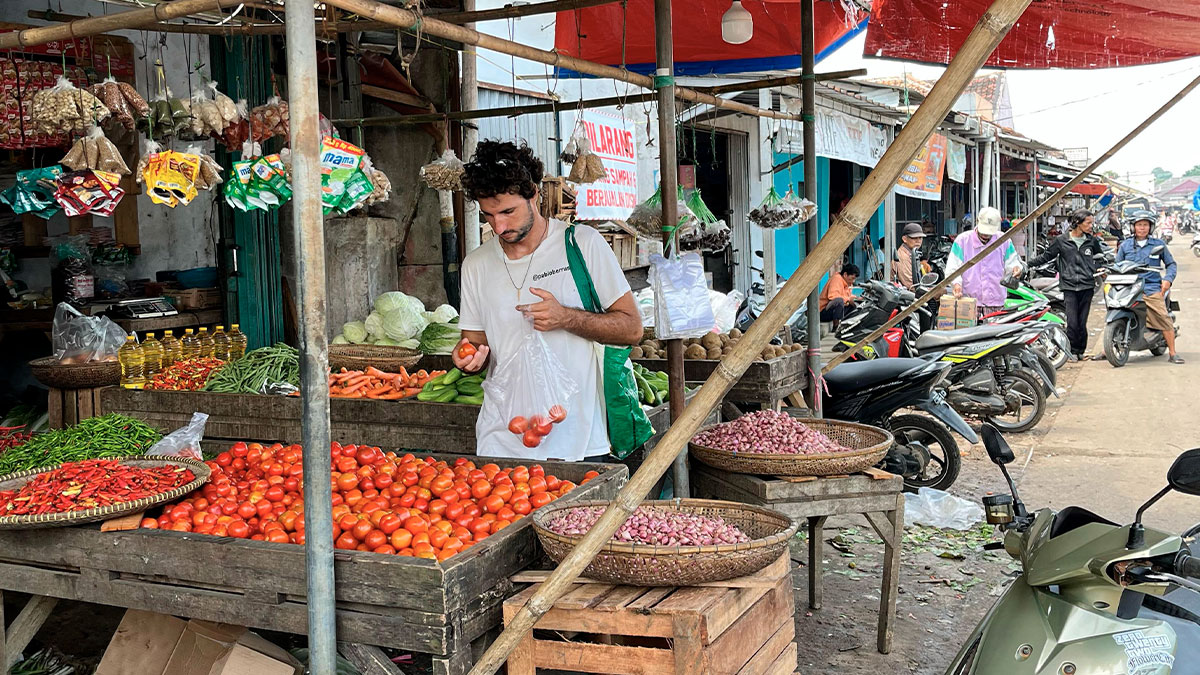
Today’s mission is to get some fresh food and diesel. I unload six jerry cans onto the boat to take them ashore and fill them up at the gas station. At the “marina,” I meet a young guy who offers to give me a ride in his pickup truck to the gas station. Within half an hour, I’m back on the Sofía, and all that’s left is to stow the cans. I head back ashore, and this time, on a motorcycle, he takes me to the traditional market in Carita. It has the same main features as the one in Belitung: lots of traffic between stalls, motorcycles, and people walking, plus a bustling atmosphere. I’m able to buy everything I need, and everything looks great. We take a stroll through the center of the market and head back to the motorcycle. Back at the “marina,” he helps me load everything onto the boat. He doesn’t want anything in return; he won’t accept anything. I invite him on board for a coffee and show him the Sofía. He tells me he’s never seen the inside of a sailboat before and that not many sailboats pass through that area.
Even though it’s a crowded bay full of tourists, it has its charm. But most importantly, it has kept me sheltered from the winds and the swell at all times. That’s how I’ve been able to work comfortably and rest peacefully. All the people tend to gather south of the “marina,” so on my evening walks, I head north along the coast. There’s a trail that runs close to the coastal rocks. I usually head in that direction, and if the sky isn’t too overcast, you can see the reef surrounded by fish. From this trail, you can see the main road, which runs further inland.
Work is progressing at a good pace, and we’ll soon be ready to set sail and head out into the Indian Ocean. Now we just need a good weather window for the crossing. It’s a good time of year, weather-wise, to make this crossing. The wind isn’t quite as steady as it should be yet, but as the days go by, I can see that things are falling into place. It’s difficult to find a perfect weather window because for the first few days I’ll be leaving the area under the influence of Indonesia. Showers, shifting winds, rain, and somewhat choppy seas will be the order of the day for the first few days of the crossing. As for the rest of the crossing, since the weather is so changeable, we’ll just have to take it as it comes. Every day, in the new update, something changes—another sign that the winds aren’t yet behaving as they should for this time of year. We’re being patient—there’s no rush. We’re ready to set sail, but it will still take us five more days to find the weather window that suits us best. We have to make the most of this window because it doesn’t look like there will be a better one in the coming days.
The pre-departure jitters are setting in. The weather has been very changeable, and I’m unsure what it will actually be like; nevertheless, we set sail for the open ocean. I just wanted to get back to ocean sailing. This is incredible. I can feel the Sofía back in her element, covering miles with her sails unfurled toward Cocos Keeling, an island located 600 miles southwest of Indonesia.