








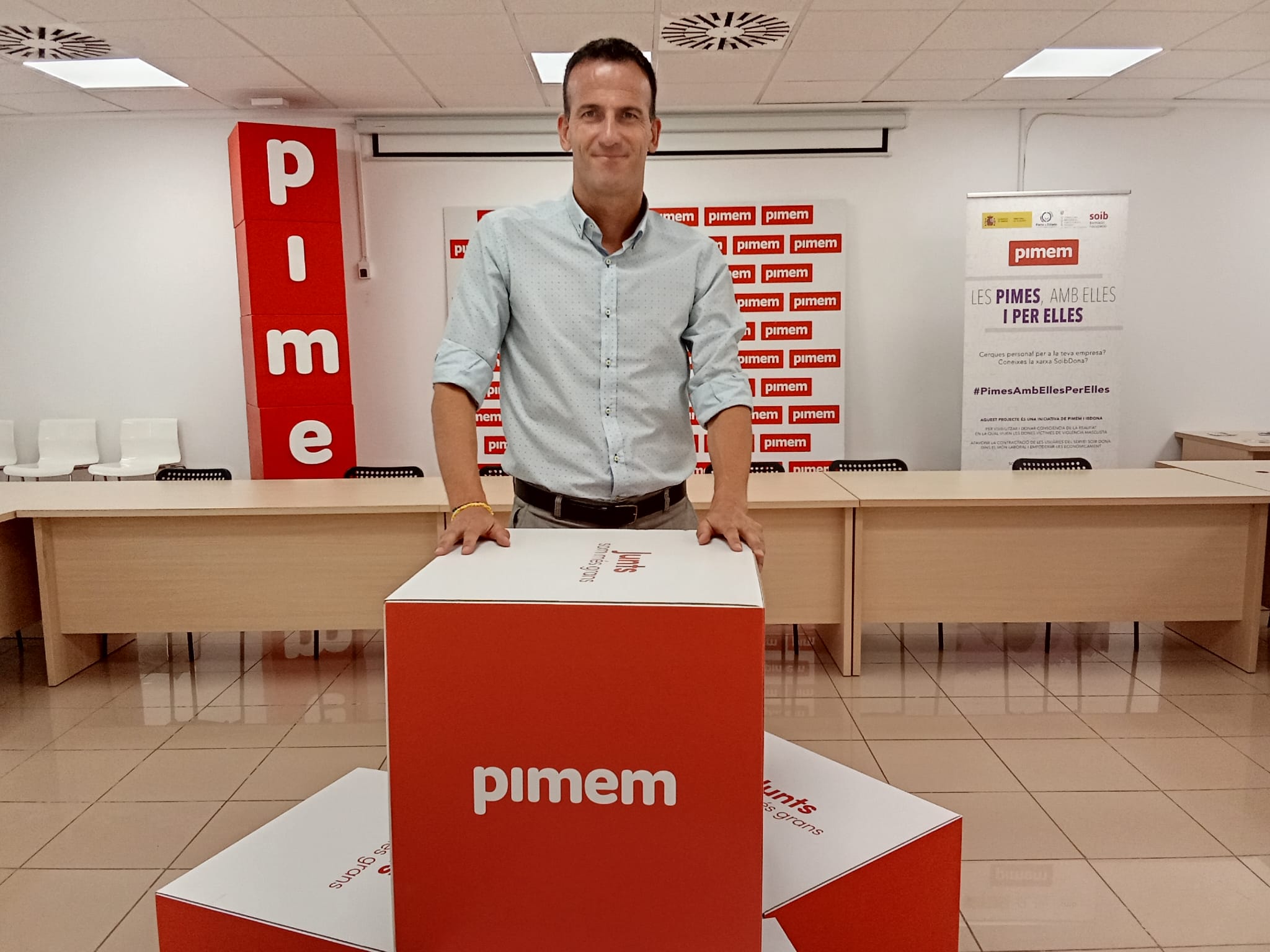
Jordi Mora (Arenys de Mar, Barcelona, 1975) has been president of the Federation of Small and Medium-sized Enterprises of Mallorca (PIMEM) since November 2016. In July 2024, he was re-elected to this position for a third time, becoming the first person in the organization’s history to serve three terms. A graduate of the ESADE Business School in Barcelona, he has maintained the critical spirit he has had since day one on all fronts and is not hesitant to criticize any of the three pillars of the economy: firstly, the employers themselves, for their role in young people’s disinterest in their work; in second place, some of these employees, for abuses related to absenteeism; and, finally, the public administration, for issues such as delays in reviewing pandemic-related aid or the legal status of self-employed workers. He argues that we must remain critical, even in the midst of a tourist season that, he acknowledges, “is going like a rocket.”
It’s already July. How would you sum up the first half of the season?
The season is going very well. The 2025 season was already very good – better than the 2019 one – and simply matching it would be a success. In fact, the numbers we have on the table regarding price increases, occupancy rates, and other parameters indicate that this season is similar to last year’s, and even 5% to 10% better. So I would say the season has taken off like a rocket, although that doesn’t mean everyone is doing well; it always varies depending on the neighborhood, location, and type of accommodation. But in general, the tourism sector has been on an upward trajectory for the last three years.
Has the impact of the geopolitical conflicts been less severe than initially feared?
We are in a global climate of uncertainty, and that is not good for either the economy or businesses. That said, considering everything that has happened, I believe the impact on the Balearic economy has been minimal, fortunately. Why? Mainly because we are building on a very strong positive momentum in the tourism sector. We are also at historic highs in job creation. The impact, therefore, has been moderate.
Despite preliminary reports from the regional government suggesting a worse scenario than in 2022 regarding Ukraine, the impact of this war has been less severe.
Yes, the impact was greater back then. The current situation is not like what we experienced during the first months of 2022, when the war in Ukraine broke out and we saw extremely high inflation. Here, we have now seen a 3 percent increase in inflation, which has affected fuel prices, and this is impacting the primary sector, the industrial sector, and small businesses and the self-employed, who are the ones suffering the most. We must remember that we weren’t receiving gas and that we had significant problems with energy costs, which skyrocketed. Furthermore, it lasted for a longer period. It’s true that there was a lot of fear at the start of the war in Iran, since 20 percent of the world’s oil passes through that region, and that has a major direct impact on the prices of practically everything. It’s a problem, first of all, for businesses, because they have to pass on the cost increases, and secondly, for workers, because it means a loss of purchasing power.
Would you say that the labor shortage problem is under control?
Not at all – there’s still a huge problem. We’ve had more than 24 consecutive months of record job creation, and we’d have to go back to 2002 to find similar figures. There are only 26,000 people unemployed across the archipelago – a ridiculously low number. And more than half of those 26,000 aren’t looking for work because they are in opposition or because they have other priorities. We are short on both skilled and unskilled labor. The solutions we used in the past are no longer viable: during the tourism boom, we used to bring in workers from abroad, but now we can’t do that because of the housing crisis. Those past solutions no longer work, so we have a structural problem that we’ve been fighting for three years and for which we see no solutions.
Is absenteeism still a significant problem for employers in the Islands?
Absolutely. In the past, during times of crisis, people were afraid of losing their jobs and would go to work even if they were sick. Now we see the opposite: many people don’t show up for work for any reason, and they know that if, for any reason, they leave the company, they will find another job within 24 hours. This affects between 3% and 5% of the GDP of the Balearic Islands. We estimate that the impact is between 1.7 and 3.3 billion euros a year. And these are burdens that companies have to bear. Our primary care system—which is responsible for issuing sick notes—is completely overwhelmed, trapped in bureaucracy and a lack of resources. One short-term solution would be to provide it with more resources, and another would be for the mutual insurance companies to participate in the process by taking on the responsibility of issuing the sick notes. Long-term absences also need to be controlled. But we don’t see any solution. Ninety-five percent of the companies in the Balearic Islands are micro-businesses, with between one and ten employees. If one or two workers are absent from one of these companies, the rest of the staff has to do their work in addition to their own. And an excessive workload leads to more sick days. It’s chaos, because you can’t plan or organize the work or staffing levels.
How are they taking it?
We’re hearing from business owners with 15 to 20 employees that they hire extra staff simply to cope with absenteeism. In other words, they hire more employees than they need in workforces of fewer than 30 people, just to be on the safe side and to account for the sick days they know are inevitable. We’ve seen it in the lodging industry, in restaurants, in retail, in bakeries… There are people who have had staff out sick for half a year. It’s an endemic problem that has now been accepted as the norm. This is made worse by the fact that, according to the two collective bargaining agreements that affect the most people in the Balearic Islands—those for the retail and restaurant sectors—the first four days of sick leave are paid for by the company. All these costs come out of the companies’ profit and loss accounts. It’s an extremely high cost and a structural problem.
Is the excess supply precisely part of the problem?
There are cases where it’s clearly abuse on the part of the employee. There’s a music festival and the next day people don’t show up for work at stores or restaurants. And there are three-month sick leaves that require some kind of proof from Social Security, with no one following up on it. Employers have to put up with it. Between medium-term sick leaves, long-term ones, and weekend absences, it’s a real mess.
Is this something that mainly affects young people, or is it a more widespread problem?
I would say it’s a cross-cutting issue, but if we had to single out one group… Aside from the “professional absentees,” who can be found at all ages, we could undoubtedly say that perhaps we haven’t managed to win over young people.
Say your mea culpa.
Yes, yes, yes. Forty years ago, the differences between generations weren’t so great. They shared a similar set of values. Today, a 25-year-old, a 40-year-old, and a 60-year-old have completely different outlooks on life, and it’s not easy for them to understand each other. I think companies need to take a fresh look at this, especially if we want to attract young people, who are no longer so concerned with career prospects, but are more interested in flexibility, free time, and other aspects.
What is the situation of self-employed workers?
Being self-employed today is a very risky venture. In the Balearic Islands, we have 110,000 self-employed people during the high season, which is an enormous figure. Proportionally, we are one of the Spanish regions with the most self-employed people, and that’s a good thing because it means we are a nation of entrepreneurs, but it’s incredibly difficult to get by. We need new legislation designed specifically for the small-scale self-employed. Changes are needed in labor law, the social security contribution system, and taxation… We don’t care which party is in government, but it has to make things much easier for us. We have self-employed people living in poverty who, when they reach retirement age, will receive an absolutely miserable pension. Self-employed people in retail or the restaurant industry who have their own staff that earns more and pays more in social security contributions than they do. A radical change is needed. Ultimately, it’s the self-employed and small businesses that sustain the middle class, and that is what we are destroying.
What is the business community’s view on the reviews of aid granted during the Covid-19 pandemic?
First of all, we are pleased that, at that time, 855 million euros were distributed – the largest grant in the history of democracy and, moreover, a non-repayable grant. But we are making very little progress with the reviews. There are not enough cases to justify this taking so many years. That is the first criticism. And it’s the fault of both the previous and current administrations. Companies that misappropriated the funds must return the money, but it already feels like a witch hunt is underway. We’ve seen some cases where, on technicalities, doubts have been raised and companies have been forced to return the grants. If this continues down this path, we will see many administrative disputes. I think the authorities should approach this with flexibility. I don’t think what they are doing makes much sense.
Having been so critical of the operation, they will be pleased with the failure of the BBVA-Sabadell merger.
We opposed it because we are in favor of competition. The banking sector is an oligopoly in which the number of institutions constantly decreases over time. Anything that reduces supply is bad for businesses and consumers. If the acquisition offer had been reversed, we would have opposed it just the same. The fewer banks there are, the more their dominant position is strengthened and, consequently, the worse the terms they will offer will be. We opposed it, among other things, because we saw that credit for businesses would be reduced. This would have been one of the first consequences of the merger. The second would have been a worsening of the terms and conditions. There would also have been a substantial reduction in the number of offices in the Balearic Islands: between 18 and 25 fewer offices, according to a study we conducted. And this would have also led to the layoffs of a large number of workers.


