








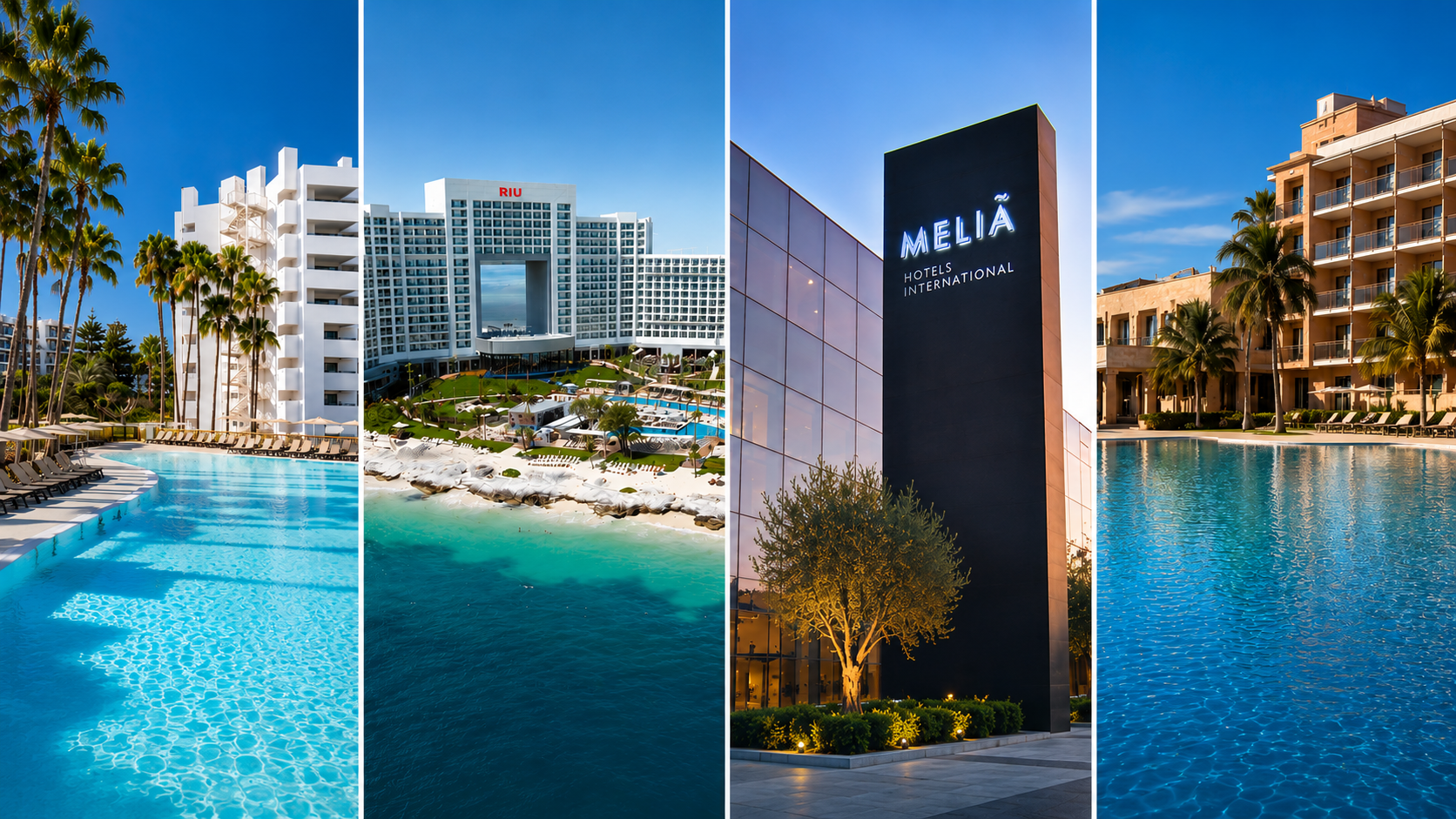
The four giants of the Balearic hotel industry are consolidating their growth at a time of boom for global tourism. The 2025 results attest to the strong performance of the Big Four among the Mallorcan chains – Meliá, Riu, Iberostar and Barceló – although some of them are in the midst of complex generational succession processes and various contingencies in their Caribbean territories, the foreign part of their empire is being battered by atmospheric and Trump-related phenomena that have negatively affected business. In this regard, the current crisis will largely shape business performance this year in the Americas.
Barceló Hotel Group
It was the last to announce its results, just this week. The broadcaster makes it clear: last year was the best in its history. Revenue slightly exceeded €7.867 billion and net profit was €131.4 million. In both cases, this represents a 4%year-over-year increase. These revenues come not only from hotels, but also from travel agencies and its airline, Iberojet. Additionally, EBITDA was €676 million (a 2% increase), and the fiscal year closed with negative net financial debt. A reflection, the company notes, of the “strong cash generation.”
Barceló is one of the Mallorcan hotel groups currently undergoing a generational transition. Marta D. Barceló Fontirroig has been appointed president of Crestline Hotels & Resorts, while Antonio Tovar Barceló has taken on the role of CEO of the Group for Latin America. Both have been appointed to the management committee. Simón Pedro Barceló was named CEO and will continue as chairman alongside Simón Barceló, who, however, has resigned from the board of directors of Barceló Corporación Empresarial.
Over the past year, the chain has opened 33 new properties and launched operations as part of its growth strategy in key markets such as Mexico, Italy, France, and Morocco, where it has acquired new hotels. It has also launched operations in Bahrain and strengthened its presence in Cape Verde, Portugal, the Maldives, and Dubai. Plans for 2026 include investing 350 million euros in the acquisition, renovation, and repositioning of hotel assets worldwide. Its presence in Cuba is very limited, with only two hotels under its management. Both belong to the Gran Caribe Group – which is affiliated with the Cuban Ministry of Tourism – and have no connection to the military conglomerate Gaesa. The decline in tourism has led to the closure of one of them, the Occidental Arenas Blancas, and the concentration of all activity at the Barceló Sol y Mar.
Meliá Hotels International
The chain led by Gabriel Escarrer closed the last fiscal year with a net profit of €200.2 million and consolidated revenues of €2,078 million, representing increases of 23.6% and 3.2%, respectively. EBITDA stood at approximately 545 million euros, while debt fell to 778.6 million euros. The company ended the year having signed agreements for 51 new properties and opened 28 hotels. Revenue per available room grew by 5.4% worldwide, placing Meliá at the forefront of the industry in this area. Looking ahead to 2026, the opening of at least 30 new hotels is planned, with the expansion of its ZEL brand as the central focus of these operations.
For Escarrer, 2025 was “a year that, once again, tested the resilience of the tourism sector.” Meliá’s CEO states that “our results exceed those recorded in our historical series, reaffirming our strategic path to continue building a more resilient company that guarantees all our shareholders greater long-term value creation.”
The withdrawal from Cuba, confirmed this week with the divestment of about fifteen hotels in response to the threat of U.S. sanctions, has been the company’s latest major move. The hotel group has stated that the impact of the decision “is limited,” as the vast majority of these hotels were already closed. Power outages, food shortages, and the loss of air connections have been strangling the sector for months.
RIU Hotels & Resorts
It was a more than positive year for RIU. The chain recorded gross revenues of 4.188 billion euros (3% more than in 2024), making it the Spanish hotel group with the highest revenue if strictly considering its hotel business. The year also ended with the chain reaching the milestone of 100 hotels after the recent addition of the Riu Ventura in Mexico. The fiscal year was not without its ups and downs. Luis Riu, the chain’s CEO and now the only visible figure after the departure of his sister Carmen, highlighted two particularly negative factors on social media. “Two things have penalized us: the weakness of the dollar against the euro, as we generate a significant part of our revenue in dollars due to the volume of our operations in the Americas, and Hurricane Melissa, which devastated Jamaica in October and forced us to close our seven hotels on the island. This had a major impact on our revenue.”
The company continues to open hotels this year in destinations such as London, Zanzibar, and Phuket, marking its debut in Thailand. Significant renovations will also take place in Mexico, Cape Verde, Morocco, Costa Rica, and Spain.
Regarding the generational succession process, Carmen Riu‘s retirement in May 2024 marked a turning point in the company’s leadership. In accordance with the agreements reached by the Family Council and approved by the group’s Board of Directors, fourth-generation family members have been gradually assuming new responsibilities. The group describes these changes as “the result of a long training process” and explains that they have been structured with “the skills and different sensibilities of the family members” in mind, in order to adjust the roles and profiles as effectively as possible.
Iberostar Hotels & Resorts
It recorded a 14% increase in revenue, reaching €5.1 billion. The family-owned company Fluxá had a solid year, with results that also include those of World2Meet, its travel division. The hotel division generated 2,369 million euros in revenue, almost 9% more than in 2024, while EBITDA increased by 17% (60% for hotels alone), confirming its financial health. The chain has announced a €1 billion investment plan through 2028, with the goal of expanding the brand and renovating its assets.
Among its most recent developments are the opening of the Iberostar Selection Riviera Cancún and, looking ahead to 2026, its expansion into East Africa with the Iberostar Selection Zanzibar and the Iberostar Selection Montenegro. Sabina Fluxá, the company’s CEO, highlighted that the results confirm the “strength of a model oriented toward profitable growth with a long-term vision.” She also noted that the company faces the future with a firm commitment to continue adding value through its model of responsible tourism.
Like Meliá, the situation in Cuba has forced the chain to cut back its operations, closing 12 of its 18 hotels on the Caribbean island – specifically those linked to Gaesa.