








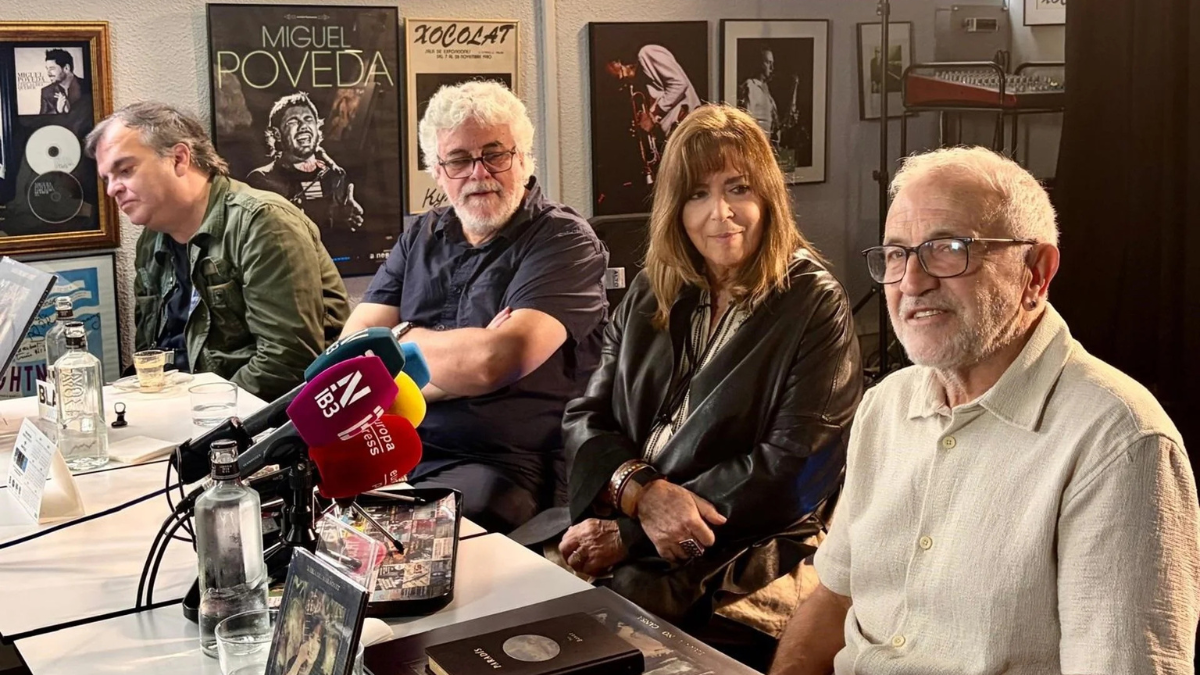
At a press conference in Palma, Bonet announced that on November 27 she will present the album on the island with a concert at the Auditòrium, where she will perform the nine songs that make up the album. Tickets go on sale this Friday.
The artist herself served as the project’s artistic director, also handling production and arrangements alongside musician and producer Toni Pastor.
The album was recorded, mixed, and mastered by sound engineer Mateu Picornell, a regular collaborator of Bonet’s, who also contributed to the project from an artistic perspective.
The singer has particularly praised the work of the record label Discmedi Blau. “I’ve never encountered a record label that has worked as hard on one of my albums as this one has,” she said. She also highlighted the involvement of the group of musicians participating in the project, consisting of guitarist Marc Grasas, double bassist Marko Lohikari , violinist Benjamí Salom , percussionist José Llorach , Llorenç Barceló on keyboards, and Tomás Salom on castanets.
“From now on, future albums must also be like this, with everyone participating,” noted the artist, who explained that many of these musicians have been part of her recent career since her return to Mallorca.
“Higher standards” for future work
She also admitted that the album’s warm reception by audiences and critics has set higher standards for her future work. “I demand of myself that the next ones be better,” she said.
The album’s design features images by Mallorcan photographer, filmmaker, and cinematographer Pepe Bonet, drawn from his portrait series ‘Paradís’. The images feature textures that inspired the album’s format, shaped like a fold-out accordion.
A song for the victims of the DANA
During the presentation, Bonet explained that one of the songs on the album, titled ‘S’aigo no’, is dedicated to the victims of the DANA in Valencia, a region with which, he admitted, he has maintained a close personal connection for decades and where he has “friends and loved ones.”
The artist acknowledged the impact of following the aftermath of the floods and noted that the song stems from the questions that, in her view, many of the affected people continue to ask themselves. “What I’ve said in the song is what people are saying,” she stated, before asking why there are still people who haven’t been able to return to their homes or why there hasn’t been enough discussion about some of the victims.
“Why are there people who don’t have a home? Why haven’t we talked about those victims we should be talking about?” the singer asked, noting that the situation remains “outrageous” months after the disaster.
In this regard, she argued that the political class is “there to help people” and lamented that many issues remain unresolved surrounding a tragedy that, as she noted, remains very much present in the collective memory of Valencia.
Gender-based violence and deaths in the Mediterranean
Bonet explained that several of the album’s songs stem from social concerns that have accompanied her for years and which, as she acknowledged, she finds impossible to ignore, including gender-based violence and the normalization of certain tragedies.
“Sadly, we’ve grown accustomed to seeing women being killed, and that’s very hard to bear,” lamented the singer, who warned that murders continue to occur despite efforts to combat this scourge. “There are still the same number of people being murdered every month, every two months, every year,” she added.
She asserted that many of her compositions stem from questions she asks herself about issues she considers unjust and that affect society as a whole. “I feel the need to ask the questions I used to ask myself and that I used to ask everyone,” she stated.
Finally, she expressed her concern about the deaths of migrants in the Mediterranean and the treatment received by those fleeing poverty, war, or persecution. Bonet lamented that society might become desensitized to these situations and called for a stronger collective response to realities she considers “inhumane.” “I wouldn’t want us to get used to seeing people die in our Mediterranean,” she concluded.