








Shipyards around the world are taking on extraordinary projects. From next-generation hybrid exploration vessels to record-breaking superyachts, today’s superyacht projects are larger, bolder, and more technically ambitious than ever before.
Let’s take a closer look at six remarkable superyachts currently under construction, as well as the design innovations, engineering feats, and ingenious solutions that set them apart.
Project Ziggy
Its most ambitious feature: the record-breaking glass exterior

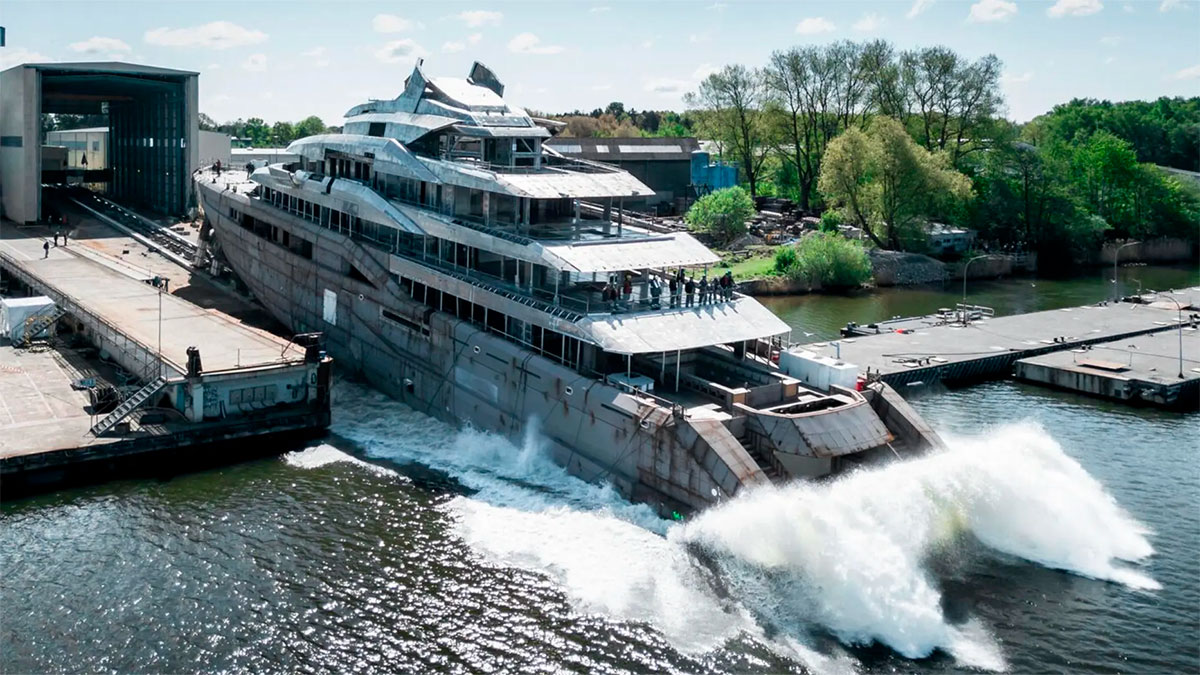
Glass plays a leading role in Project Ziggy, the 332.6-foot (101.4-meter) superyacht being built by the German shipyard Lürssen. Its exterior (designed by Harrison Eidsgaard) is defined by extensive glazing and a series of cascading aft decks, with large structural glass elements that bring natural light deep into the interior. The result is a muscular yet contemporary silhouette that makes the most of its considerable proportions, featuring glass elements that rank among “the largest” ever built by Lürssen.
As befits a superyacht of its size, Project Ziggy features several pools and wellness facilities spread across its decks, while the bow deck is certified for helicopter operations.
The yacht has reached the milestone of its technical launch and is now moving into the outfitting phase, with delivery scheduled for 2028.
Project Spyder
Its most ambitious feature: the multi-level beach club

The beach club is usually the most important social space aboard a superyacht. Project Spyder takes it a step further with a spacious, multi-level layout designed to bring guests as close to the water as humanly possible. The 288.7-foot (88-meter) Admiral project owes its angular and decidedly modern exterior to Espen Øino, while the interiors are the work of the Italian firm FM Architettura.
Among its most notable features is a 110.8-foot (33.8-meter) pool located directly above the 1,076-square-foot (100 m²) beach club, with three glass panels in the floor that allow natural light to filter into the space below. Four retractable platforms extend the beach club outward and create additional waterfront terraces, while the convertible bow deck can accommodate everything from a pickleball court to a helipad.
Project Spyder is expected to be delivered in 2027.
Project Faith
Its most ambitious feature: the circular mezzanine

Double-height spaces are not uncommon on a superyacht, but Project Faith takes them in a different direction with a circular mezzanine that connects the main and upper decks. It’s an ingenious use of the impressive 2,560 GT interior volume of this 288.7-foot (88-meter) yacht, and this architectural feature lends the central salon a true sense of scale.
The owner’s suite, measuring 1,356 square feet (126 m²), is another highlight, along with accommodations for 14 guests, an infinity pool at the stern, and a spacious beach club. The exterior design is by Tim Heywood, while H2 Yacht Design is responsible for the interiors.
Project Faith is being built at the Dunya Yachts shipyard in Istanbul, and delivery is scheduled for 2028.
Project 410
Its most ambitious feature: its size

Royal Huisman had to expand one of its shipyards to accommodate Project 410. This is the simplest way to illustrate the scale of the ambition behind this 278.8-foot (85-meter) vessel, which will soon become the world’s largest single-masted sailboat.
As usual, the project has been shrouded in secrecy: we know the designer (Frers Design, based in Milan) and that its carbon-fiber mast and boom, along with the integrated sail system, will be supplied by its sister company, Rondal. The rest of the details have come to us in occasional glimpses, with just a handful of photographs to make the wait more bearable until its launch and delivery next year.
Project Y729
Its most ambitious feature: the engineering platform

Building custom yachts is, by its very nature, a time-consuming business, so Oceanco is exploring whether the process can be made more efficient without sacrificing the owner’s ability to customize it. Project Y729 is the first yacht developed through the Dutch shipyard’s Simply Custom program, which combines a well-established technical platform with a design approach that goes far beyond a semi-custom model.
Its design team is outstanding (Espen Øino for the exterior and Zuretti Design for the interiors), but it is the engineering that has earned it a spot in this article. Its direct-current electric propulsion architecture is designed to make more efficient use of onboard energy, while an ingeniously designed dry exhaust system channels engine emissions up the mast and away from guest areas. The system is rounded out with catalytic converters and diesel particulate filters to help reduce emissions, and it is compatible with HVO (Hydrotreated Vegetable Oil) renewable fuel.
Project Y729 is currently at Oceanco’s facility in Alblasserdam, where final outfitting work is underway in preparation for its delivery in 2027.
Project Master
Its most ambitious feature: conversion

Not all superyachts start out as a sketch. Project Master, for example, began life as a commercial deep-sea rescue vessel before being acquired for an ambitious conversion at the Dutch shipyard Icon Yachts. The 229.6-foot (70-meter) vessel is being transformed into a long-range explorer designed to sail to remote regions for underwater exploration and scientific research.
Espen Øino is responsible for redesigning the exterior (I sense a pattern here), while the British firm Winch Design is in charge of the new interiors. Among the most exciting additions are a dedicated research laboratory, as well as space for a research submersible. A commercially certified helicopter deck and two large tenders further expand its expedition capabilities.
Project Master has moved into the outfitting phase following a successful technical launch, and is expected to be delivered in 2028.


