







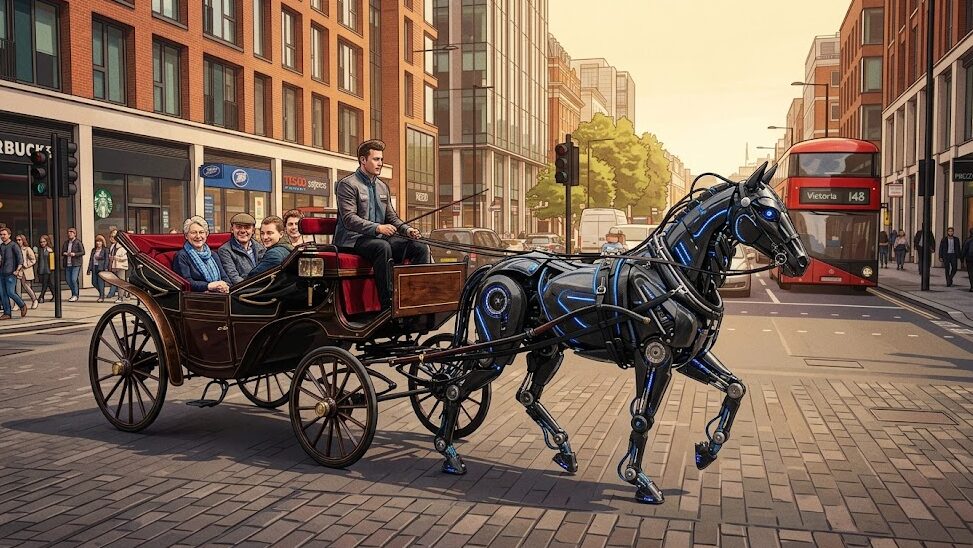
Some cities are defined by their monuments, while others by the image they project to the world. Palma has its own character: the leisurely pace of horse-drawn carriages, the sound of horseshoes on the asphalt, and the sightseeing tours through some of its most iconic spots. But what happens when a postcard image from the past begins to clash with the sensibilities of the present? Can a tradition continue to occupy the streets of the future without reinventing itself?
These issues are at the heart of the debate over replacing horse-drawn carriages with electric vehicles. It’s a discussion that goes beyond their appeal to tourists and addresses issues such as animal welfare, changes in customs, and the transformation of the urban landscape.
With this goal in mind, Satya Animal, Progreso en Verde, and Arde have organized a demonstration this Saturday at 6:00 PM in Palma. The march will start from Plaza Porta de Santa Catalina and will travel along La Feixina, Paseo de Sagrera, and Avenida Antoni Maura, ending at Plaza de la Reina.
Organizations are asking the City Council to establish a public timeline for the transition to electric horse-drawn carriages, with defined deadlines, and to ensure that the horses used in this activity are retired in a dignified manner. The proposal is not simply about replacing one vehicle with another, but about rethinking a traditional practice and determining what place it should have in a city that aspires to evolve without sacrificing its identity.
A tradition in the face of changing attitudes
The organizers argue that physical exertion, traffic, asphalt, and exposure to the elements subject horses to constant risks in a tourist leisure activity. They also question the effectiveness of existing restrictions and controls in ensuring their protection.
From their perspective, electric vehicles offer an alternative way to maintain tourist routes without relying on the physical strength of animals. The technology, therefore, makes it possible to envision a new take on a traditional experience, adapted to social expectations increasingly focused on animal welfare.
The debate raises a fundamental question: how to preserve a city’s recognizable features without assuming that all historical practices must remain intact. In the case of Palma, the discussion affects both the tourism model and the way public space is understood, as well as the limits of certain economic activities.
Saturday’s demonstration is part of a program of actions organized by these same organizations. On Friday at 10:00 a.m., an event is scheduled at the University of the Balearic Islands (UIB) against vivisection and animal testing. On the same day, at 6:00 PM, there will be a rally in front of Louis Vuitton against the use of animal fur in the fashion industry.
The program will conclude on Sunday at 10:00 a.m. with a rally in front of Marineland to protest the captivity of marine animals. Although the demands address different areas, the organizations consider them part of the same broader debate about the use of animals in human activities and the need to review practices they deem incompatible with their protection.
The transition to a different model
The transition to electric horse-drawn carriages doesn’t just depend on having a technological alternative. It also requires planning, institutional decisions, and a timetable that lays out how and when the changes will take place. For this reason, the organizers insist that the transformation should not be reduced to a mere declaration of intent.
For Palma, the challenge lies in reconciling tradition, tourism, and new social demands. The images that define a city are not set in stone: they evolve alongside its inhabitants and the values they choose to prioritize.
Saturday’s demonstration will bring this debate to the streets, from the Porta de Santa Catalina to Plaza de la Reina. The goal is to turn a call for animal welfare into a broader conversation about the city’s future. Perhaps the horse-drawn carriages of tomorrow will no longer need horses. The question is when Palma will be ready to take this step.