







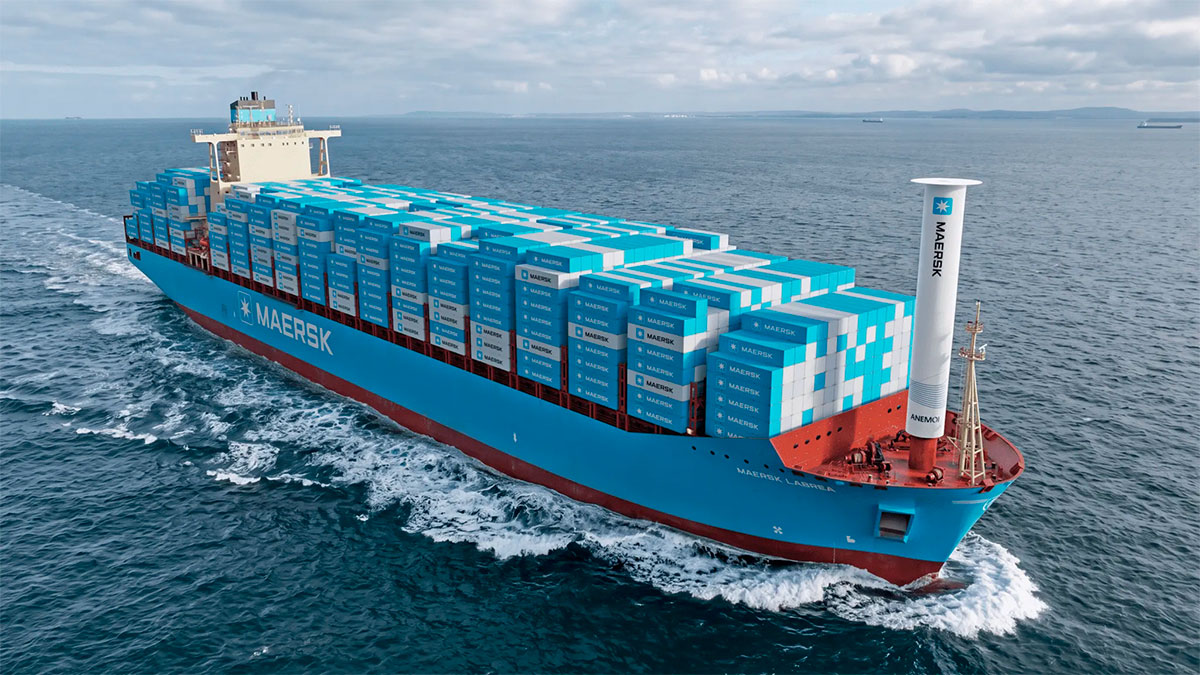
The world’s second-largest container shipping company, the Danish firm A.P. Moller-Maersk, has signed an agreement with the British company Anemoi to install a rotor sail on one of its container ships as part of a pilot project set to begin in mid-2027. The installation comes at a time when the maritime sector is turning once again to wind as a source of propulsion in the face of increasingly stringent environmental regulations.
A Space Challenge on Deck
Unlike oil tankers or bulk carriers, where the open deck facilitates this type of installation, container ships present an added challenge: almost all of the available deck space is used for cargo storage. “Container ships have not been a priority for this type of installation due to the lack of deck space,” Nick Contopoulos, commercial director of Anemoi, explained to the media. However, he points out that these ships operate on very fixed routes, which allows for advance knowledge of wind patterns and sailing speed, thereby improving the return on investment.
Technology based on the Magnus effect
The 35-meter-tall rotor sail will be permanently installed in a vertical position at the bow of the ship, an 8,700-TEU container ship of the Maersk Lima class. Unlike traditional sails, this is a motorized cylinder that rotates on its axis to harness crosswinds: the rotation accelerates the flow of air on one side of the tube and slows it on the other, creating a pressure difference that generates forward thrust and reduces the workload on the main engine. The system can operate in winds of up to 35 meters per second.
Ole Graa Jakobsen, Maersk’s chief fleet technology officer, notes that the project represents “a valuable opportunity to gain practical experience and assess its relevance to our fleet and to container shipping in general.” The vessel will continue to operate on its regular commercial service across the North and South Atlantic throughout the trial period.
A precedent that has already proven successful
Maersk isn’t starting from scratch: In 2018, the oil tanker Maersk Pelican installed two 30-meter rotors manufactured by Norsepower. Over the following twelve months, the vessel reduced its fuel consumption by 8.2% and avoided approximately 1,400 metric tons of CO₂, according to independent validation by Lloyd’s Register.
According to Anemoi’s estimates, each of its rotor sails (which are typically installed in groups of three to five units) saves approximately one metric ton of fuel and three metric tons of CO₂ emissions per day. The cost ranges from $600,000 to $1.2 million (between 517,000 euros and one million euros) per unit, not including installation costs.
The Rise of Assisted Wind Propulsion
Gavin Allwright, secretary general of the International Sailing Ship Association, notes a growing interest in these technologies as environmental regulations for maritime transport become stricter. According to his data, there are currently about 110 commercial installations on ships over 400 metric tons gross tonnage, between 80 and 90 on order, and about 50 in the planning stages. “In recent years, we’ve seen the number of installations double annually,” says Allwright, who also points to rising fuel costs resulting from the war in the Middle East as a driving factor.
Peter Jameson, managing director of the Boston Consulting Group, estimates that wind propulsion could lead to fuel savings of between 5% and 25%, depending on the vessel and the route. However, he warns that the main barrier today is commercial rather than technical: “Installing these systems can cost several million dollars, and the payback period can extend well beyond a typical charter contract. Often, the shipowner bears the initial cost, while the charterer benefits from the savings on the fuel bill, so the incentives are not naturally aligned.”
Regulatory pressure from Europe
Maritime transport, which accounts for about 3% of annual global carbon emissions, was incorporated into the European emissions trading system starting in 2024. In addition, the FuelEU Maritime regulation requires a gradual reduction in the emissions intensity of fuels used by ships operating in EU ports such as Algeciras, Valencia, and Barcelona. Meanwhile, the International Maritime Organization is negotiating new emissions rules for the sector, amid divisions over the level of ambition and opposition from the United States to decarbonization efforts.
With this pilot program, Maersk is joining a trend that, while it does not turn container ships into zero-emission vessels, harnesses a free source of energy to reduce the global merchant fleet’s fossil fuel consumption, voyage by voyage.