








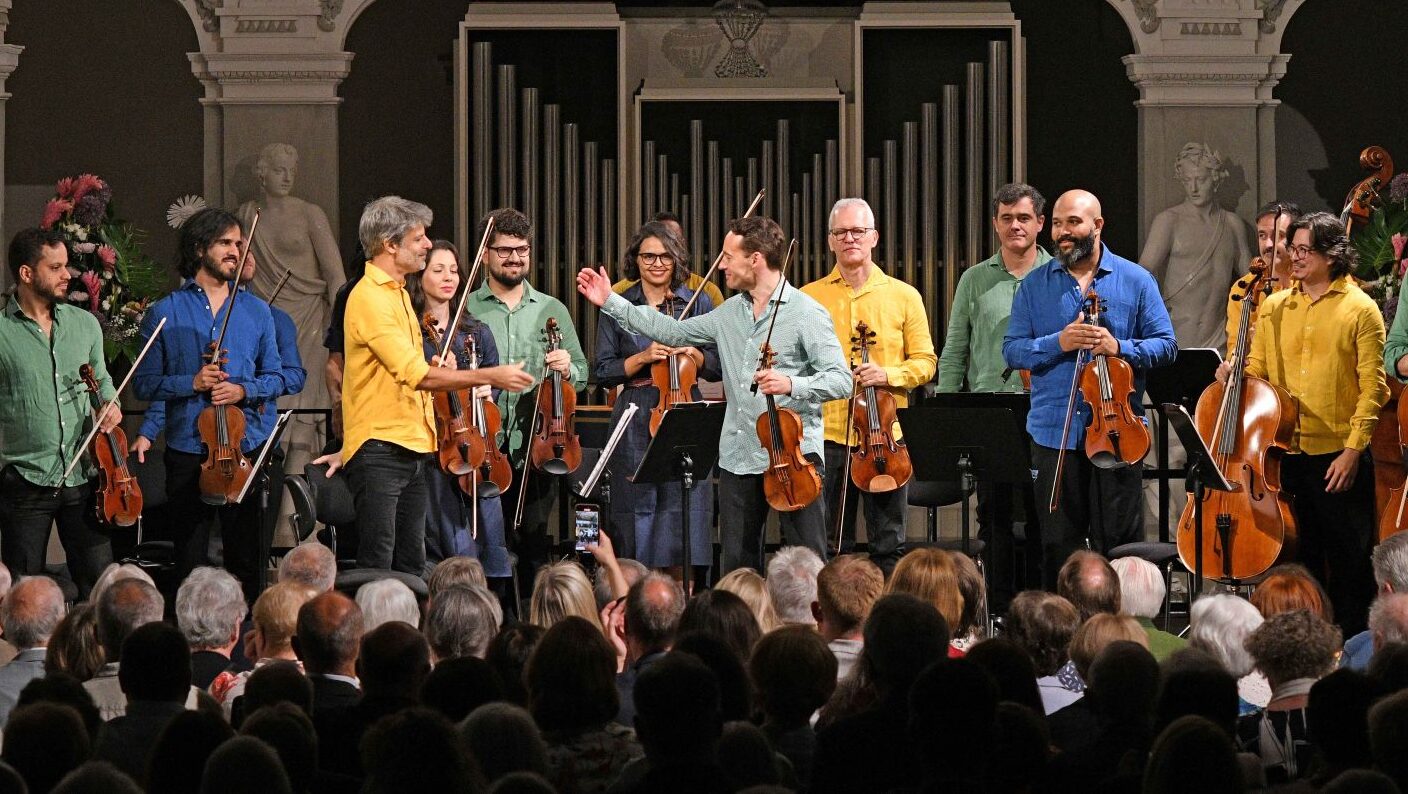
The Dominican Cloister, in the heart of Dalt Vila, Ibiza, will host the eighth edition of the Ibiza Conciertos International Classical Music Festival from August 29 to 31. This year, the event features an unconventional program: bringing European musical tradition and the energy of Brazil face to face.
The man responsible for this is German violinist Linus Roth, the festival’s founder and artistic director, who will arrive on the island with one of the most fascinating instruments in the world of music: a 1703 Stradivarius, known as the ‘Dancla’. He will be accompanied by the Johann Sebastian Rio Orchestra, arriving directly from Rio de Janeiro and specializing in building bridges between classical music and Brazilian popular traditions. The result can be heard over three nights at 9:00 PM, on a stage that adds an element difficult to replicate in a conventional concert hall: the Ibiza sky as part of the program.
The first performance, on Saturday, August 29, will probably be the clearest statement of intent of this year’s festival. SamBach: From Bach to Brazilian Samba establishes a dialogue between the world of Johann Sebastian Bach and the sounds of samba and bossa nova. The project, which has already been performed at major European festivals, is based on a simple yet ambitious idea: to show that classical music should not be seen as a closed world. Bach’s Violin Concerto will be performed alongside arrangements inspired by Brazilian music, seeking connections between Baroque precision and Brazilian rhythmic freedom.
“This eighth edition is one of the most special we have ever organized,” explains Roth, who sees the arrival of SamBach in Ibiza as the culmination of a long-awaited project. “We want to inspire through a unique musical journey that takes the audience from the great classics to the unmistakable rhythms of Brazilian music.” The second night takes a different direction, while maintaining the same concept. On Sunday, August 30, Antonio Vivaldi’s “The Four Seasons” will share the spotlight with works by Brazilian composers such as Heitor Villa-Lobos, César Guerra-Peixe, Ernani Aguiar, Sivuca, and Gadelha.
It is, in essence, a musical journey between two worlds: Baroque Venice and folkloric Brazil, separated by thousands of miles and several centuries, but united by the universal language of music.
An evening to listen to Brazil
The festival will conclude on Monday, August 31, with a Brazilian Night, featuring the Johann Sebastian Rio Orchestra as the star of the show. The program will include works by Villa-Lobos, Cláudio Santoro, Ernani Aguiar, and César Guerra-Peixe, as well as popular classics and melodies associated with choro and samba. Some of the arrangements have been created specifically for Ibiza Conciertos, making the final day an unusual experience on the traditional classical music circuit.
The Brazilian ensemble, under the artistic direction of violinist and conductor Felipe Prazeres, has for years been developing precisely this type of hybrid musical language. Their concerts have filled some of Rio de Janeiro’s main venues, such as the Theatro Municipal, the Sala Cecília Meireles, the Cidade das Artes, and Vivo Rio, and the orchestra has shared the stage with artists like Gilberto Gil, Alceu Valença, Marco Pereira, and Linus Roth himself. Its goal is clear: to maintain the excellence of a concert orchestra without sacrificing the spontaneity and accessibility of popular music.
In an increasingly experience-driven cultural market, Ibiza Conciertos has an asset that no marketing campaign can replicate: the very venue where the events take place. Dalt Vila, a UNESCO World Heritage Site, gives the festival a dimension that goes beyond the repertoire. The historic architecture of the cloister, the Ibizan nightlife, and the venue’s intimate atmosphere make each concert an experience that combines heritage, cultural tourism, and music.
It’s also a way to present the island from a different angle. Ibiza is often internationally associated with electronic music, leisure, and high-end tourism. Initiatives like this broaden the narrative and place the island on a different map: that of international destinations capable of attracting artistic talent and audiences drawn to culture.
A Stradivarius with three centuries of history
In this context, Linus Roth’s presence is one of the main artistic highlights. The violinist won the ECHO Klassik Award for Best Newcomer in 2006 for his debut recording with EMI and won it again in 2017 for a recording of the violin concertos by Shostakovich and Tchaikovsky with the London Symphony Orchestra.
But there is one particularly remarkable aspect of his career: Roth has built much of his reputation by reviving a repertoire that had been forgotten by the major international circuit. His work with the Polish-Soviet composer Mieczysław Weinberg led him to become the first violinist to record the composer’s complete works on CD. In 2015, he also founded the International Weinberg Society, dedicated to promoting Weinberg’s music.
A professor of violin at the Leopold-Mozart-Zentrum of the University of Augsburg since 2012, Roth combines his teaching and concert activities with the role of artistic director at various European festivals. In Ibiza, he also plays an exceptional instrument: the 1703 Stradivarius ‘Dancla’, loaned by the L-Bank Baden-Württemberg Musical Foundation.
The project also aims to ensure that the festival doesn’t end when the lights go out in the cloister. The Ibiza Conciertos Association collaborates with the Ibiza and Formentera Association Against Cancer (IFCC) to bring free concerts to hospitals and nursing homes, and to bring music to cancer patients and their families. It’s a less visible but significant aspect: using an international cultural event as a platform to have an impact on the local community that hosts it.
Experience in numbers
Tickets for the concerts will cost €40, while residents of the Balearic Islands can attend for €25 and children under 14 for €10. There is also a three-night pass for €96, reduced to €72 for Balearic Island residents and €24 for children under 14.
The organizers will also offer a minibus service to facilitate access to the Upper Town. The shuttle bus will run between 8:00 PM and 9:00 PM from Passeig de Vara de Rey, next to the Hotel Montesol, to the concert venue. Tickets are available at www.ibizaconciertos.com.
This eighth edition explores an idea that is tied to the evolution of cultural tourism: when the destination ceases to be simply the place where an event takes place and, instead, becomes part of it. For three nights, Ibiza will be precisely that: the stage where Bach meets Brazil, where a Stradivarius more than three centuries old holds a dialogue with samba, and where classical music leaves behind the solemnity of grand concert halls for a few hours to meet the Mediterranean.


