








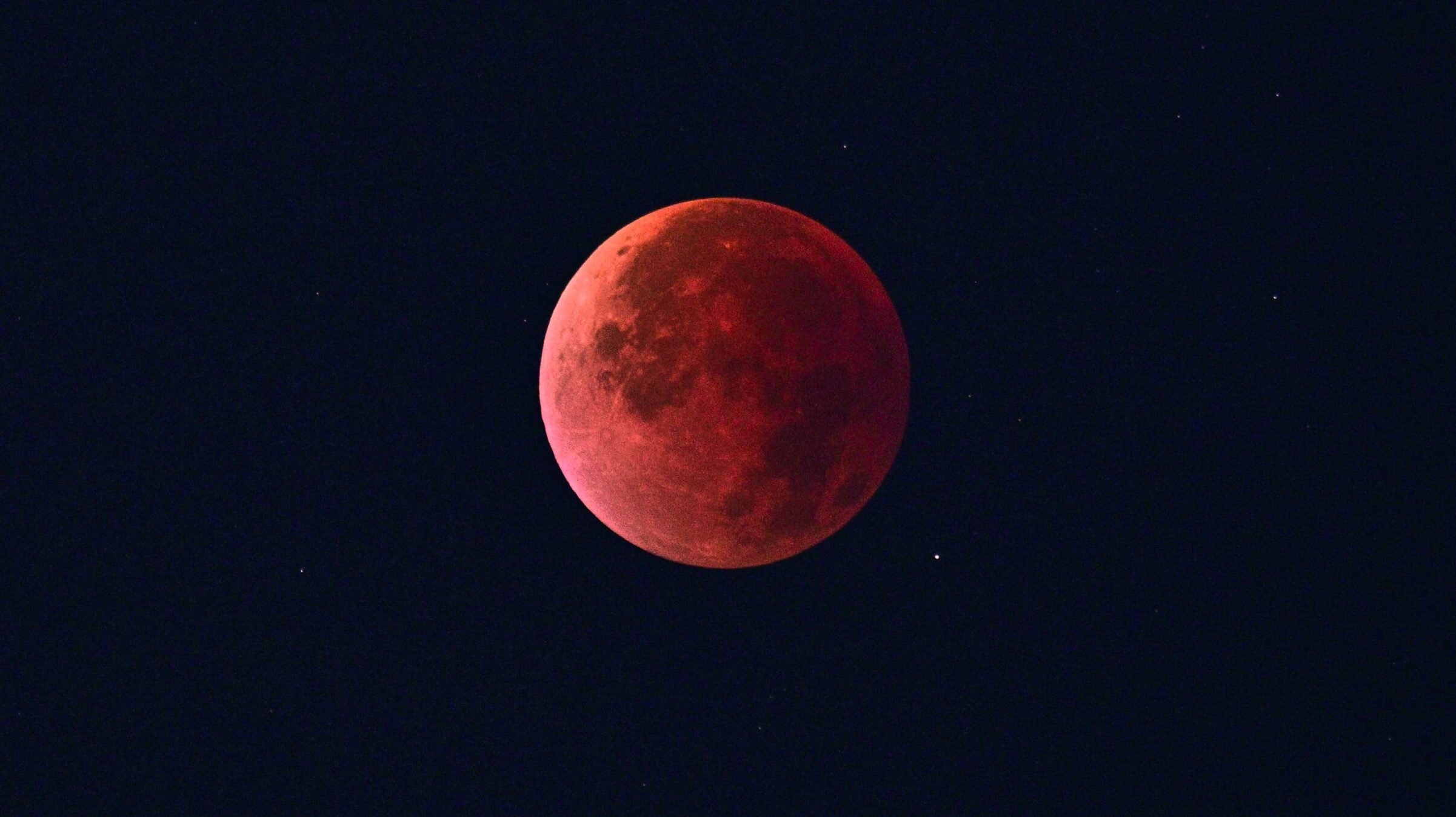
The solar eclipse on August 12 sparked a level of public excitement in the Islands that few could recall. The event drew tens of thousands of people to the Islands, and its aftermath is still being felt: beyond the visits to the eye doctor (which, fortunately, were few and far between), the phenomenon has sparked a collective craze for stargazing that is driving a wave of new enthusiasts to look for upcoming events on the calendar. The next one is coming up this month: in the early hours of August 28—from Thursday to Friday—when a 93% lunar eclipse will occur.
Salvador Sánchez, president of the Foundation of the Institute of Astronomy and Astronautics of Mallorca (FIAAM), explains to Forbes Baleares that even though this is a partial eclipse, the fact that it will reach 93% at its peak means there will be little difference from a total eclipse. Likewise, it will also deserve the name “red moon” or “blood moon,” as the moon will most likely take on shades ranging from pink to ruby. However, Sánchez warns that the color will depend heavily on atmospheric clarity: if the air is more polluted, there is a greater chance that it will take on a brownish hue, “like matte brick.”
“Blood moon” or “red moon” is the term commonly used to describe the reddish appearance the moon takes on during the total phase of a total lunar eclipse. At that moment, the Earth blocks the sun’s direct light, and the atmosphere filters out the light, allowing only red, pink, or orange hues to pass through while blocking other colors. “What’s nonsense is when you hear that ‘the eclipse will coincide with the full moon phase’: all eclipses have to occur during a full moon.”
In that regard, he asserts that it will be a great opportunity “to take some really good photos.” Especially since the forecast calls for clear skies. This will also help reveal a starry sky, adding perspective and depth to the images taken by amateur photographers. Otherwise, it will be “very similar” to the solar eclipse on August 12 in terms of the position of the Sun, about 15 degrees above sea level.
In this case, the schedule varies significantly: it will begin at 4:30 a.m., and the peak will occur starting at 6:15 a.m. The western part of the island of Mallorca—and more specifically, from high points in the Serra de Tramuntana—will be the best place to observe the phenomenon.
Schoolchildren’s Interest
In any case, this new event takes place against a backdrop of growing public interest in astronomy, which Sánchez sees extending beyond the historic solar eclipse of August 12. At the very least, it is a booming phenomenon whose momentum has already been evident over the past decade. “For at least six or seven years now, astro-tourism has been on the rise and is here to stay. People are becoming more and more interested in it,” he notes, emphasizing that this includes both tourists and residents, as well as the countless workshops and school activities that fill the calendars every year at key venues such as the Mallorca Astronomical Observatory (OAM)—and with which the Mallorca Institute of Astronomy and Astronautics Foundation, chaired by Sánchez, collaborates.
He explains that this interest is leading to an increasing number of students enrolling in astrophysics, astronomy, and space sciences. Where does this growing interest come from? Sánchez is certain: “It’s the future.” The future of humanity lies in the stars, and that future is drawing closer every day, so it’s inevitable that new generations will feel increasingly drawn to space exploration.
Beyond the lunar eclipse on August 28, there are already events with highly anticipated dates. On August 2, 2027, a partial solar eclipse with 80% coverage will be visible from the Islands (Andalusia will have better viewing conditions in this case), while on January 26, 2028, another partial solar eclipse will take place, revealing a dazzling ring around the Sun in the late afternoon—known as the “ring of fire.” Likewise, for a total solar eclipse like the one that occurred on the 12th, we will have to wait until November 17, 2180.


