








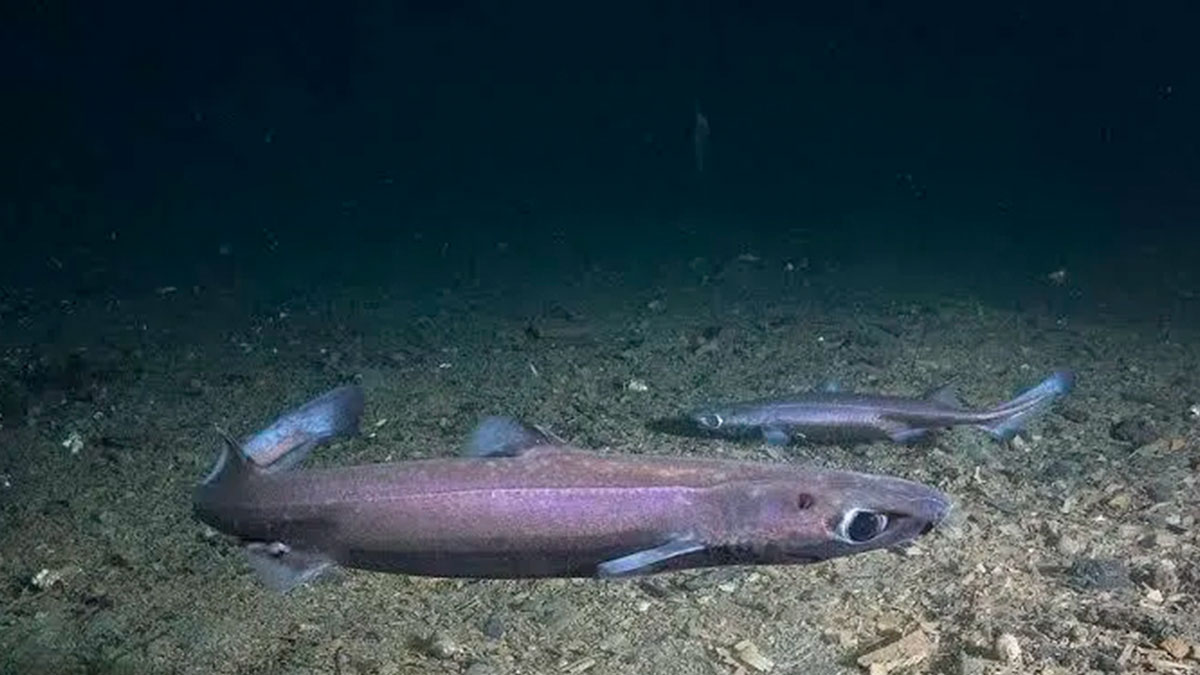
The net emerged from the depths just before dawn. The deck lights flickered against a gray horizon, and the crew waited for the usual mix of mud, broken shells, and the occasional discarded fish. Instead, the net pulsed with hundreds of small bodies with shiny bellies, their large eyes—adapted to the darkness—staring back at them. Their skin was marked by faint bioluminescent patterns that looked like scattered constellations.
They weren’t just any fish. They were velvet-bellied lantern sharks.
For years, this species (scientifically known as Etmopterus spinax) has remained a scientific blind spot in the Adriatic Sea. Occasional sightings, often decades apart, painted a picture of scarcity: an occasional visitor to the deep waters, so to speak. But between 2023 and 2025, a fishery-based monitoring program off Vlorë, Albania, began to fill that gap. More than 319 individuals of Etmopterus spinax were recorded from bottom trawlers and longlines operating at depths between 450 and 650 meters, and the species appeared consistently in catches at depths greater than 500 meters, sometimes with more than 50 individuals in a single haul. Among them were newborns, juveniles, and pregnant females, suggesting that parts of the Adriatic continental slope may serve as a breeding ground.
Yes, a species that was once considered merely a visitor now appears to regard the area as its “home,” with young that begin their lives in cold, dark, deep waters that most of us will never see. This is an exciting discovery for shark science, as deep-sea species such as lanternsharks grow slowly, mature late, and produce relatively few offspring. These are life strategies designed for stability, but those same characteristics become their greatest vulnerability as industrial fishing expands into deeper waters. After all, a population that cannot recover quickly is a population that may quietly disappear. That is why one of the study’s most striking findings was the difference in survival rates depending on the fishing gear used. Sharks caught by bottom trawling suffered 100% mortality upon reaching the vessel, while those caught by longline were sometimes still alive when brought on board. That difference may seem like a mere technicality, but it suggests that how we fish is just as important as how much we fish, especially in deep-sea ecosystems where recovery is slow and data are scarce.
The researchers also used DNA analysis of mitochondrial COI sequences, which revealed moderate diversity and six previously unrecorded haplotypes. Essentially, these sharks are not genetically uniform, and although the Adriatic population appears to be partially isolated, its configuration results from both movement and restriction. So what does it mean that a species long assumed to be rare turns out to be consistently present, reproductively active, and genetically distinct on a regional scale? It means that our initial hypotheses may be wrong, and that deep-sea fisheries are interacting with ecosystems that we are only just beginning to map in biological detail. If the upper Adriatic slope is functioning as a nursery for the velvet-bellied lanternshark, it could also be important for other deep-sea species with similarly slow life histories.
The fact is that our deep-sea fisheries do not operate within a fully understood system. We operate in a system where the map is still being drawn while harvesting is already underway, with bottom trawls and longlines plundering these ecosystems out of sight before a baseline ecological understanding even exists. We are removing biomass from systems that are still being defined in real time. We are applying industrial pressure to populations whose connectivity, spawning grounds, and spatial dependencies are only now being inferred through studies like this one. By the time declines are recognized, the ecosystem has already changed, and we are left trying to reconstruct what “normal” was based on fragmented records and degraded signals. In a shallow-water fishery, we may have decades of observations to work with. In the deep sea? Often, we rely only on sporadic encounters, opportunistic sampling, and long periods of silence that can mask both stability and collapse.
Whether we want to admit it out loud or not, deep-sea management is still often based on the premise that low visibility equals low vulnerability. If the upper slope of the Adriatic functions as a nursery, then it is a structure that is vital to a broader ecological network. And if that is true, the impact of a disturbance is not limited to what gets caught in a net, but extends to reproductive failure, reduced gene flow, and the gradual erosion of population structure—which we may not detect until it has already been flattened. This finding raises many questions, but for now we have 319 sharks that serve as clear, measurable, and repeatable evidence that life in the depths of the Adriatic is more abundant—and more vulnerable—than previously assumed.


