








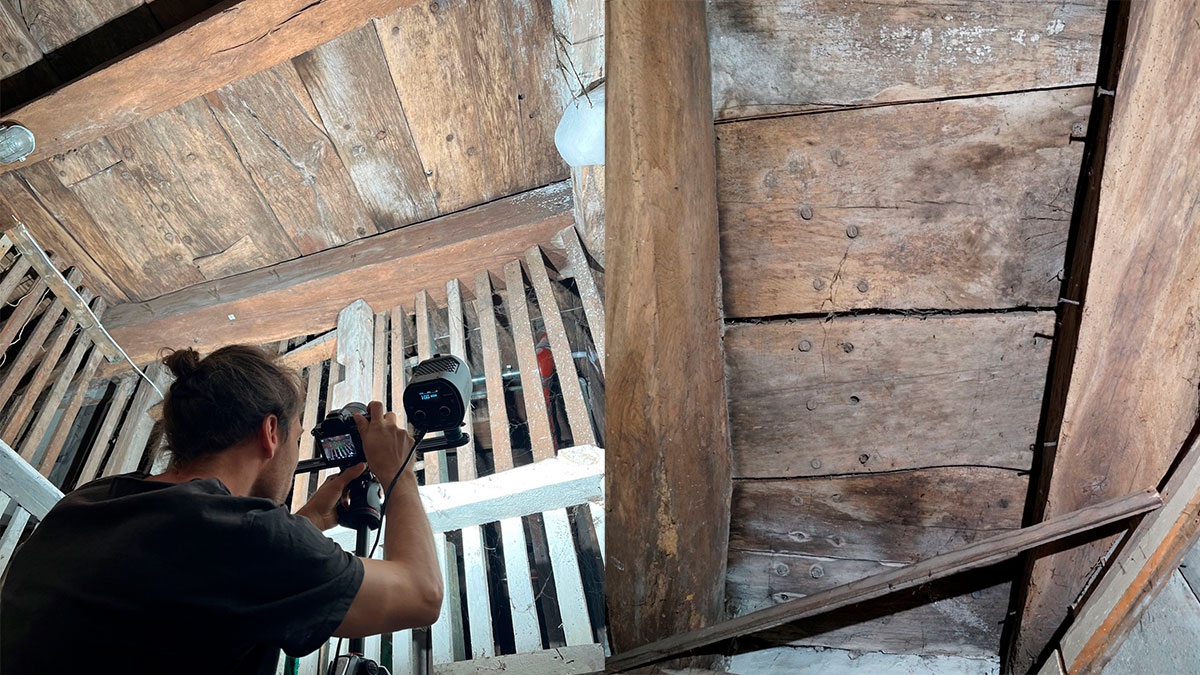
What at first glance appeared to be a ceiling made of reused wood in a medieval basement on Konradigasse Street in the city of Konstanz, in southern Germany, has turned out to be something far more remarkable: the nearly complete remains of a medieval ship’s hull. The discovery, announced by the Landesamt für Denkmalpflege (LAD)—Baden-Württemberg’s cultural heritage agency under the Stuttgart Regierungspräsidium—could become one of the most valuable sources of information for understanding how ships were built, repaired, and recycled in the Lake Constance region during the Middle Ages.
The discovery was made by an interdisciplinary team of architects, architectural historians, and archaeologists from the LAD during a historical and architectural study of the basement, which dates back to 1244. “At first, it was only clear that the planks had been reused. The real surprise was that they had originally been part of a ship,” explains Dr. Aline Kottmann, head of medieval archaeology at the LAD. According to the researchers, the discovery documents the practices of material reuse and the circular economy in medieval domestic construction, in addition to providing new insights into the shipbuilding techniques of the time.
The deck, which measures more than 25 square meters, consists of at least 19 planks joined together with wooden dowels and rows of nails characteristic of medieval shipbuilding. The most striking feature, according to the researchers, is that a large portion of the planks retain their original arrangement: these are not loose pieces reused in isolation, but rather a section of the hull that maintains the same structure it had aboard the ship. “It wasn’t just isolated fragments that were reused, but a virtually complete and articulated hull,” notes Alexandra Ulisch, a member of the “Wracks und Tiefsee” (“Wrecks and the Deep Sea”) project, the LAD initiative dedicated to searching for shipwrecks on the Lake Constance seabed, whose prior experience in naval archaeology has been key to identifying and analyzing the discovery.
Initial analyses suggest that it is a flat-bottomed cargo sailing ship, a type of vessel well documented in the Lake Constance region, with parallels to the Kippenhorn shipwreck near Immenstaad, which dates to the 14th century. If it is confirmed that some of the planks belong to the hull’s side plating, the discovery could provide previously unknown information about a particularly complex aspect of shipbuilding from that period: the transition between the ship’s flat bottom and its sides.
A shipwreck that can be studied without diving
The planks also bear traces of their working life on the water. Archaeologists have identified at least four repaired areas, where damaged sections were removed and replaced with precisely fitted pieces of wood. One of these repairs stands out in particular: a dovetail joint for which, as of now, there is no known direct parallel among medieval naval finds in the region. “They are precisely cut to fit together and secured to the ceiling just as they were assembled on the ship. This has allowed the caulking mass—the insulating material between the planks—to be preserved in some places as well,” explains Ulisch. This substance, of particular interest to naval archaeology, has already been analyzed.
Unlike most of the known medieval shipwrecks in Lake Constance—which remain submerged and can only be studied through underwater archaeology, requiring considerable logistical effort—the planks from Konradigasse are preserved in a dry and accessible environment, offering ideal conditions for further analysis. “The discovery goes far beyond a mere chance find. It is a valuable testament to medieval shipbuilding techniques and is of particular importance for naval archaeology in the Lake Constance region,” Kottmann emphasizes.
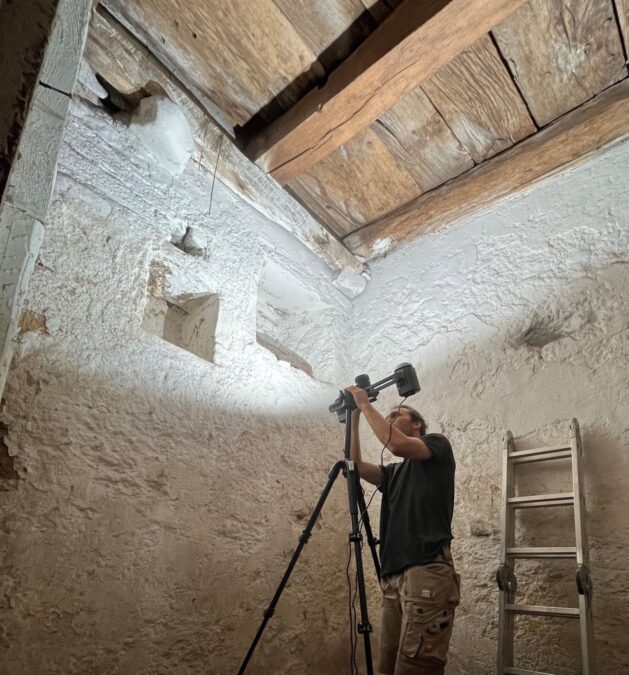
In mid-August 2026, the find was recorded in three dimensions using the “Structure from Motion” (SfM) technique, for which hundreds of photographs were taken and are being digitally combined into a single image. In addition, wood samples were collected for dendrochronological analysis. “The samples will be analyzed in the coming weeks. We’re really looking forward to seeing what it reveals,” concludes Kottmann. The LAD emphasizes that this press release is based on preliminary results and that further details will be released once the ongoing analyses are complete.
