








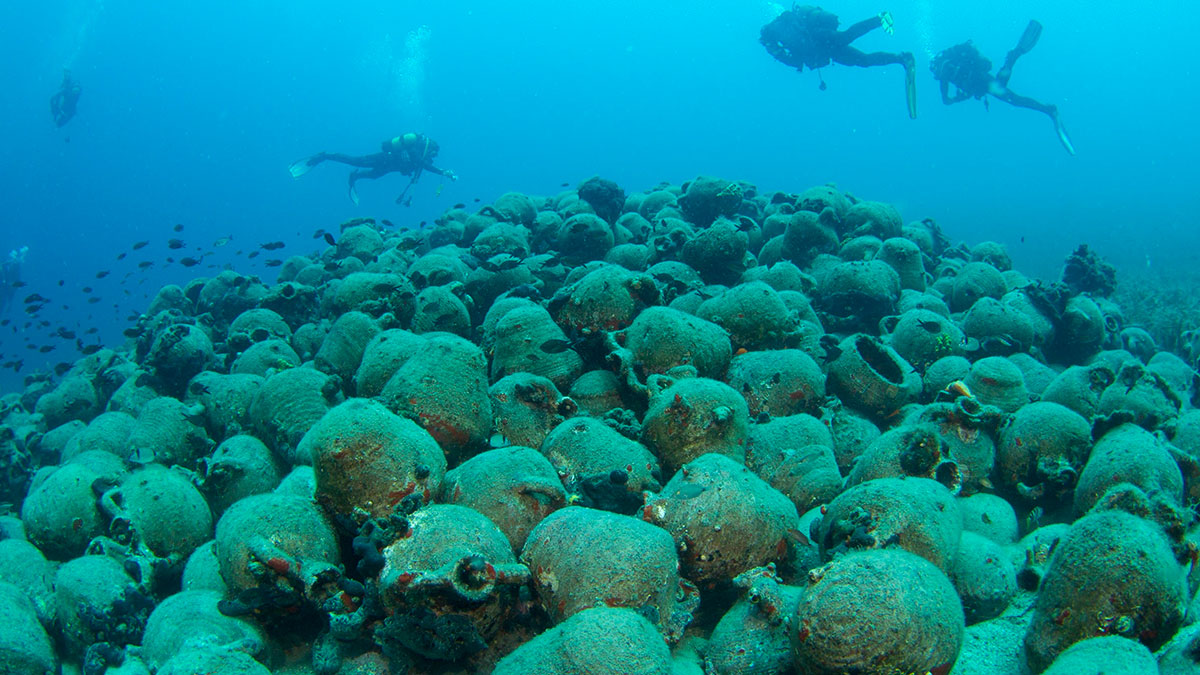
A secret dating back more than two millennia lay hidden beneath the waters off Sicily. A team of divers has located, off the coast of Mazara del Vallo, a 2,100-year-old Roman shipwreck laden with hundreds of wine amphorae, virtually intact and still arranged just as they were stowed more than twenty centuries ago. Italian Culture Minister Alessandro Giuli has described the find as “one of the most important underwater archaeological discoveries of recent years.”
The shipwreck lies at a depth of about 46 meters, just over three miles off the Sicilian coast. The well-preserved hull measures approximately 21 meters in length and 6 meters in beam, dimensions that place the vessel among the best-documented Roman shipwrecks found in Italian waters in recent years.
The discovery, as extraordinary as it was accidental, came about thanks to a tip from local fishermen, who alerted the cultural heritage protection unit of the Carabinieri, the Italian military police. It was spearfisherman and freediver Giacomo De Mola and his partner Igor Bisulli who, while scanning the seafloor with a StructureScan sonar, noticed what appeared to be a large rock. It wasn’t.
“I walk closer. And my heart stops,” De Mola said in a video posted on social media. Beneath him lay a vast field of amphorae. “Without a doubt, this is the most incredible discovery of my life,” he added. “It’s hard to describe what it feels like to be, after nearly twenty centuries, among the first humans to see that place again.”
Most of the cargo consists of Dressel 1A-type amphorae—ceramic vessels with two handles and a narrow neck used primarily for transporting wine, though also for olive oil. Their extraordinary state of preservation is largely due to the depth of the wreck itself: at 46 meters, the cargo was protected from both surface waves and accidental looting, remaining exactly as it was arranged more than two thousand years ago. Along with the amphorae, two anchors and a lead pipe were also found.
For archaeologists, the value of the discovery goes beyond the artifact itself: it is an intact snapshot of Roman trade logistics in the 1st century B.C., a detailed map of the routes that connected Italy with the rest of the Mediterranean and made wine one of the commodities that drove the empire’s economy.
Specialized divers from the Carabinieri were sent to the site to document the discovery, while the Sicilian Maritime Superintendency is preparing a new phase of scientific research. The experts will attempt to determine the exact date of the shipwreck, the origin and destination of its cargo, and the condition of the preserved material, in addition to establishing protective measures for what authorities are already describing as a site of exceptional archaeological significance. The shipwreck has now been added to the Sicilian region’s inventory of protected heritage sites.
The discovery adds to a long list of Roman shipwrecks found in Sicilian waters and the Mediterranean in general—one of the world’s richest areas for underwater archaeology due to its strategic location along the ancient maritime routes connecting Greece, the Middle East, North Africa, and Europe. Among the most recent discoveries are a 2nd-century B.C. shipwreck discovered in 2021 off the coast of Palermo at a depth of 92 meters, and another located in 2013 off the coast of Liguria, near Alassio, carrying a cargo of about fifty amphorae.