








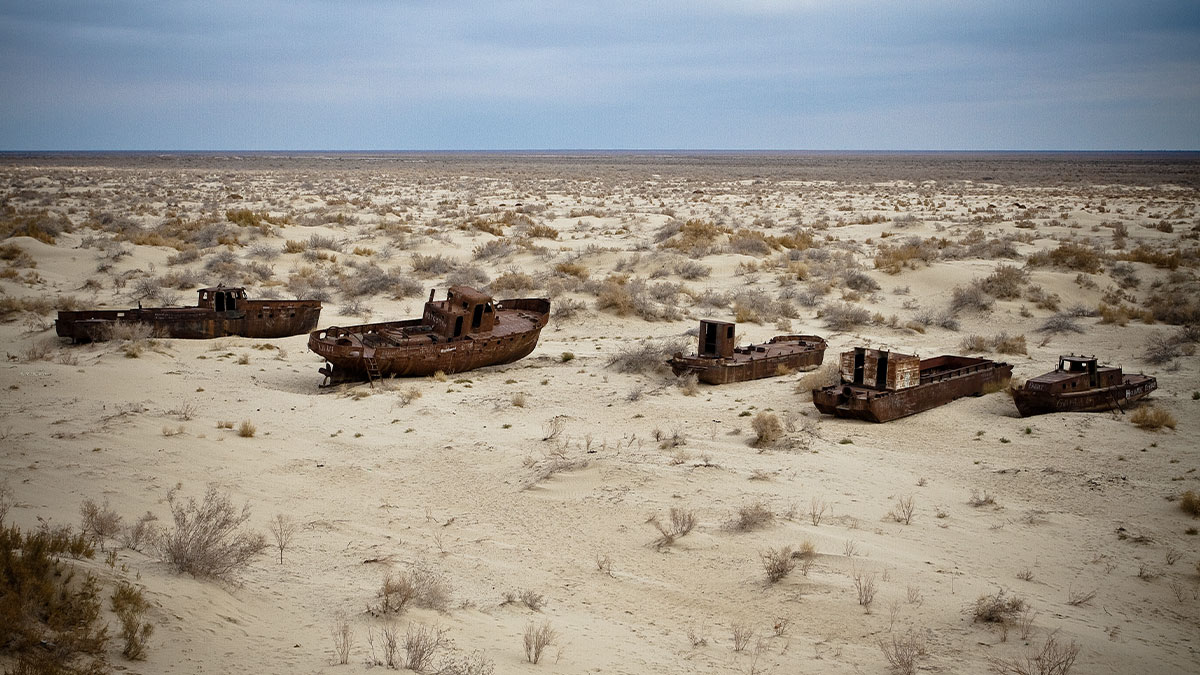
The Aral Sea, located between Kazakhstan and Uzbekistan and considered for decades to be one of the greatest environmental disasters caused by human activity, could also become a new front in the fight against climate change. A study led by Spanish researchers and published in the journal *Science* concludes that the dry bed of the former lake has become a significant source of carbon dioxide (CO₂) following decades of drying up.
According to the study, since it began shrinking in the 1960s —as a result of the diversion of water from the Amu Darya and Syr Darya rivers for agricultural irrigation—the Aral Sea has released approximately 748 million metric tons of CO₂, a figure equivalent to the combined annual emissions of Spain, France, and Belgium.
The study also warns that the process is not over. Researchers estimate that the former wetland could still emit another 605 million metric tons of CO₂ if its degradation continues. To prevent this, they propose a carbon market-based financing approach: converting these potentially avoidable emissions into tradable carbon credits that would help raise international funds to support the ecosystem’s water recovery. Depending on the price of these assets, the mechanism could mobilize between 3.1 and 15.8 billion euros.
The research focuses on a phenomenon that could occur in other large lakes and wetlands around the world affected by water loss, such as the Great Salt Lake and the Salton Sea in the United States, Lake Urmia in Iran, Lake Chad, and the Caspian Sea—whose future is of particular concern to the scientific community.
The study explains that lakes typically act as natural carbon sinks, as their sediments store organic matter that has accumulated over decades. However, when the water surface disappears, those sediments are exposed to oxygen, which triggers biological processes that accelerate the decomposition of organic matter and release CO₂ into the atmosphere.
To quantify this process in the Aral Sea, the scientific team conducted an expedition in 2022 to the lake’s former bed. By collecting and analyzing sediment samples from various areas that were exposed at different stages of the drying process, the researchers reconstructed the evolution of carbon emissions since the 1960s and estimated the volume that remains stored there.
Beyond the case of the Aral Sea, the study points to a possible reassessment of carbon balances in regions where the expansion of irrigated agriculture has contributed to the disappearance of wetlands. By incorporating the emissions generated by these dried-up ecosystems, the climate balance associated with land use could differ significantly from current estimates.