








This month, a heat wave emptied the Fourth of July parades in the eastern United States. In June, a deadly heat wave gripped Europe, where Western Europe ended up recording its hottest June on record. Both events were reported as separate emergencies. We weren’t wrong to do so. But both are part of a larger story that we’re only just beginning to tell. First, let’s clarify a few concepts.
What is El Niño? El Niño is a natural warming of the tropical Pacific Ocean that can alter weather patterns around the world. It changes the way heat and moisture move between the ocean and the atmosphere, altering the likelihood of droughts, heavy rains, heat waves, and storms in different regions.
Is it caused by climate change? No. El Niño is a natural climate pattern, not something caused by global warming. But climate change can exacerbate its impacts, because each El Niño now develops in a warmer atmosphere and over warmer oceans.
Why does El Niño matter right now? A strong El Niño is currently forming in the Pacific, over an ocean that is warmer than any we have ever recorded. According to NASA, the ocean has already absorbed more than 90% of the extra heat trapped by greenhouse gases. Now, some of that heat is moving back into the atmosphere and returning to us in the form of weather.
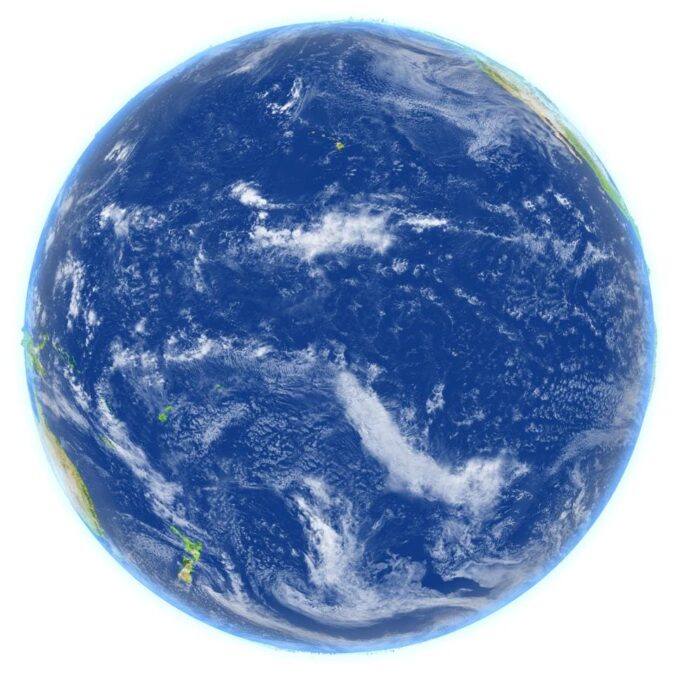
Imagine the scale of this. The ocean covers about 71% of the planet. From the Pacific side, the Earth is almost entirely water. That water is the largest heat reservoir we have. We monitor the air because that’s what we feel. But the heat is in the ocean.
What the ocean has stored up—and when it releases that heat—tells us more about this fall and winter’s weather than any forecast map. The ocean isn’t just warm right now. It’s a coiled spring.
Air temperature is what we feel. Ocean temperature is what determines the conditions.
The ocean continues to break heat records, and this year it has been reported that,
The ocean is warming faster, not slower. Ocean heat content rose again in 2025, marking the ninth consecutive record-breaking year, according to Inside Climate News. Every second, the ocean absorbs roughly as much heat as 12 Hiroshima bombs. Kevin Trenberth of the National Center for Atmospheric Research calls it the clearest single sign that the planet is warming: unlike the air, it hardly fluctuates. It just keeps rising.
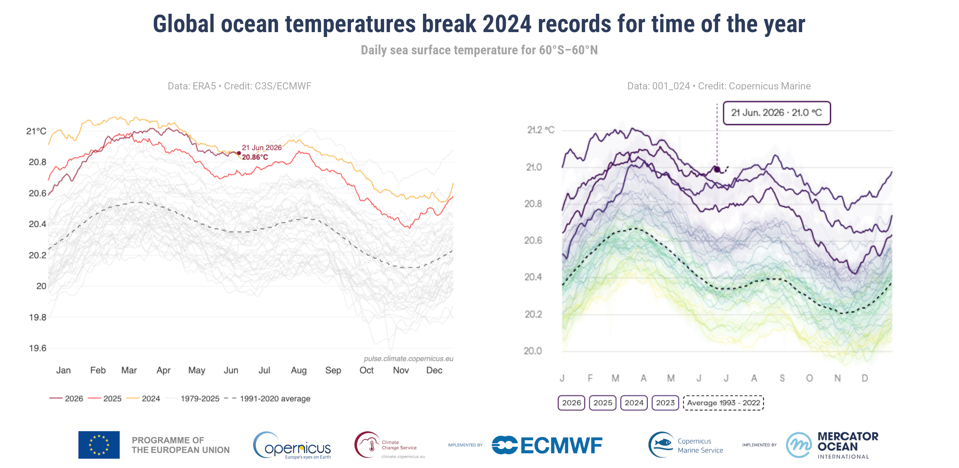
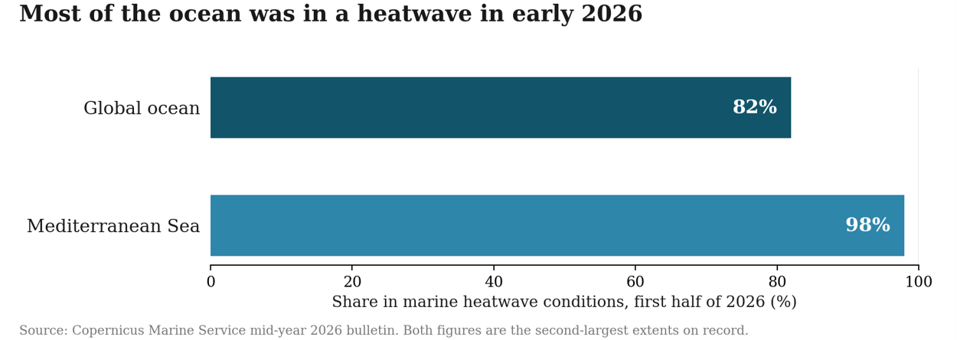
This year, the heat made headlines. On June 21, global sea surface temperatures reached a record high for this time of year: 21.0 degrees Celsius, surpassing the records set in 2023 and 2024, according to data from Copernicus Marine. Two independent European systems—one based on observations and the other on ocean modeling—reached the same result through different methods. June became the warmest June ever recorded for the oceans. And throughout the first half of the year, marine heatwaves spread to cover nearly 82% of the global ocean at some point. The Mediterranean was the hardest hit: nearly the entire sea recorded above-normal temperatures, and intense to extreme marine heat affected nearly 80% of its surface. Warm water doesn’t stay still. Such a warm sea is a reservoir of energy pressing against the lower atmosphere, and the laws of physics won’t let it stay there.
The first payment already has a name: El Niño
The fastest way for ocean heat to reach the rest of the world is through El Niño, and it is now gaining strength. In June, NOAA declared an El Niño and put the probability at 63% that it will be very strong—with temperatures exceeding 2.0 degrees Celsius in the tropical Pacific—peaking between November and January. That would make it one of the strongest on record, which dates back to 1950. This month, the World Meteorological Organization said it is strengthening rapidly and warned that it will increase the likelihood of droughts, heavy rains, and heat waves around the world.
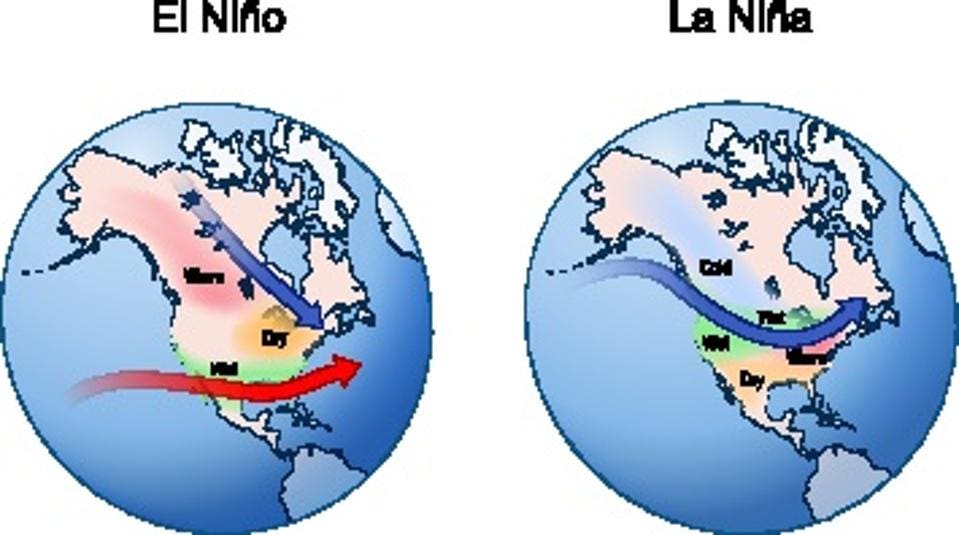
El Niño works by pushing heat out of the Pacific and into the atmosphere, where it is then distributed. It shifts the jet stream and alters where rain falls and where droughts occur. The WMO’s July forecast points to wetter conditions in southern Europe and the southwestern United States, and drier conditions in Australia, India, the Horn of Africa, Central America, and the Caribbean. For next winter, NOAA expects the typical El Niño pattern: storms moving across the southern United States, a drier Ohio Valley and Tennessee, and a milder north.
There is a deeper connection that most headlines overlook—one that runs from the ocean to El Niño, not the other way around. The warmer the ocean is, the more fuel each El Niño has to work with. And the evidence increasingly points in one direction: the heat we’ve stored is making stronger events more likely. A 2024 study in *Nature Communications* found that the warming of the deep ocean alone could make extreme El Niño events 40 to 80 percent more frequent, and that the effect persists even after we stop emitting greenhouse gases. We have altered the mechanism that releases heat.
We can already begin to sketch out the likely pattern of problems. On the wet side, a strong El Niño tends to unleash powerful storms and “atmospheric rivers” on the U.S. West Coast. Climatologist Daniel Swain has written that the winter of 2026–2027 is shaping up to be the season that leaves California drenched and flooded, with a real possibility that a tropical storm could veer toward the drought-stricken Southwest as early as this fall. On the dry side, the pattern over Australia, the Amazon, and the Horn of Africa means the same thing on the ground: low reservoir levels, less hydroelectric power, failed crops, and forests primed for fire. Hurricanes tend to split in two directions. El Niño typically tears apart Atlantic storms with strong winds, which is why NOAA expects a quieter Atlantic season, while the same pattern can generate stronger hurricanes in the central and eastern Pacific.
Two things keep this in perspective, and the second one is the cause for concern. El Niño alters the probabilities; it does not guarantee any specific outcome. And every forecast is based on how past El Niño events have behaved, yet there has never been an El Niño over such a warm ocean. We simply cannot know this from experience. Carlo Buontempo, head of the Copernicus Climate Change Service, describes the current conditions as “uncharted territory.” The safest bet is not that this El Niño will behave like the last strong one, but that it will behave in ways for which we are less prepared. And since El Niño strikes hardest toward the end of its cycle, the global heat record is more likely to fall in 2027 than this year.
Even without El Niño, warm ocean waters are reshaping the climate
El Niño is the most noticeable sign, but not the only one. A warmer ocean evaporates more water, and warmer air holds more of it. That increases the likelihood of heavy rains, gives extra energy to storms forming over warm water, and eliminates the cool nights that coastal areas depend on. That last part was the silent killer of this month’s heat: meteorologists kept warning that it was the nights that never cooled down—not the afternoon peak—that were driving up the death toll. The Mediterranean illustrates this most clearly. A sea that runs 5 to 6 degrees above normal in early summer is a massive reservoir of moisture, and it often falls later in the year as sudden and violent autumn rains. Europe saw this in 2023, when record-breaking heat in the North Atlantic was followed by brutal heat, deadly floods in Spain, and fierce wildfires around the Mediterranean.
One caveat is important: A warm ocean does not automatically mean more storms everywhere. It provides the fuel; winds and other conditions determine whether a storm actually forms. But where the conditions align, the extra heat translates into extra strength, and the World Meteorological Organization reported this week that record-breaking heat in the upper Pacific is already helping to fuel stronger cyclones in the southwestern Pacific. The message isn’t that ocean heat guarantees any specific disaster. It quietly tips the odds, region by region, toward extremes.
The long-term cost is higher, and part of it is already set in stone
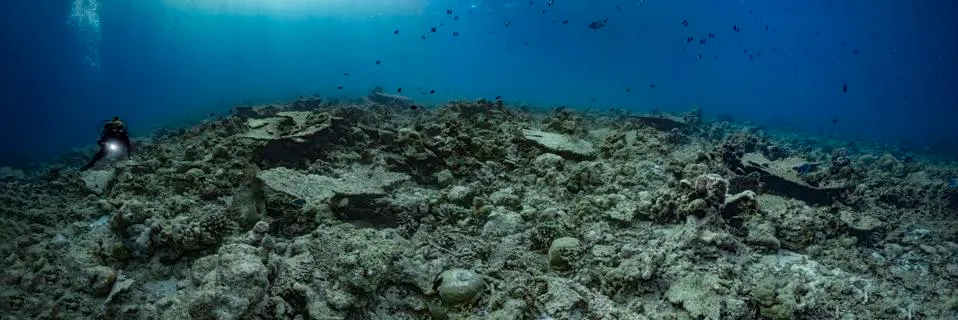
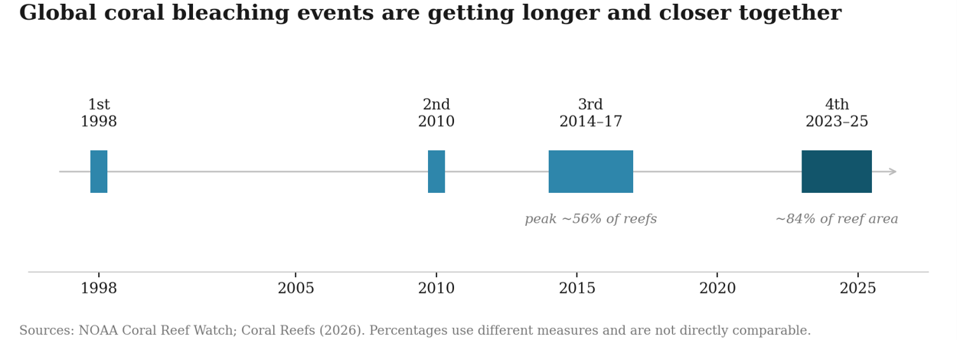
Seasonal effects are just the tip of the iceberg. The deeper changes are more significant, slower, and—on any human timescale—permanent. The ocean transports heat downward, so the heat added at the surface continues to sink, and even if we stopped all emissions tomorrow, the depths of the ocean would continue to warm for centuries. Warm water also expands, which is a major reason why sea levels are rising. It holds less oxygen. And as it absorbs carbon dioxide, it slowly becomes more acidic. Coral is the most obvious victim. The world has just experienced its fourth global mass bleaching event, which, according to NOAA’s Coral Reef Watch, affected nearly 84% of the world’s reefs across the three oceans between 2023 and mid-2025. A study in the journal *Coral Reefs* found that thermal stress persisted uninterrupted from 2018 to 2025, and warned that bleaching is becoming an almost annual phenomenon.
This isn’t just about nature. The heat drives fish toward cooler waters and throws the fisheries that depend on them into chaos. During the last strong El Niño, warm seas helped cause the collapse of the world’s largest single-species fishery—the Peruvian anchovy—and an entire season was canceled. A warmer ocean is a poorer and less predictable one, and the burden falls on food supplies, coastal economies, and the nearly three billion people who get their protein from the sea.
A child born today will live into the 22nd century—long enough to see where this all leads. Let’s ask the hardest question head-on, because the answer belongs to those who will inherit it. A child born this year could easily live into the 2100s. The reefs are the first to fall. The world’s warm-water corals—home to as much as a quarter of all marine life—are on track to disappear almost entirely within that child’s lifetime, as rising temperatures compound the pollution and overfishing that are already putting them under strain. The IPCC found that between 70 and 90 percent of them will die with 1.5 degrees of warming, and more than 99 percent with 2 degrees. Warming had already reached 1.37 degrees by 2025. That threshold is no longer far off.
And 2 degrees is closer to the best-case scenario than to where we’re headed. Under current policies, the world is on track for about 2.8 degrees this century, according to the UN’s 2025 Emissions Gap Report, and if we continue burning fossil fuels, it’s heading toward 3 or 4 degrees—or more—by 2100. At that level of heat, the ocean does not stabilize. Oxygen is depleted from the water, acidity rises, and the IPCC warns that beyond 2 degrees, the risk of species extinction and the collapse of entire ecosystems increases rapidly. A dying ocean is not science fiction. It is the end of the road we are on, and it falls within the span of a lifetime that has already begun.
And it’s even more brutal at sea than on land. When the heat comes after us, we move: toward the shade, toward a cool room, toward a night when the temperature finally drops below body temperature. A reef can’t move at all. And almost everything else in the ocean eventually runs out of places to go. There’s no water colder than at the poles, no oxygen in the depths that the sea hasn’t already lost, no way to escape a heat that arrives faster than any species can adapt. How much of this a child born today will actually see remains to be seen. It depends on what we do next.
The world has just taken a real step toward protecting the ocean, and almost no one has noticed
The science is clear, and what’s at stake is obvious. What matters now is what those in charge do about it, and the results are mixed. Let’s start with the good news—because there is some. On January 17, 2026, after nearly twenty years of negotiations, the High Seas Treaty went into effect. It is the first binding agreement to protect marine life in the two-thirds of the ocean that lie beyond any country’s borders, and more than 80 nations have signed it. For the first time, the world can establish protected areas on the high seas. It’s exactly the kind of joint action this moment needs—and proof that it’s still possible to achieve. And yet, if you missed it, you weren’t the only one. An agreement covering half the Earth’s surface came into force with a tiny fraction of the attention devoted to a simple decision on interest rates. That is the silent problem underlying this whole story: the ocean is the largest and most important climate system we have—and the one we monitor the least.
Systems that monitor the ocean are politically fragile
The contrast with politicians in Washington is striking. In May, the National Science Foundation (NSF) ordered the shutdown of most of the Ocean Observatories Initiative, a network of some 900 deep-sea sensors, built at a cost of about $386 million, which had been sending live data on ocean temperature, chemistry, and currents for more than ten years. Following an outcry from scientists and an unusual bipartisan revolt in Congress, the decision was reversed in June: the NSF said it would stop removing equipment, replace what had already been removed, and establish a panel of experts. Reversing the decision was the right move. But the fact that such a system could be hanging by a thread at this very moment—just as the ocean is entering uncharted territory and a very strong El Niño is forming—shows how easily our eyes on the sea can be shut with a single political decision. Helen Findlay of the Plymouth Marine Laboratory summed up what is at stake: if constant monitoring is eliminated, she said, we are doomed to “navigate an increasingly volatile ocean with ever-diminishing visibility.”
We still control how much heat we’re going to add
It all comes down to one number that we still control: how much more heat we add before we stop. The ocean will continue to warm until greenhouse gas emissions reach net zero. That sets the order of what needs to happen.
First, stop adding heat. Reducing fossil fuel emissions is the only way to turn things around, and the good news—which I’ve written about before—is that money is already flowing: clean energy now attracts nearly twice as much annual investment as fossil fuels.
Second, reduce methane and other short-lived climate pollutants. These leave the atmosphere much faster than carbon dioxide, so reducing them is the quickest way to slow warming in the short term. If implemented quickly, these cuts could prevent up to about 0.5°C of warming by mid-century, buying time for people, ecosystems, and the ocean while the world completes the more difficult task of ending fossil fuel emissions.
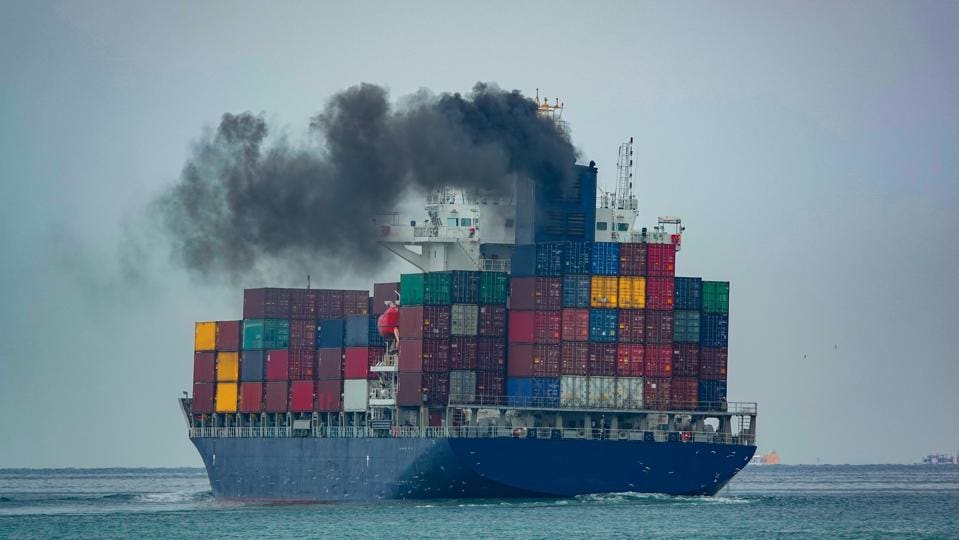
There is a hidden catch in that first step. Burning fossil fuels also releases sulfate particles that reflect sunlight and cool the planet—a “dirty umbrella” that the IPCC estimates has masked about 0.4 degrees of warming. Cleaning up that pollution—something we must do because it kills millions of people each year—lets some of that hidden heat through. The ocean has already felt it. Following a 2020 regulation that reduced sulfur in ship fuel by about 80%, NASA satellites observed a sharp drop in reflective “ship plumes” over the busiest shipping lanes, and some studies suggest that the sudden loss of these aerosols may have contributed to the acceleration of ocean warming behind the 2023 records. The answer isn’t to keep the air dirty. Rather, cleaning it up makes rapid methane cuts more urgent—not less—so that we don’t remove the protective umbrella faster than we’re lowering the temperature beneath it.
The rest is about resilience as the heat that has already built up makes its way through. Protecting and restoring “blue carbon” habitats—mangroves, seagrass beds, and salt marshes—that store carbon and protect coastlines. Mitigating overfishing, pollution, and habitat loss, which leave marine life less able to withstand the heat. And funding marine heatwave forecasts that now give fishing fleets and coastal communities weeks of advance warning.
We already know the cost, and we know the benefit
For investors, this is where the story takes a financial turn. The ocean accounts for more than 3% of global GDP, according to the OECD, and feeds some three billion people. Allowing it to collapse isn’t free: the High-Level Panel for a Sustainable Ocean Economy, a group created by 14 heads of state, estimates that continuing on the current path could cost more than $8 trillion by 2050. It also puts a number on the alternative, and the figure is surprisingly clear: every dollar invested in healthy ocean projects yields at least $5 in return, as the World Resources Institute found in the Panel’s work—a return that most ordinary investments cannot match. And yet, the ocean remains one of the least-funded global goals of all. Funding remains scarce not because the returns are poor, but because the risk has been miscalculated—treated as an environmental footnote rather than a line item on the balance sheet. An ocean breaking record after record is a sign that this situation cannot last much longer.
The sea has been quietly paying off our debts. Now it’s collecting them.
For decades, the ocean absorbed the heat we couldn’t see and asked for nothing in return. That was never a gift. It was a reprieve.
The record-breaking ocean heat this summer is that reprieve running out. It’s returning as a strengthening El Niño, as more intense fall rains and more severe droughts, as bleached reefs, displaced fish, and a heat record more likely to be broken next year than this one. We can’t cool the ocean by looking the other way. And we can’t ask it to bear more than it already does.
The ocean has bought us some time. What we do now will determine whether we have wasted that time.
Ingmar Rentzhog is the CEO and founder of We Don’t Have Time.


