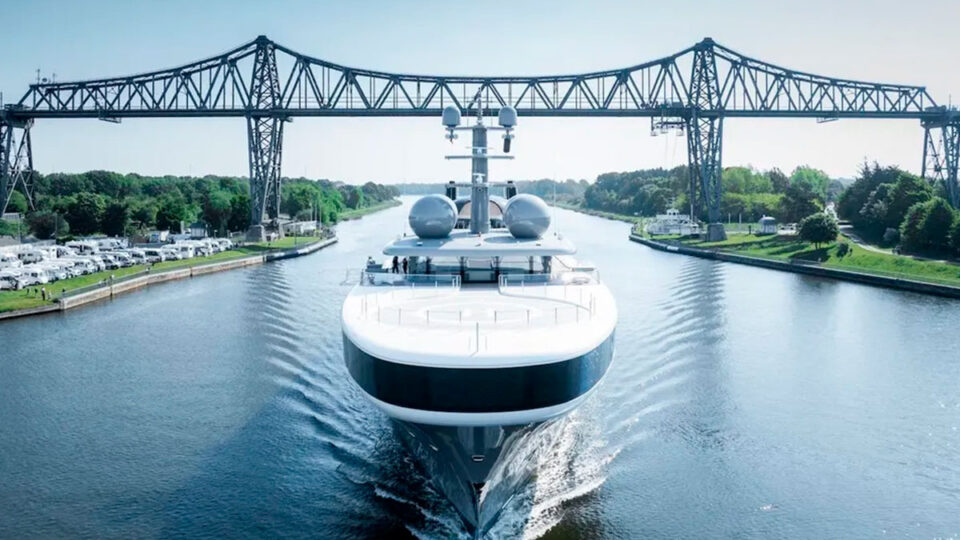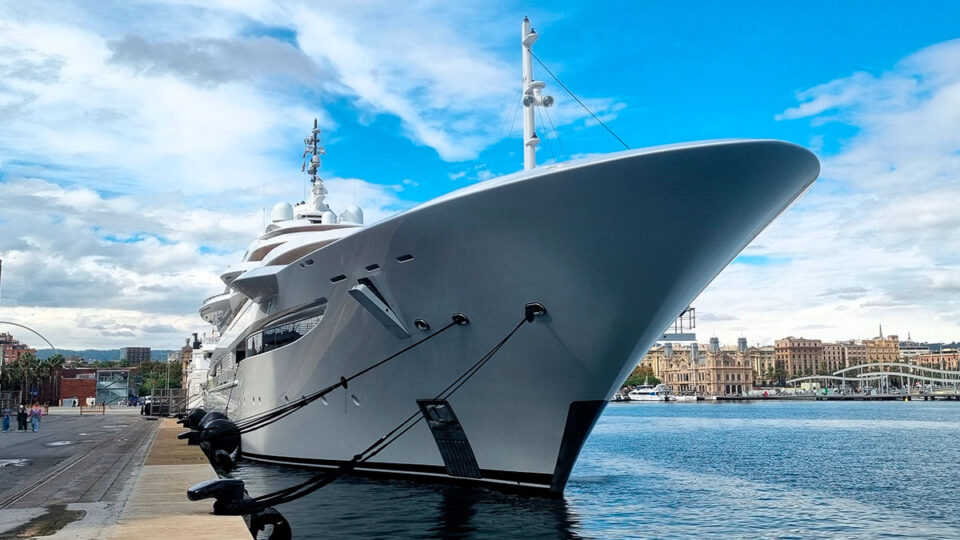








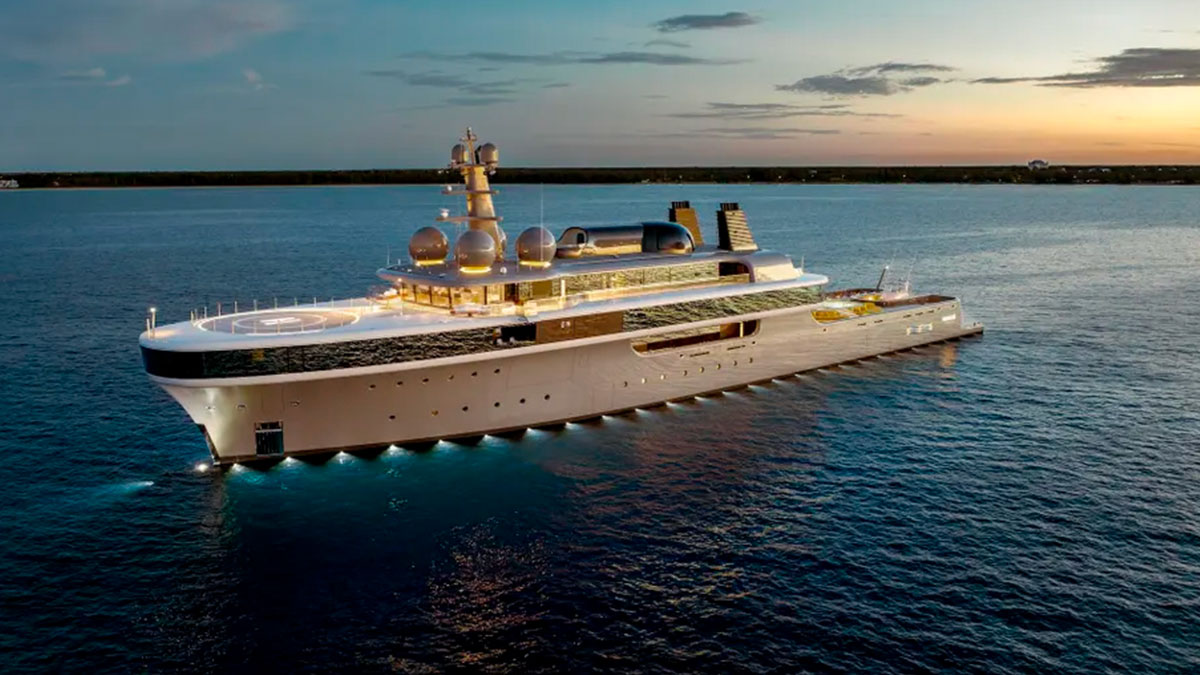
When Japanese businessman Yusaku Maezawa commissioned Lürssen to build a 375-foot (114.2-meter) superyacht, he wasn’t exactly looking for a conventional yacht. The result is Nausicaä: a vessel whose silhouette is more reminiscent of a futuristic aircraft carrier than the familiar profile of stacked decks found on a traditional gigayacht.


The owner, space tourist Maezawa, made his fortune by founding Start Today, the company behind ZOZOTOWN, one of Japan’s largest online fashion platforms. He later sold a majority stake in the business to Yahoo Japan, in a deal that helped cement his position among the country’s wealthiest entrepreneurs.


But his profile extends far beyond e-commerce. A prolific collector of contemporary art, Maezawa became the first Japanese private passenger to travel to the International Space Station, where he spent 12 days in orbit.
His passion for experiences that push the boundaries of what is possible may offer a useful perspective for understanding Nausicaä (something Maezawa himself mentions during an hour-long tour of the superyacht, available on YouTube).


This is the first major superyacht project in which Australian industrial designer Marc Newson has been responsible for both the exterior and the interior—an unusually broad scope of work for a designer whose portfolio ranges from the Apple Watch to the interiors of Qantas aircraft, among other projects.
On the Nausicaä, that unique creative vision extends from the yacht’s overall design to its furnishings, architectural details, and engineering solutions.


Instead of relying on the stepped decks and pronounced curves typical of yachts of this size, Newson has created a relatively understated, almost monolithic silhouette. The superstructure appears to blend into the hull, featuring long glass panels and a distinctly industrial style.
However, the exterior is not merely a stylistic exercise. Nausicaä is built to 1D ice class, which allows her to operate in light ice conditions and gives her the flexibility to sail far beyond the traditional Mediterranean and Caribbean routes.
The Skydome: a glass hall overlooking the sea


One of the yacht’s most extraordinary architectural features is the Skydome, a glass-enclosed space located at the top of the vessel and designed to bring the outdoors inside in an almost uninterrupted way.
The structure consists of seven enormous curved glass panels, each measuring approximately 9.8 by 9.2 feet (3 by 2.8 meters) and about 2.4 inches (62 millimeters) thick. Each weighs about 2,310 pounds (1,050 kilograms), which required a considerable engineering effort to install.
The space houses Maezawa’s private study, which offers him a panoramic view from which to work, read, or watch the yacht glide through the water. The glass architecture is not merely decorative; it is central to Newson’s design philosophy, in which the yacht’s relationship with its surroundings is reflected time and again.
A garage for a sport fishing boat


At the stern, Nausicaä features one of the most unusual solutions for tenders on a yacht of this size: a dry dock exclusively for a 41-foot (12.5-meter) sport fishing boat.
Instead of relying on a conventional crane or an exposed platform for the tender, the yacht features a custom-built sled system that launches and retrieves the sport fishing boat almost imperceptibly.
Once the tender is launched, the system can retract and be hidden from view, allowing the space to be transformed into a sheltered area for guests. This solution integrates the tender’s layout into the yacht’s architecture, rather than treating it as an afterthought.
An art gallery, a golf simulator, and an elegant interior design


Inside, Newson extends this design language through a series of spaces that highlight sculptural forms, unusual proportions, and an emphasis on natural light. The yacht features a two-level atrium, and the main deck is partly dedicated to an art gallery, reflecting Maezawa’s interest in contemporary art.
In fact, throughout the yacht, art is not merely an addition to the onboard experience, but an integral part of its layout. Rather than filling the yacht with custom-commissioned furniture and artwork, the interior design treats the architecture itself as the defining element.
The details and furnishings have been designed to complement the overall aesthetic, avoiding the fragmented style that can occur on large custom-built yachts when various design disciplines come together.
A submarine and a pop-up beach club: a yacht built around a connection to the sea


Nausicaä’s list of amenities goes beyond the conventional inventory of a superyacht. The yacht has its own submarine, allowing the owner and his guests to explore beneath the surface as well as travel on it (in the YouTube video, the owner is seen descending into the depths aboard the submersible alongside his dog). The submarine’s deployment and storage system is also seamlessly integrated into the hull.
At the bow, a glass-enclosed observation lounge is located beneath the helipad and offers a panoramic view of the water. It is one of the clearest expressions of Newson’s approach: using glass and geometry to create environments that feel connected to their surroundings while remaining structurally and functionally distinct.


In addition, the yacht accommodates up to 18 guests in nine cabins, attended to by a crew of about 36 people. But the guest capacity is probably the least interesting aspect compared to the spaces themselves, which are designed to accommodate a wide range of experiences, from art and entertainment to exploration and privacy.
At 375 feet (114.2 meters), Nausicaä is undoubtedly a statement of scale. But the most interesting statement is one of design ambition. Maezawa appears to have commissioned a yacht that reflects his appetite for the unconventional, while Newson has taken advantage of the freedom afforded by the commission to create something that resembles less a conventional superyacht and more a unique piece of industrial design.