








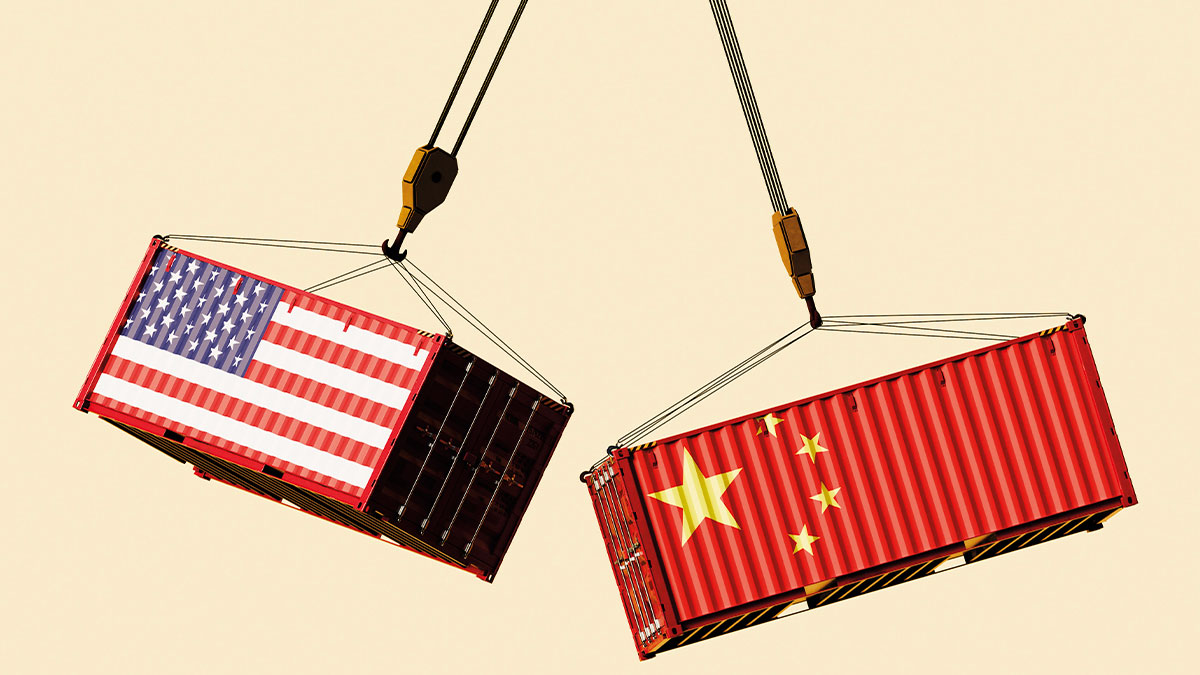
It’s impossible to avoid reading, hearing, or seeing the first and last name of the 47th president of the United States when discussing geopolitics, the economy, wars… and even the naval and shipping industries. Donald John Trump is omnipresent in headlines, articles, websites, photos, and print magazines—just as we are doing right now in the pages of Nautik Magazine. This time, there’s a compelling reason: the trade war with China has reached the shipbuilding industry—and with a vengeance—as the country led by Xi Jinping, President of the People’s Republic of China, now accounts for more than 50% of global shipbuilding. Around 55% of the world’s merchant ships now come from Chinese shipyards—a trend that Washington is attempting to counteract, or overshadow, as one might expect: with tariffs.
On October 14, 2025, the United States Trade Representative (USTR) imposed port fees on ships built, operated, or owned by China: up to $50 per net metric ton per voyage, a figure that was set to increase each year through 2028. Beijing responded within days with a mirror tariff on U.S. ships. According to estimates by the consulting firm Alphaliner, had the measure remained in place, the world’s ten largest shipping companies would have paid up to $3.2 billion in a single year, with Cosco—the Chinese state-owned shipping company and already the world’s fourth-largest—bearing the heaviest burden.
The escalation lasted less than a month of peak tension. Following the summit between Trump and Xi Jinping in Busan, South Korea, in late October, the two powers agreed to freeze mutual tariffs for one year, until November 9, 2026. In other words: by the time you read this issue, the truce will be just a few weeks away from expiring, and there is no guarantee it will be renewed. The investigation that led to the U.S. tariffs—launched under Section 301 of the Trade Act—concluded that Beijing had built its naval dominance through state subsidies, cheap credit, and protection of the domestic market. It had not merely built that dominance through industrial efficiency.
Trump’s Efforts Toward a Resurgence
Washington remains determined to revive an industry that today accounts for just 0.1% of global ship production—a far cry from the dominance it enjoyed after World War II. The plan combines subsidies, local content requirements, and partnerships with allied shipyards: South Korea’s Hanwha has already taken control of the historic Philly Shipyard in Philadelphia, Pennsylvania, to accelerate military and commercial shipbuilding on U.S. soil. Behind the tariff standoff, in reality, lies a military concern: the same shipyards that launch container ships can be converted to build warships, and Beijing can produce in a single year what the U.S. Navy would take decades to launch.
The magnitude of the gap explains the U.S. sense of urgency. According to data cited by the Pentagon itself, China’s shipbuilding capacity is more than 200 times that of the United States, and China currently has more active combat vessels than the U.S. Navy, albeit with lower tonnage. Washington and Beijing have each established trade and investment councils to manage their disagreements without triggering new crises like the one in October, but no one in the industry considers the matter settled: all it would take is a statement from Trump or new Chinese controls on rare earths for port fees to be reinstated overnight, just as automatically as they were frozen.
For Spain, this is not a distant issue. A large portion of the container ships that dock in Valencia, Bilbao, Las Palmas, or Algeciras come from Chinese shipyards, and the same is now true for passenger and roll-on/roll-off cargo transport. One example: the new GNV ferries, which serve Barcelona, Genoa, and Tangier Med, were built at the Guangzhou shipyards in China as part of a fleet renewal project valued at more than 1.2 billion euros. European shipyards such as Fincantieri and Spain’s Navantia are watching the standoff between Washington and Beijing, knowing that, regardless of who wins, the future of civilian shipbuilding is no longer decided in the Atlantic, and that Europe will have to choose a side—or build its own— before the truce expires.
This article is part of Issue 8 of Nautik, which you can find at newsstands and in our online store.


