








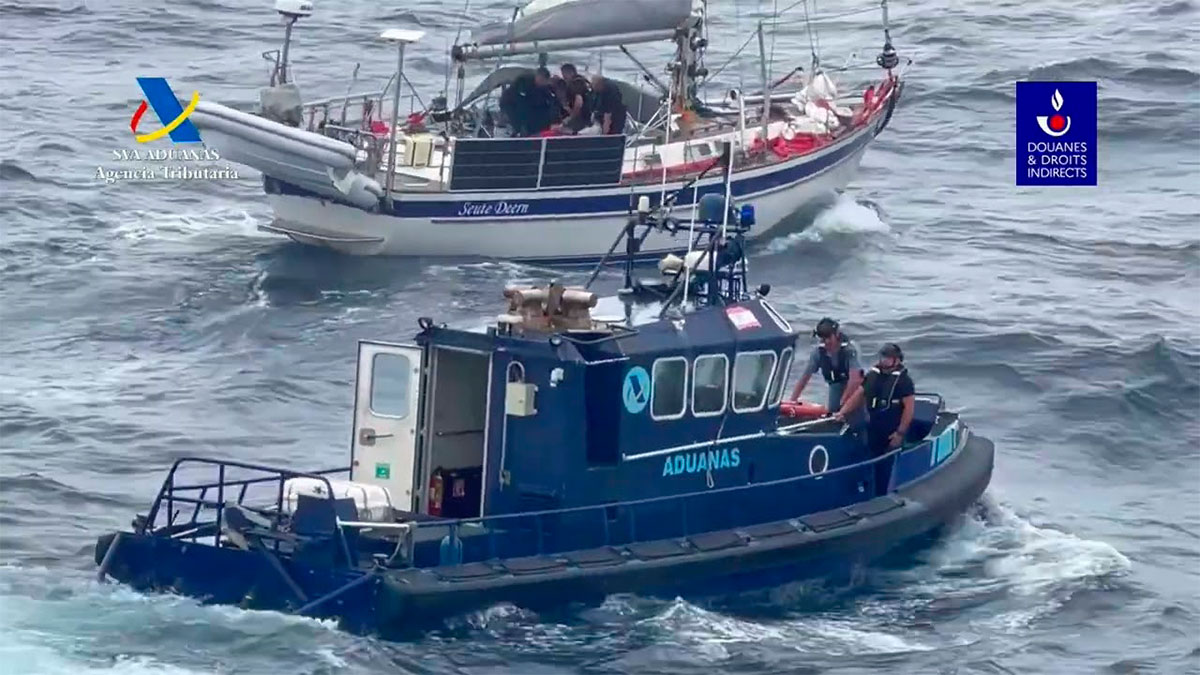
The Tax Agency’s Customs Surveillance Service (SVA) has intercepted a Polish-flagged sailboat carrying nearly 2,100 kilograms of cocaine, about 400 miles off the Galician coast. The vessel, named Seute Deern, has been towed to the port of Vigo, where both the drugs and the five detained crew members will be brought before a judge.
The operation, code-named “Doncella” and led by the SVA Unit in Girona, resulted in five arrests and concluded an investigation that began in February, when intelligence reports indicated that a sailboat between 13 and 15 meters in length was off the Catalan coast and may have been involved days earlier in an illicit operation in the border area between Spain and France.
Officers identified the sailboat—a sloop flying the Polish flag and measuring 14 meters in length—in the port of Roses (Girona) last June. The man who appeared to be its owner, a Chilean national, had a criminal record for theft and robbery, which led investigators to focus on this line of inquiry from the start.
The boarding at sea
On July 11, while already under surveillance, the sailboat left Roses without activating the AIS tracking system (which is mandatory while at sea) in order to evade tracking. From that point on, thanks to cooperation with the British NCA and the U.S. DEA, coordinated through the Maritime Analysis and Operations Center—Narcotics (MAOC-N), the Special Operations vessel Petrel I managed to locate the vessel in the early morning hours of September 14, 400 miles off the Galician coast.
While being towed to Vigo, in rough seas, the boat lost its mast due to the waves.
During the boarding, agents found 70 unmarked bales of cocaine scattered throughout the vessel, weighing approximately 2,100 kilograms. The four crew members (of Argentine, Uruguayan, Colombian, and Albanian nationalities) were arrested. The Albanian crew member served as a “notary” for the receiving criminal organization, assuring his group that the operation was proceeding as planned.
Facilitators’ Network Busted
While the Petrel I was towing the sailboat toward Vigo, the operation was completed on land with the arrest of the organization’s leader—a Chilean national residing in Girona—who was responsible for recruiting vessels with specific characteristics. The investigation remains open, and the arrest of a second individual—a Spanish national residing in Barcelona who was in charge of guarding the vessels and monitoring for any potential approaches by the authorities—is not ruled out in the near future.
According to customs sources, the high-end sailboat was equipped with solar panels, a B&G antenna for GPS geolocation, and a connection to Elon Musk’s Starlink satellite network, which investigators point to as a channel increasingly used by drug traffickers to communicate on the high seas.
International Cooperation
The operation was carried out in close cooperation with the French Customs Intelligence and Investigation Directorate (DNRED), with support from the Intelligence Center against Terrorism and Organized Crime (CITCO) and the MAOC-N. The case will be handled by the National Court, which will conduct the interrogations of the detainees.
The five individuals arrested are charged with alleged crimes of membership in a criminal organization, smuggling, and crimes against public health.
Galicia, the heart of the Atlantic Route
The case confirms the continued existence of what is known as the “Atlantic Cocaine Route,” the route used by sailboats from South America to transship drugs on the high seas before smuggling them into Europe. According to data from the Tax Agency, cocaine seizures in Galicia skyrocketed by 386% in 2025, reaching 9.3 metric tons, which cements the region’s status as one of the main entry points for maritime drug trafficking on the continent.