








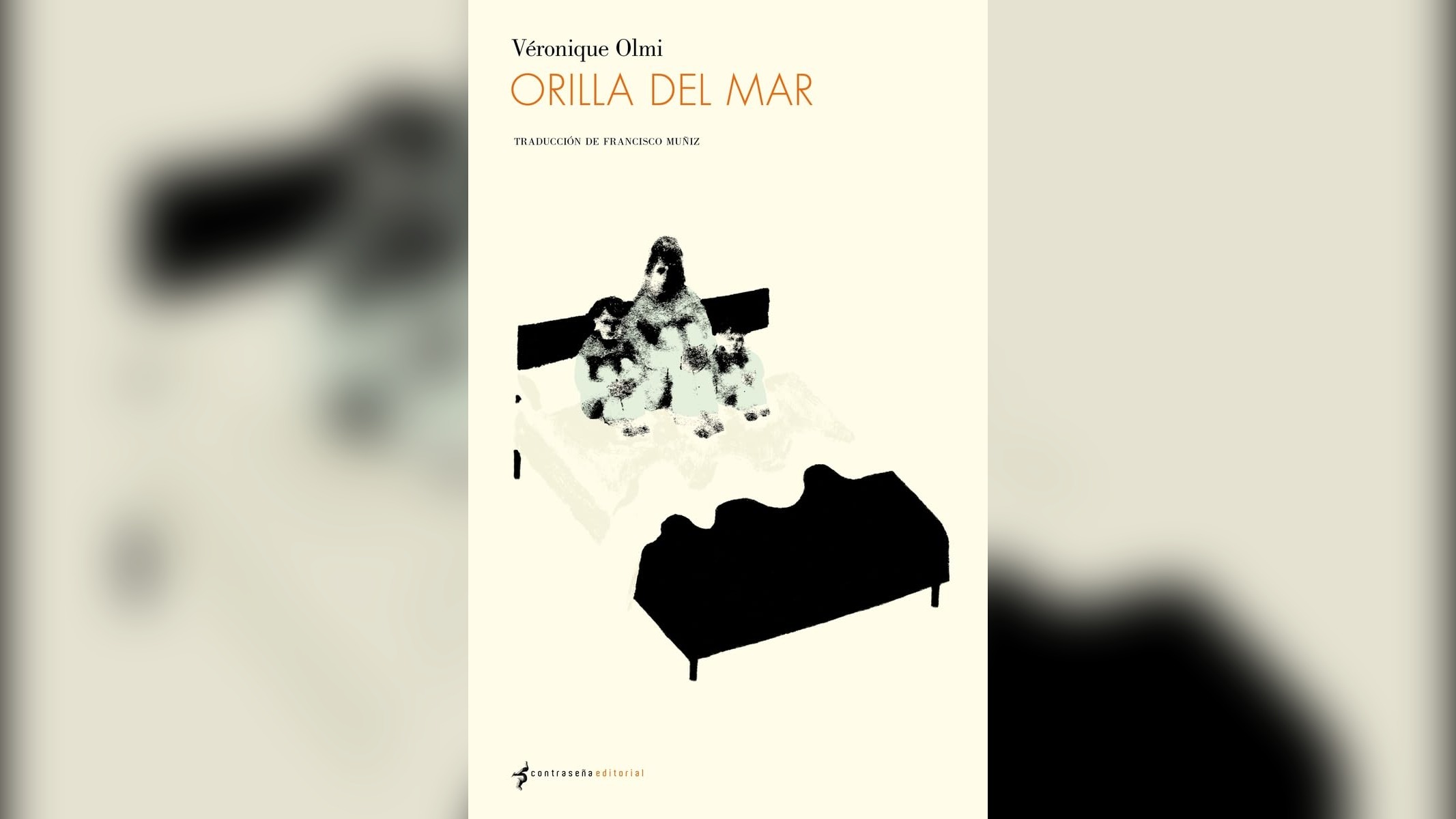
In the history of literature, the sea is often assigned a gentle role: that of a setting for leisure, freedom, or renewal. Véronique Olmi (Nice, 1962) turns that convention on its head in Orilla del mar, the short novel that earned her the Alain-Fournier Prize in 2001 and is now being reissued in Spanish by Contraseña, translated by Francisco Muñiz. Here, the sea is cold and bleak—a winter sea upon which the rain falls relentlessly, indifferent to the suffering of those who approach it. Far from offering comfort, the seascape serves as a mirror reflecting the protagonist’s inner decline.
The story follows an unnamed woman traveling by bus with her two sons, Stan, nine, and Kevin, five, to a coastal town. It’s the family’s first vacation, and the boys find it strange that their mother chose this particular time of year, when they should be in school. They arrive in the town at night and check into a modest hotel, with a tiny room almost entirely taken up by the bed. The next day, they head down to the beach, stop at a café, and, after an afternoon cooped up in the hotel, end up at a fair. The mother struggles to keep up the illusion of a happy getaway, but the rain—which greeted them upon their arrival and never lets up—gradually strips away that pretense page by page.
That gray coastline, devoid of light and warmth, where time and space blur into a constant haze, exacerbates the family’s isolation. The sea, far from opening up a horizon, closes in on them. Beneath that coastal surface also lie economic precariousness, loneliness, and a motherhood stripped of idealization. Over the course of barely a hundred pages, Olmi maintains a restrained, direct, and yet lyrical prose that precisely captures the narrator’s fragmented state of mind. The novel leaves a lasting impression, and its reception in Italy—which was particularly laudatory—highlighted precisely that “ruthless” beauty that offers the reader neither concessions nor respite.


