








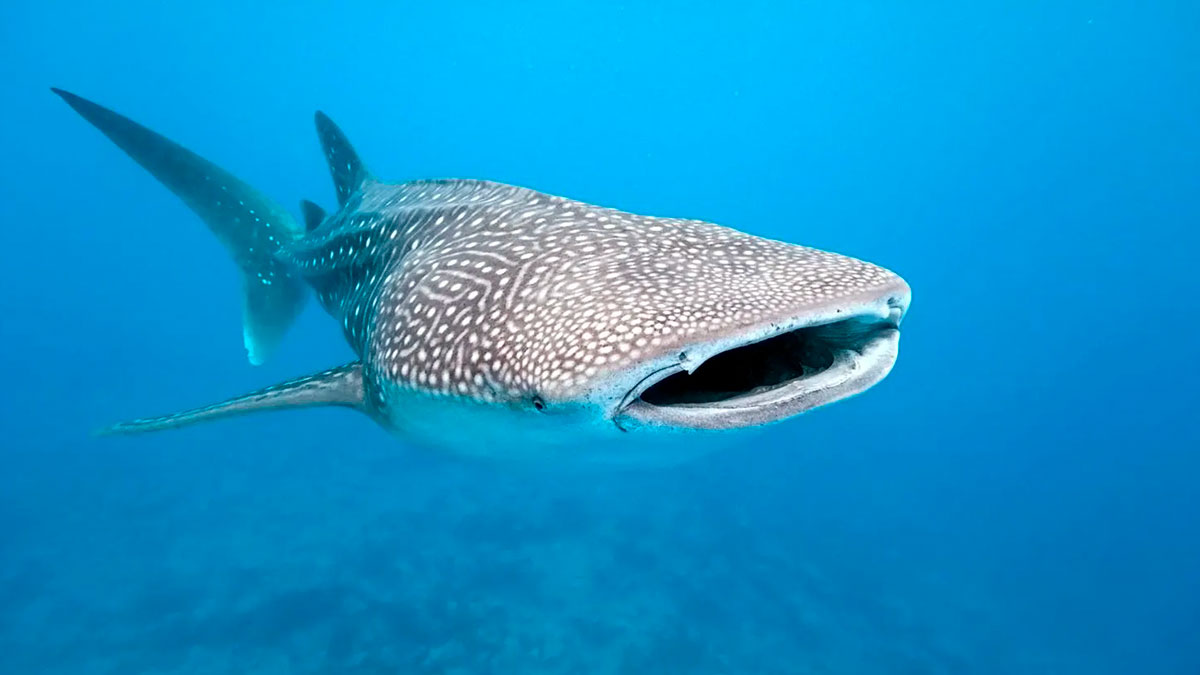
For researchers working off the Yucatan Peninsula in Mexico, one particular whale shark has become a familiar sight. Its name is Milo, and it has done something no other shark has ever achieved in a tracking study: over the course of nearly a decade, it has traveled more than 34,000 miles (54,700 kilometers), setting a record for the longest documented movement trajectory of any shark.
Milo is a 26-foot (8-meter) male whale shark that was first tagged with a satellite tag in 2017; the tag transmitted data for only a couple of weeks while researchers were still refining the tagging technique. But rather than losing track of him, the research team kept trying, and Milo was successfully fitted with new fin-mounted satellite tags in 2018, 2020, 2023, and, most recently, in July 2026.
These repeated efforts, in turn, resulted in a long-term record of a single animal’s life. “Milo is a very significant whale shark, a large subadult male measuring more than eight meters in length,” explained Rafael de la Parra of the Mexican conservation organization Ch’ooj Ajauil AC. “He was the first one I fitted with a real-time satellite tag mounted on his fin.” Nearly 10 years later, de la Parra fitted Milo with his fifth tag.
Thanks to these tags, we have been able to confirm that Milo has traveled extensively throughout the Gulf of Mexico, around the northern Caribbean islands, east of Bermuda, and as far north as Massachusetts in the United States. At other times, however, he has remained in relatively small areas for months.
“Milo has revealed just how flexible whale sharks can be,” said Dr. Mahmood Shivji, director of the Guy Harvey Research Institute at Nova Southeastern University. The shark has demonstrated “the ability to undertake extremely long migrations, deep into the Atlantic,” while also showing that it is “just as content to ‘stay put’ for months in small areas.”
Whale sharks are often described as nomadic giants. While they are undoubtedly capable of undertaking enormous journeys, Milo’s recorded movements suggest that their lives are not a single, continuous oceanic road trip. Rather, these sharks may alternate between long migrations and periods when certain areas offer them exactly what they need… and what they need is usually tiny!
Whale sharks (Rhincodon typus) are the largest fish in the ocean, and some individuals reach extraordinary sizes. Despite their size, they are filter feeders that eat some of the ocean’s smallest animals (including zooplankton, fish eggs, and larvae). In the summer, enormous quantities of fish eggs and larvae accumulate near the surface off the coast of the Yucatán Peninsula, creating a seasonal feeding frenzy that attracts whale sharks and manta rays from across the region. It is here that researchers have repeatedly encountered Milo. This seasonal aggregation has become both an important research hub and a premier ecotourism destination, with local boat operators taking visitors out to swim with whale sharks. In 2026, the aggregation experienced a remarkable resurgence, with hundreds of whale sharks and manta rays present each day, following several years of lower numbers.
Since 2017, the research team has attached 48 fin-mounted satellite tags to whale sharks in the Yucatán Peninsula region. The fact that Milo has been tagged multiple times makes his record particularly unusual, as researchers have been able to link movement data spanning nearly 10 years. “Long-term studies like this are essential to better understanding the complete life history of these long-lived animals,” says Dr. Guy Harvey, founder and president emeritus of the Guy Harvey Foundation. “Being able to tag the same animal five times and track it for nearly a decade is unprecedented.”
Previous research by the Guy Harvey Research Institute suggests that whale sharks may live for more than 125 years, so a decade is only a fraction of a whale shark’s potential lifespan. Even so, that relatively brief window can reveal insights that would be impossible to glean from a single season of observations. Repeated tracking can show—and in fact has shown—where the sharks feed, which habitats they return to, and how their movements change over time. It can also help scientists understand the relationship between whale sharks and the oceanographic conditions that concentrate their food: when a shark repeatedly appears in an area at a certain time of year, what is it responding to? Temperature? Currents? Prey availability? Or some combination of these three factors?
Whale sharks are currently classified as an endangered species by the International Union for Conservation of Nature; threats to them include overfishing and collisions with boats. Understanding their migration routes can also help identify the locations and corridors that are important for their survival. With Milo, we have living proof that, although a whale shark can travel thousands of miles across the open ocean, that same individual can return time and again to the same productive feeding grounds. And, in a way, he has made the vast ocean seem a little smaller.