







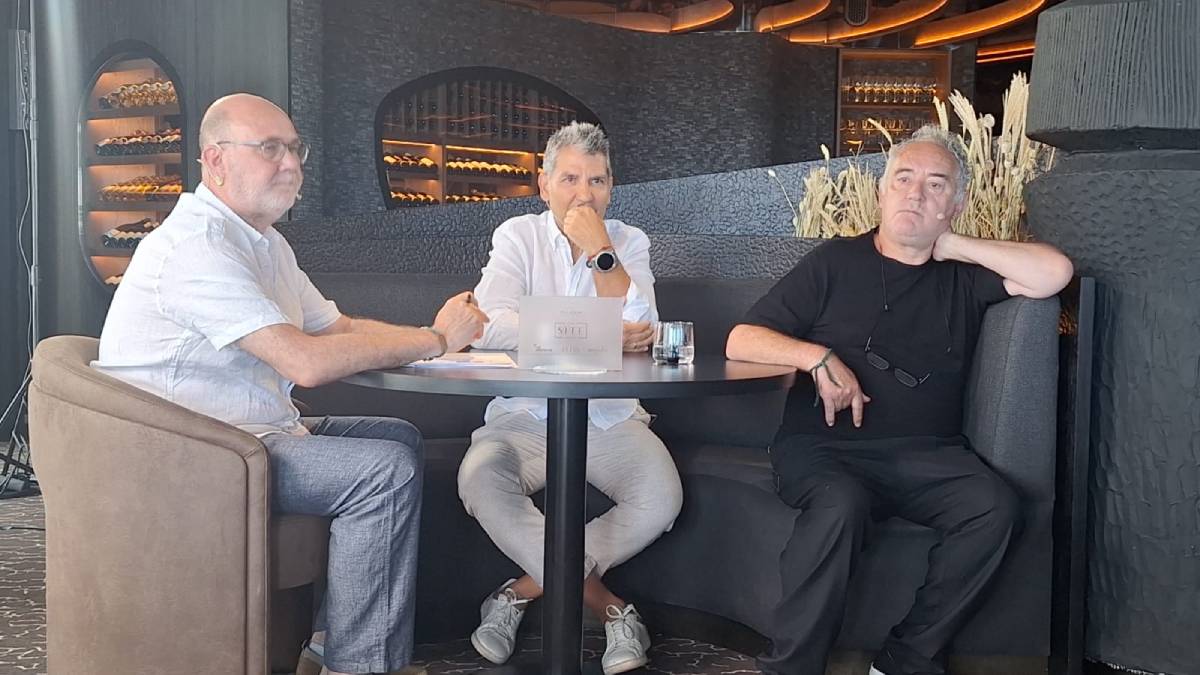
Award-winning chefs Ferran Adrià and Paco Roncero recently held an interesting and fascinating debate in Ibiza about the current state of the restaurant industry, how to approach the restaurant business, and its future, in front of about twenty media representatives and gastronomic experts from the Balearic island at the Bless Collection ‘The Site’ hotel in Platja d’en Bossa.
Paco Roncero and Ferran Adrià, two masters of contemporary cuisine with several Michelin stars to their name. They have known each other for years. They worked together at El Bulli and on other projects within the group. They are colleagues, friends, and lovers of the culinary arts. With this goal in mind, they sat down together at chef Dabi García’s restaurant Leña to talk about current topics for an hour, under the attentive and enthusiastic gaze of the audience, in an event organized by Toni Masanés for the first podcast of The Site Bless Collection, titled “Gastronomy, Creativity, and Technology.”
In response to the first question – “What’s the first thing you pack in your suitcase?” – Ferran, with his usual wit, replies that “the most important thing about a trip is not having to check luggage; I’ve been traveling the world for 46 years and have saved thousands of hours by not having to check luggage.“ When asked the same question, Roncero answers, “I bring two small suitcases: one for clothes and my sneakers, and the other empty, to fill with whatever catches my eye and interests me from a place, and to satisfy my curiosity, one of the most important things for a chef.”
The talk focuses on technology and its advances, and in light of this, Ferran points out that “innovation must be managed; it has to be easy to use so that its drivers are satisfied. Martian-style innovation, on the other hand, tends to cause a lot of headaches. If you don’t understand things, you can’t do them. We live in a Matrix: if you don’t connect the dots, it doesn’t work.
Roncero spoke about his experience with his luxury and avant-garde restaurant Sublimotion, also located at The Site and recognized as the most expensive in the world (€1,750 per person, with only 12 seats). “Sublimotion is crazy; it has evolved over a decade to establish itself as a world-leading restaurant. Techniques have become more accessible: you can now eat very well at any restaurant because people want to have fun and enjoy experiences.” To which Adrià adds: “I experienced it myself yesterday, and I can say it’s a unique restaurant and a product of modern execution. It’s the last rung on the luxury gastronomic ladder; the price isn’t for everyone, but considering how expensive hotel prices and everything else are becoming, we had been receiving millionaire guests from all over the world at El Bulli for years.“
I pose the essential question about the gastronomy of Ibiza and the Balearic Islands: Why have the world’s best chefs opened restaurants on the island? Ferran doesn’t hesitate for a second and answers immediately. “Ibiza has the best culinary scene in the world. It’s incredible. On the French Riviera, it’s hard to find a simple, charming place to eat well by the sea, but here, they’re everywhere.”
The gastronomic bubble takes center stage in this face-to-face interview: “It’s not that important; in our culinary world, it self-regulates, although it is currently going through a turbulent and complex period. Currently, there are many two- and three-star restaurants in Europe and, with some exceptions, it’s possible to get a reservation for today, and most of them rely on alternative revenue streams to survive, such as conferences, books, and consulting work. Ninety percent have to find ways to make ends meet.” At this point, Roncero highlights the importance of management: “An aspect that was forgotten in culinary training until recently, but which is vital for streamlining ingredient purchasing and the chef’s work. You can’t just cut and prepare the fish and wild mushrooms to feed hundreds of diners; you need suppliers who make this job easier for you, just the way you want it, while maintaining quality.”
Ferran takes the floor and asks the audience, “Do you know how many times I’ve been told that I’ve ruined traditional cuisine? And I wonder what the difference is between traditional cuisine, popular cuisine, and home cooking.” The most common style, however, is eclectic; this menu combines bread with tomato with a triple tuna dish – this exemplifies the eclectic approach.”
Roncero concludes by saying, “We don’t go to restaurants to be surprised. Curiosity drives us to find something different.” Adrià, for his part, says, “I’ve retired; I don’t have a restaurant, nor do I want one. When I want to go to a good restaurant, I go to see my brother Albert in Barcelona, at Enigma.”


