








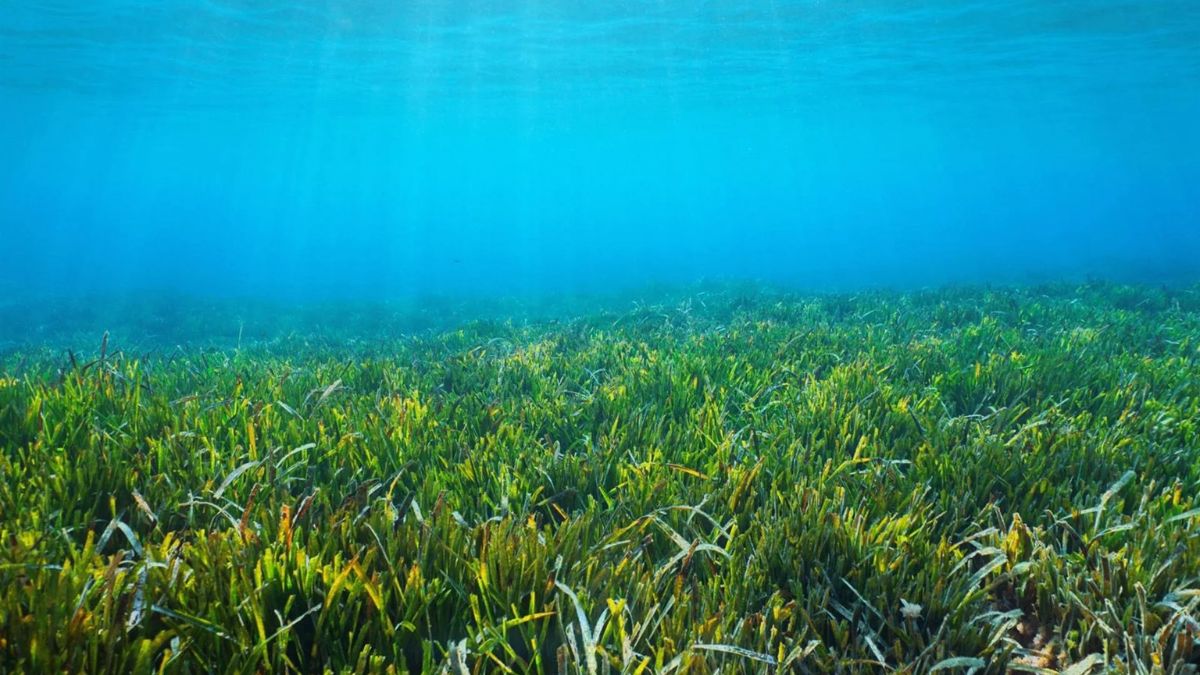
The waters around the Balearic Islands have the highest carbon dioxide (CO₂) sequestration capacity in the western Mediterranean, thanks to seagrass meadows, especially Posidonia oceanica.
This is revealed in a study, led by Imedea CSIC-UIB researcher Nerea Piñeiro-Juncal, which quantifies for the first time the amount of CO₂ stored by coastal ecosystems, known as "blue carbon," such as seagrass meadows and salt marshes in Spain and Portugal.
According to a press release from Imedea, seagrass meadows are part of a natural system capable of storing the equivalent of approximately 25% of the annual emissions from these two countries.
In general, the research highlights that these areas store an "enormous amount" of carbon, and the western Mediterranean plays a significant role. Thus, the Balearic Islands play a "decisive" role, as seagrass meadows of *Posidonia oceanica* account for around 40 percent of the total area of the seagrass meadows analyzed.
This plant, which is found exclusively in the Mediterranean, according to the study, accumulates carbon in the marine sediments over centuries, turning the seabed into "a true natural depository."
According to Nerea Piñeiro-Juncal, "seagrass meadows are long-term carbon sinks." "In the Balearic Islands, their extent makes them Spain's main blue carbon sink, contributing significantly to adaptation to climate change."
In fact, the report notes that of the 1,976 square kilometers (km²) of seagrass meadows and marshes that store CO₂ in Spain and Portugal, the largest percentage corresponds to the seabed of the Balearic Islands archipelago, at 650 km².
Similarly, they have highlighted that Spain and Portugal are home to two of the main types of blue carbon ecosystems: seagrass meadows and salt marshes. To date, no 'comprehensive' national assessment of the carbon stocks of blue carbon ecosystems (BCEs) has been carried out in Spain and Portugal.
The study by Piñeiro's team assesses the magnitude of the carbon sink associated with these ecosystems across the Iberian Peninsula and the Spanish island territories, as well as the potential CO₂ emissions resulting from their degradation.
Thus, it is estimated that the biomass ecosystems (BEs) in the study area store 95 teragrams (Tg) of CO₂ in biomass and the top meter of soil, which is equivalent to approximately 25 percent of the CO₂ emissions from Spain and Portugal in 2022.
However, the study warns that this 'climate treasure' is not guaranteed, as the deterioration of these ecosystems over the past century has already released large amounts of CO₂ into the atmosphere.
Specifically, the research suggests that, for this reason, between 11 and 27 Tg of CO2 may have been released over the past century, and forecasts predict that if protection measures are not strengthened, many more emissions could be released in the coming decades.
Specifically, it is estimated that between 1.3 and 5.6 Tg of CO2 will be released over the next 30 years. According to the study, this highlights "the urgent need to redouble conservation and restoration efforts."
In this regard, they point out that in the Balearic Islands, tourist pressure, boat anchoring, pollution, and coastal development are some of the main threats to seagrass.
"Their degradation not only entails a loss of biodiversity, but also the release of carbon accumulated over hundreds or thousands of years and the loss of their carbon sequestration capacity, which helps offset some of the emissions from the island population," they state.
For the researcher, the value of these ecosystems "goes far beyond carbon," as "they are fundamental to the health of the coast and to key sectors like tourism."
"And the fact is that, in addition to their role in climate change, seagrass meadows are essential for the archipelago: they protect beaches from erosion, improve water quality, and serve as a refuge for numerous marine species," she adds.
For this reason, the study paves the way for the integration of blue carbon into climate and conservation policies, and proposes incorporating the obtained data into national emissions inventories and using it as a basis for carbon restoration and offset projects.
"In the context of the climate crisis, the message is clear: protecting seagrass not only preserves the archipelago's landscape and biodiversity, but also directly contributes to slowing global warming," they conclude.