







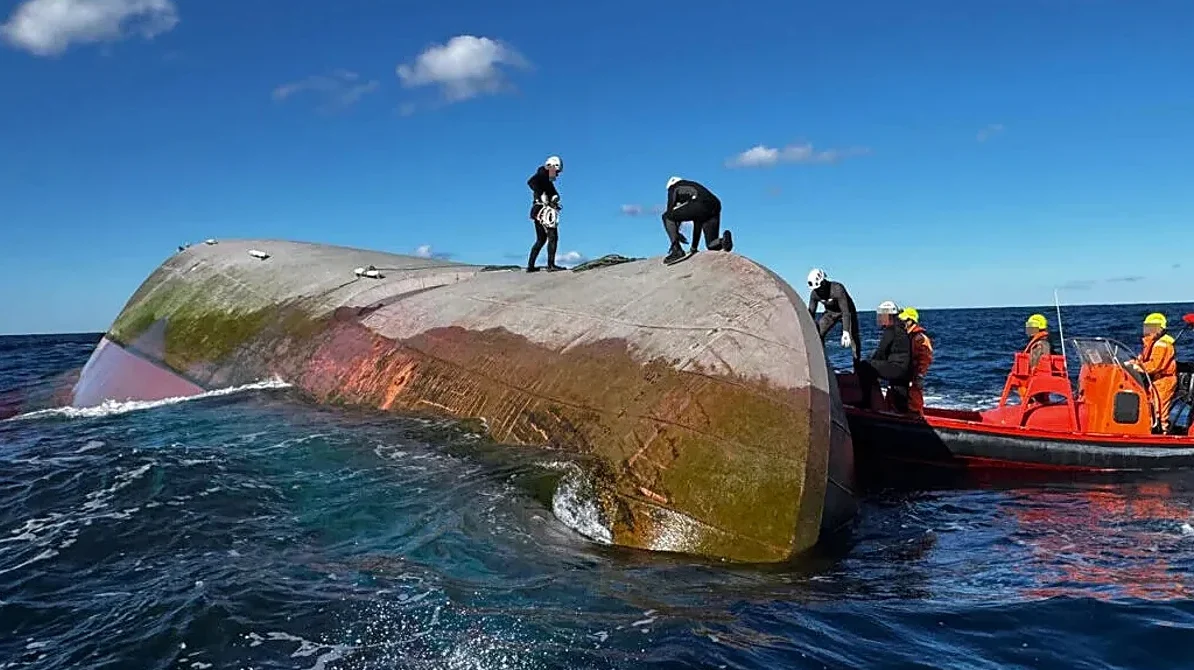
The future of the Med Emre, the ship that remains capsized off the coast of Ibiza with some 7,000 tons of diesel in its tanks, faces a new source of uncertainty. The Regional Government of Murcia and the City Council of Cartagena have rejected the proposal to move the ship to that port to drain its fuel, an operation that the central government had reportedly proposed to the Murcian authorities. This refusal adds to those of the regional governments of the Balearic Islands and the Valencian Community.
Regional President Fernando López Miras and Cartagena Mayor Noelia Arroyo made their opposition public after an emergency meeting convened this Friday at City Hall. The meeting took place after First Deputy Prime Minister Carlos Cuerpo informed López Miras of the decision to use the Port of Cartagena to receive the ship and remove the fuel it is carrying.
The regional government’s response was one of outright opposition. López Miras described the proposal as a unilateral decision and asked the Spanish government to consider other alternatives. “No one is giving us any safety guarantees in the face of the danger posed by an operation of this type,” said the president, who believes that Cartagena should not have to assume the risk of a possible environmental disaster resulting from an accident that occurs hundreds of miles off its coast.
The concerns of the Murcia authorities are not limited to a possible fuel spill. As both leaders warned, the planned tow route would pass through areas of particular ecological value and could endanger strategic infrastructure for the region’s industrial and energy sectors.
López Miras pointed out that the port of Cartagena is the only one in the Mediterranean that has ten protected areas within the Natura 2000 network. Among the areas that could be affected by a possible accident, he mentioned the Calblanque Natural Park, the marine reserves, the cetacean corridor, and several protected areas designated as Sites of Community Importance (SCIs). He also warned of the possible consequences for fishing, agriculture, and other coastal economic activities.
Adding to this situation is the proximity of the Mar Menor, another factor that, according to the regional president, must be taken into account before deciding the ship’s fate.
The strategic importance of the port of Cartagena
One of the key arguments against the proposal is the impact an incident could have on the Escombreras industrial complex. This infrastructure includes facilities such as a refinery, liquid traffic terminals, and a liquefied natural gas plant, and plays a significant role in the national energy supply.
López Miras pointed out that approximately 40 percent of Spain’s fuel supply comes from the Escombreras Valley and warned that its only access road is a particularly vulnerable point. An accident, a sinkhole, or a grounding during operations could endanger maritime traffic and the operation of an infrastructure that he considers strategic for the country’s economy and energy supply.
The mayor of Cartagena raised another cause for concern: the proximity of the arsenal and the naval base, facilities that are part of the national defense infrastructure. Arroyo questioned who could guarantee that the relocation would be carried out without posing a risk to the local environment and asked that other sites be considered if there were no sufficient guarantees.
The time required to complete the operation is also one of the objections. According to López Miras, the salvage of the Med Emre could take months, as it will be necessary to carry out righting maneuvers, remove the cargo, and recover the wreck with specialized equipment, all while occupying a considerable amount of port space. An operation of this type could disrupt normal activities in Cartagena, affecting its facilities and commercial traffic.
“The Region of Murcia cannot accept being the destination for this operation without first evaluating all the consequences,” declared the regional president, who insisted that the central government must find an alternative. “We are talking about environmental, industrial, economic, and operational risks that must be evaluated before any decision is made. They cannot put Cartagena at risk; they cannot put the Region of Murcia at risk for an accident that took place 200 kilometers from here,“ concluded López Miras.
Also attending the meeting were the president of the Port Authority of Cartagena, Pedro Pablo Hernández, and the regional councilors for the Presidency, Marcos Ortuño, and for Infrastructure, Jorge García Montoro.
Another rejection of the ship’s fate
Murcia’s refusal follows similar stances previously adopted by the governments of the Balearic Islands and the Valencian Community, which have also refused to allow the ship to dock in their ports.
The Med Emre capsized in the early hours of Thursday, about 19 miles northwest of Ibiza. The accident killed the chief engineer and left the vessel with some 7,000 tons of diesel in its tanks, raising ongoing concerns about the risk of marine pollution.
Cartagena is more than 120 miles from the accident site, roughly twice as far as the Valencian coast. Moreover, the complexity of a discharge operation that could last several weeks increases the uncertainty about the cargo ship’s final destination.