








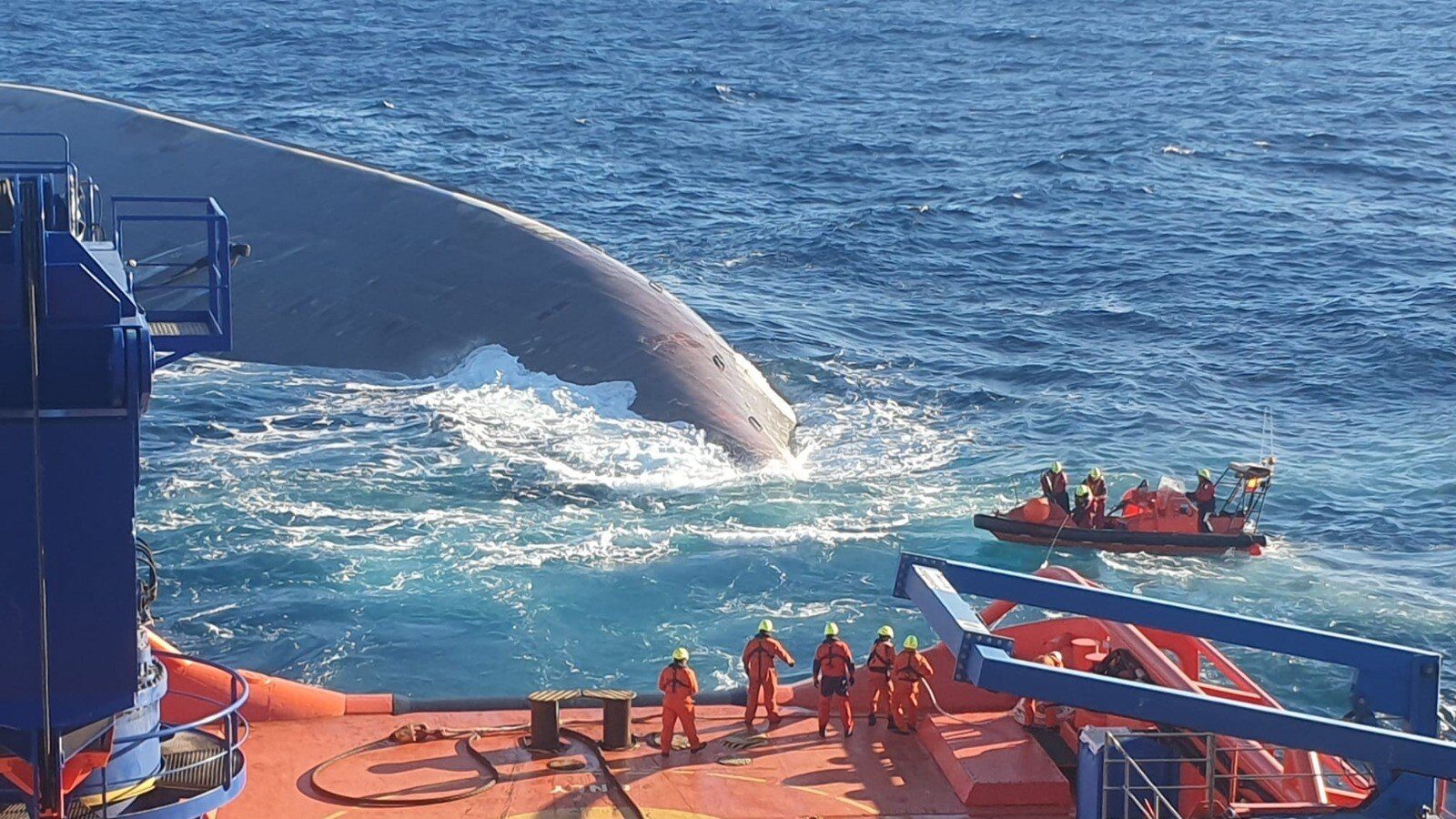
The future of the ‘Med Emre’, the oil tanker that sank off the coast of Ibiza with about 7,000 tons of diesel on board, enters a crucial phase this Friday. A team of divers has set sail aboard the tugboat María Zambrano to inspect the ship’s structure and assess the damage sustained in the accident. The outcome of this operation will be crucial in allowing the General Directorate of the Merchant Marine to decide how to proceed with the salvage operation.
The vessel remains capsized and partially submerged, but still afloat. Additionally, it remains secured with a rope to the Maritime Rescue vessel Clara Campoamor, which has managed to stabilize its position and prevent it from shifting further. This securing represents a significant step forward in the operation, as it allows for maintaining control of the wreck while recovery options are evaluated.
The underwater inspection will provide a more accurate picture of the condition of the keel and the fuel tanks. According to information provided by the authorities in recent hours, the fuel tanks appear to remain intact and no new trace of oil has been detected. The iridescence initially observed on the water’s surface has also disappeared, although environmental monitoring is ongoing.
Towing and recovery: the next challenges
The structural assessment will determine whether the “Med Emre” meets the necessary conditions to be towed to a port or shelter location yet to be defined. Whether the vessel can be moved will depend both on its condition and on the strength of the mooring system installed by the Maritime Rescue Service.
The shipowner has already submitted a preliminary salvage proposal, which is currently being reviewed by the General Directorate of the Merchant Marine. Among the measures under consideration are the transfer of the vessel and the subsequent removal of the 7,000 tons of diesel, a technically delicate operation that will require the supervision of maritime authorities.
If the tanks remain sealed, one option for removing the cargo would be to use a fuel transfer procedure known as “hot tapping,“ which involves connecting hoses to the tanks to pump out their contents to another vessel. The complexity of this operation and the weather conditions could affect the timeline.
Meanwhile, the investigation into the causes of the shipwreck is also ongoing. The captain of the ‘Med Emre’ and three other crew members have arrived in Cartagena to testify before the Independent Authority for the Investigation of Maritime, Aviation, and Railway Accidents and Incidents. One of the questions investigators are trying to clarify is the speed at which the vessel listed and eventually capsized during the night from Wednesday to Thursday.
A maritime and environmental operation under surveillance
The accident occurred while the Maltese-flagged vessel, operating on the Algeciras–Barcelona route, was sailing with 17 crew members on board. All were rescued, although one later died and six others received medical attention for minor injuries, mainly due to hypothermia.
Since then, the Maritime Rescue Service and the relevant authorities have maintained an operation to monitor the vessel and prevent any possible pollution. The Clara Campoamor plays a central role in the operation thanks to its capabilities in responding to marine pollution incidents.
The Government of the Balearic Islands has kept the Territorial Civil Protection Plan (Platerbal) at Level 0 and is continuously monitoring the situation through Emergency 112. Meanwhile, the General Directorate of the Merchant Marine is coordinating decisions regarding rescue operations, in collaboration with the relevant agencies.
The immediate priority is to ensure the vessel’s stability and confirm that the cargo remains contained. Future decisions will depend on the results of the underwater inspection, in an operation that combines maritime safety, the protection of Mediterranean ecosystems, and the technical complexity of recovering an oil tanker carrying thousands of tons of fuel.