







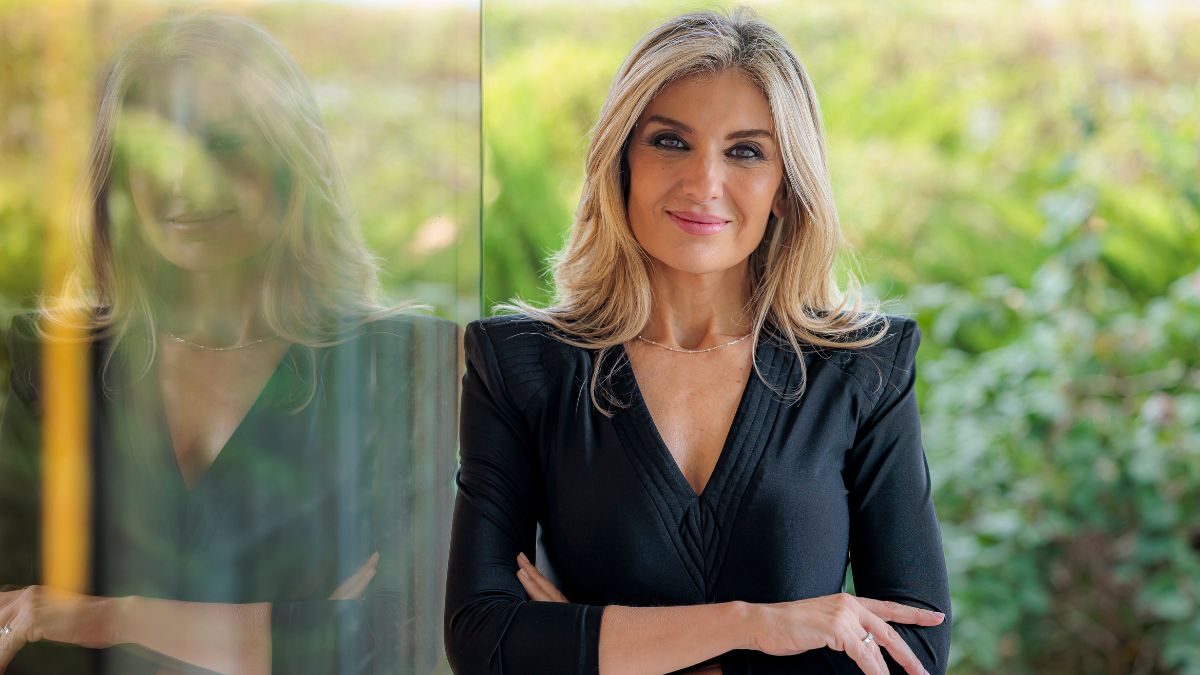
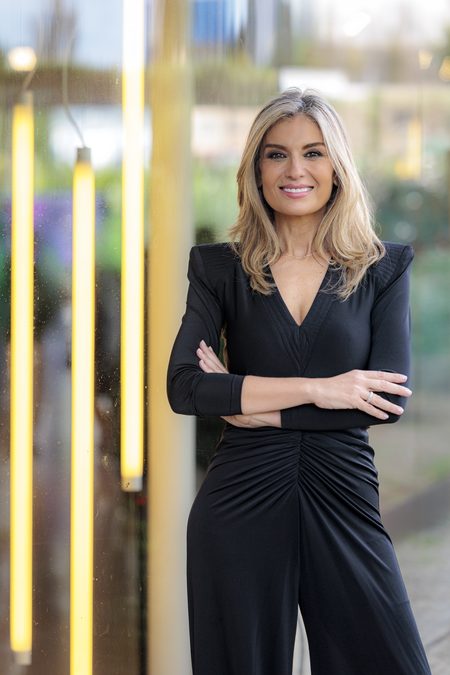
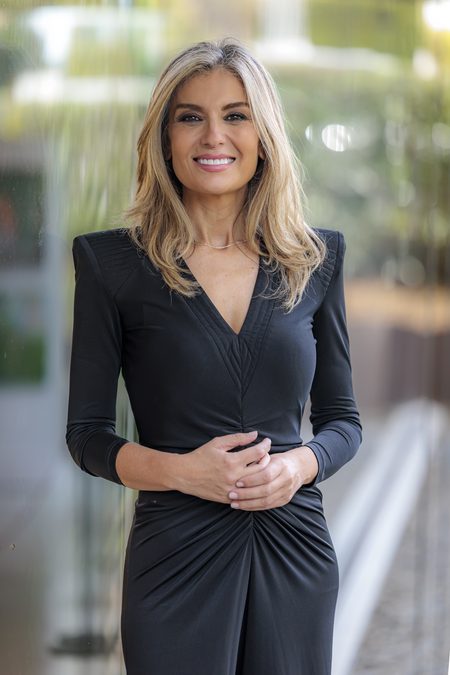
Sandra Golpe, director and anchor of the midday news program on Antena3 Noticias 1, (Cádiz, 1974), has been honored with the Tanit Spirit Award at the Tanit Awards, just days after receiving the 2026 Antena de Oro, another prestigious award for her work as a broadcaster.
What is your connection to Ibiza?
It’s been special ever since I used to come here for a week every summer with my friends on vacation; we met some farmers who rented us their house and treated us wonderfully in their own home with breakfasts and bullit de peix. I have wonderful memories of those days in my twenties. We explored the island’s hidden corners and idyllic coves, but we didn’t really go out at night. I’ve come to appreciate the richness of the Balearic Islands through Ibiza, then Formentera, and Mallorca. I also hosted an event for Mari Carmen Gutierrez’s Cancer Association a few years ago. This time, Montse Monsalves invited me to receive the Tanit Award, and I’ve returned absolutely delighted.
Were you surprised by the nature of the conference and the awards?
It has been an honor to receive this award alongside other women from Ibiza—hardworking, humble, and entrepreneurial—and at the same time to share it with Carola Balestena and Josefina, powerful and inspiring women in their respective fields. It was a double treat—a weekend in paradise and an award, surrounded by amazing women.
Does it have special meaning for you?
Thanks to the Tanit Awards, I’ve discovered the hidden—and perhaps most interesting—side of Ibiza through the award winners. Ten wonderful women, each in her own field. We must recognize the work of Alicia Reina and Eva Ballarin, the driving forces behind these awards. I’m leaving Ibiza feeling grateful and amazed by all the female talent you have here!
Are you familiar with Adlib fashion?
Not in great detail, but I was surprised by how unique the stores are and the way they’re decorated and how they display the clothes and gifts. There’s a special sense of style and attention to detail in that regard. I love looking at the store windows because they show good taste, design, and originality.
Was your promotion to head of the nation’s most-watched newscast something you sought, or did it come unexpectedly?
I’ve been working hard in television journalism for 30 years, and I never would have imagined myself hosting a leading news program. I’m very shy—I struggled with shyness throughout my childhood, adolescence, and young adulthood—but life takes you down paths you could never imagine. My first job opportunity, which paid minimum wage, came at a local TV station in Madrid, after I’d worked in radio and print media. Antena 3 hired me when I was thirty, and I’ve worked on all of their newscasts and programs. As a child, I didn’t plan on becoming a journalist, but I was certain it would help me step outside my comfort zone—like therapy for my insecurities and insecurities. Back then, I identified with the female reporters who traveled the world; it seemed fascinating and out of reach to me. I set myself the goal of trying to break out of my shell and see the world as a journalist.
Did you ever dream of hosting a newscast?
Never ever—I used to love the radio and the late-night shows hosted by José María Carrascal, Olga Viza, Nieves Herrero, and Andrés Aberasturi. I’ve watched a lot of TV, but I never saw myself as a news anchor, and I’ve been working in news journalism for 30 years now. I’ve been on the air since 2005; I started at Antena 3 in 2008 on the Morning News, then moved to the weekend broadcast and the Monday-through-Friday prime-time slot. In 2017, they let me host on my own to see how it would go; within a few months, I was anchoring the *Telediario* after having filled in for almost everyone at the network and done just about everything.
How did you tackle that enormous challenge?
I just asked to be able to choose my own production team, so I looked for people from different places, of different ages, and with different perspectives, and we began to grow our audience—and now we’re the most-watched show on TV. I’m where I am today thanks to the viewers, the strength of my team, and my approach to delivering the news—knowing how TV works behind the scenes, gaining knowledge, getting to know the people around me, and having built everything from the ground up. Understanding what it takes to produce a live broadcast or a news segment is important, and mastery requires a lot of hard work and years of practice.
Do ratings figures keep you up at night?
We are a private television network that depends on viewership and ratings because these reflect the public’s trust in our news program as a source of information about current events. Viewership even affects our mood—anyone who says otherwise is lying. We’re scrutinized constantly; trust takes years to earn, and you can lose it in a single day because of one mistake. We devote all our energy, passion, and our very being to this. You have to be lucky to make a living doing this.
Women have taken on leading roles in major programs, but this does not seem to be enough or equitable.
We’ve always been on TV, but in a different way—back then, there weren’t any women commenting on the news. We weren’t a woman wearing a tie like Carrascal; we were supporting figures, and we carried ourselves with great dignity. However, what you see on TV now reflects the makeup of newsrooms, and at Antena 3, women are leading the society, politics, and international news segments. The playing field is more evenly balanced these days, even at the senior management level, but we still have a way to go there. Talent has no gender—we need to look for people who are talented, law-abiding, and good people to build a team.
Is the current state of television in Spain complicated or different?
-Television remains a mass medium; when something important happens, people turn to the TV for information, and we haven’t lost that habit even though our children are watching less and less television. Traditional media—such as print media, radio, and conventional television—should be the go-to sources for news without the fear of being fed fake news. We’re living in a new era where AI has reared its head, and we’re constantly exposed to information that isn’t true. We offer viewers, readers, and listeners the guarantee that we won’t spread falsehoods, and that makes us indispensable as a media outlet. We need to figure out how to ensure that our children turn to us for information.
Will artificial intelligence change the way we perceive information?
We can’t ignore the field—it’s impossible. Even political parties are already using AI in their campaigns and messaging. We can’t look the other way, but we need to know how to manage this powerful tool that is already helping us. It must remain only an aid and must be regulated—it should be a tool to be used correctly, and it already is.
There’s a lot of talk about polarization. How do you view this phenomenon?
As a citizen, I find this sad; it’s a shame because it only creates division and problems. As professionals, we must not contribute to fostering it in our daily work. I have always been against extremism and extreme ideologies; virtue lies in the middle ground of balance. In our news coverage, we try to present perspectives from across the political spectrum, from left to right; we reflect these views, and as journalists, we draw our own conclusions.
Is there polarization in the media as well?
-I speak from my own experience; we try to provide an accurate reflection of what’s happening without contributing to polarization. We all know that public television is the government’s television at any given time. Both Antena 3 and La Sexta have their own editorial lines, and the viewer chooses.
Politics has found its way into people’s homes through television and other media, tainting everything. Is this necessary?
-That’s not fair; social media is more to blame than traditional media because it’s the one that polarizes people. They say, “Television is manipulation,” and that’s deeply unfair because it lumps everyone together. It’s like saying that everyone in a family is a bad person. I’m against labels in general; readers and viewers are intelligent and know how to tell the difference. I think you have to be honest in your work. I go to sleep with a clear conscience every night—there’s no need to manipulate. A news journalist’s job isn’t about opinion; it’s about information, and at three in the afternoon, that’s easy for me.
Are the upcoming general elections business as usual?
-That’s the question everyone’s asking. I couldn’t tell you what’s going to happen. Logic tells me that after so many scandals a government has been dragging along, the more years it’s in power, the more scandals there will be. Pedro Sánchez cited an astronomical figure on the show *La Revuelta*. It seems there will be a change in government—if the PP wins, it’ll need Vox to govern—but a lot of people are waiting to see what happens and what the president has to say. The PSOE has formed alliances with parties we never would have imagined, and no matter what anyone tells you, nobody really knows what’s going to happen. We’ve been living through one scandal after another for years; it’s hard for me to predict what will happen the day after tomorrow and whether that will turn the polls upside down. As of today, I think there will be a change in government—but with Vox.
Would you have liked to do a different kind of show?
-I don’t see myself in that situation. When I was a little girl, I dreamed of hosting a music and entertainment radio show, but the career opportunities that have come my way have been in the field of news. I’m in a familiar world—the news studio—where I feel comfortable, but in life, you can never rule anything out.
What is Sandra Golpe dreaming about right now?
Who would have thought I’d become a familiar face on the news? It’s a dream I never dreamed of—or even imagined. I realize that the greatest success, at this point, is being comfortable at home, watching my son grow up, writing, and enjoying life as much as possible with my parents and the people around me. The greatest success is when people recognize your work and say, “What a great person he was.”