







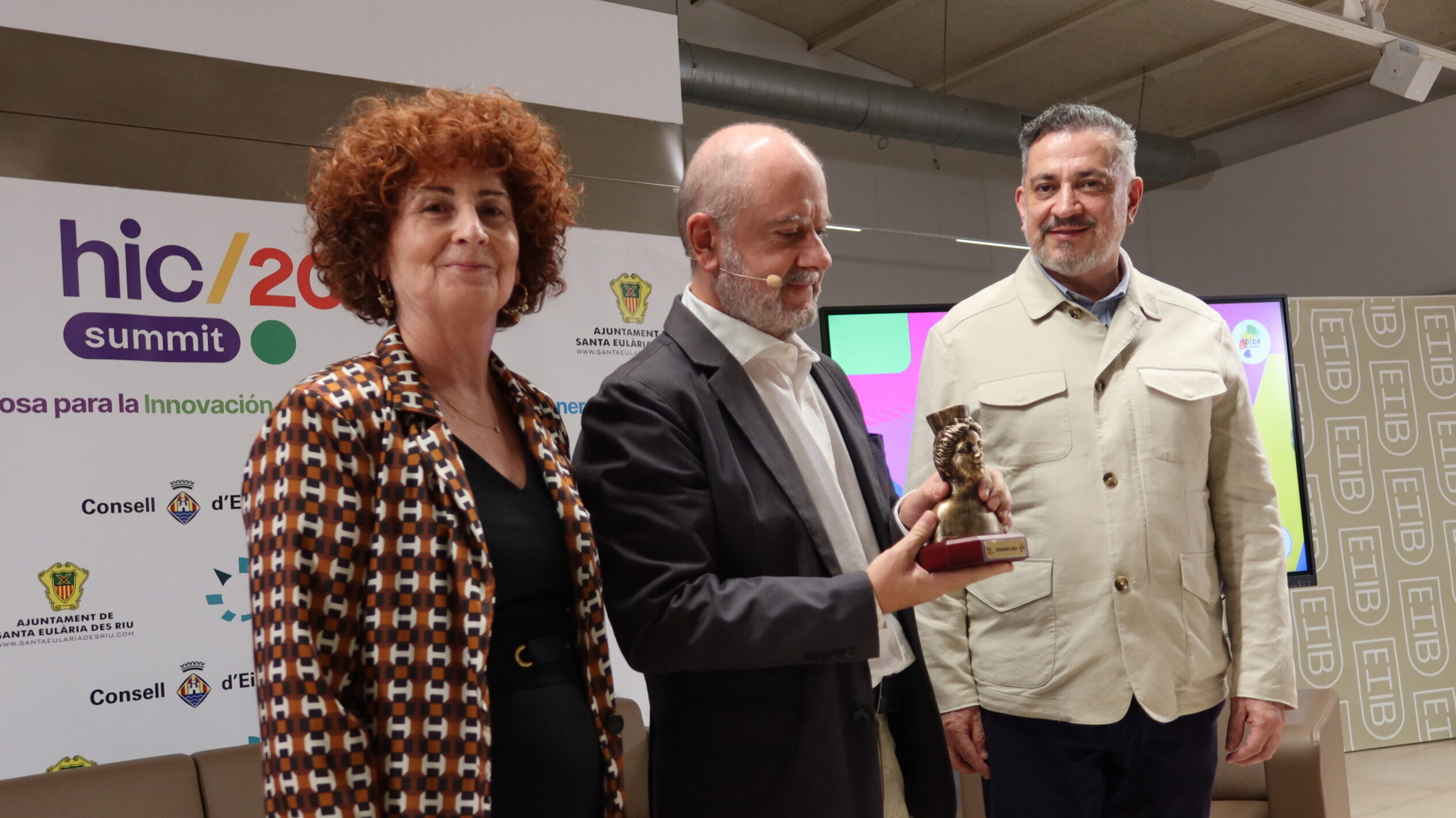
The eighth edition of the HIC Summit kicked off this Wednesday with a gathering that brought together chefs and industry professionals to discuss the value of culinary identity in tourist destinations and opportunities for sustainable development through gastronomy. HIC Summit, the forum for innovation and regenerative culture held in Ibiza since 2019, kicked off its eighth edition with a day dedicated to gastronomy. The event, held at the Balearic Islands School of Hospitality, brought together about a dozen professionals to exchange experiences and perspectives on the role of gastronomy as a link between territory, identity, and tourism, and to discuss challenges such as training, resource management, and attracting talent.
The opening session served as the setting for the presentation of the first HIC Talentum Award at the HIC Summit 2026, which was received by Benjamín Lana, president of Vocento Gastronomía and director of Madrid Fusión and San Sebastián Gastronomika, in recognition of his professional career and his contribution to promoting Spanish gastronomy.
During her remarks, Lana highlighted the value of gastronomy, “the great cross-disciplinary field that unites virtually all human activities—the animal that cooks, as the writer James Boswell defined it in the 18th century.” “In Spain, we are very fortunate to be a leader in the agri-food sector, tourism, and culture. And if there is one common thread that ties all of this together, it is gastronomy,” she asserted.
Lana highlighted Spain’s privileged position as an international culinary leader and elaborated on the need to better harness that potential, emphasizing not only the talent of its chefs—“who are expected to do a great deal: to be sustainable, responsible with their ingredients, good managers, creative…”—but also the richness and diversity of its ingredients. She also emphasized the importance of the hospitality industry developing its own culinary identity, integrated into its value proposition and linked to the destination. “The hospitality industry has some unfinished business when it comes to gastronomy. If you don’t have your own narrative around food, you’re missing something,” she stressed.
A new generation of chefs committed to ingredients and their origins
Under the title “Gastronomy with Identity: Origin as Inspiration, Commitment as an Ingredient,” four young chefs from different regions of Spain shared their vision of an approach to gastronomy that integrates territory, creativity, and responsibility into a single language. Featuring Lucía Grávalos, chef at Desborre (Community of Madrid); Walter Sidoravicious, head chef at Omakase by Walt (Balearic Islands); Carlos Casillas, chef at Barro (Ávila); and María José Martínez, chef at El Lienzo (Valencian Community), the discussion addressed how new generations of chefs are exploring new ways of understanding sustainability.
Reducing food waste through techniques such as fermentation, logical shopping planning, exploring new culinary techniques, and taking responsibility from a practical perspective—tailored to the reality of each business and compatible with health regulations—were some of the ideas discussed. The discussion also addressed working conditions and team organization as a means of attracting and retaining professionals and ensuring sustainability.
Gastronomy and the Region: Local Resources, the Circular Economy, and New Opportunities
The second panel discussion, “Gastronomy, Community, and Territory: Challenges and Opportunities,” addressed the potential of gastronomy to generate economic activity, strengthen local communities, and develop unique tourism offerings based on each destination’s own resources.
Maribel Juan Torres, president of the Balearic Council for Organic Agricultural Production; Zelia Sicot, coordinator of the “Eating in Ibiza” gastronomic club at the Tourism Promotion Board; David Basilio, director of operations at Linkers; and Lluís Oliva i Munar, president of the Ibiza and Formentera Chapter of the Official College of Architects of the Balearic Islands, participated in a discussion focused on the challenges and opportunities of linking gastronomy to the local region.
The circular economy as a means of reducing costs and creating synergies between the primary sector and the restaurant industry, the role of organic farming and the opportunities offered by the new Balearic agricultural law to move in this direction, the need to strengthen training, facilitate access for SMEs to new business opportunities, and address the housing crisis as a means of attracting and retaining talent were some of the topics discussed at the roundtable.
“To be competitive, we have to look inward; we have to focus on development, not just on the product and the restaurant. We have to turn content into productivity—what do I have in my region that I can offer to my community and, above all, to my small and medium-sized businesses? Gastronomy must adapt to the products available and make the most of them year-round. We need to attract young people. And we need the government to treat us for what we are: the only industry in this country—the tourism and gastronomy industry,” summarized David Basilio, director of operations at the consulting firm Linkers.